




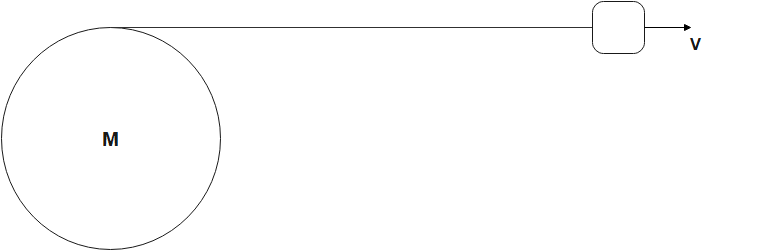
A block of mass $\mathrm{m}$ is attached to a pulley disc of equal mass $\mathrm{m}$ and radius $\mathrm{r}$ by means of a slack string as shown. The pulley is hinged about its center on a horizontal table and the block is projected with an initial velocity of $5 \mathrm{~m} / \mathrm{~s}$. Its velocity when the string becomes taut will be
A.$3~\text{m}/~\text{s}$
B.$2.5~\text{m}/~\text{s}$
C.$\dfrac{5}{3}~\text{m}/~\text{s}$
D.$\dfrac{10}{3} \mathrm{~m} / \mathrm{~s}$
Answer
 Verified
634.5k+ views
Hint: In the center, a pulley is hinged and a massive thread is wrapped around it. Angular acceleration and its angular velocity rise will be due to torque supplied by force pulley. The hinge force is always equal and opposite to F. Calculate Force and momentum by using the theorem of momentum .
Formula used:
$F=\dfrac{\Delta(P)}{\Delta(t)}=\dfrac{m\left(v_{2}-v_{1}\right)}{t}$
Complete solution Step-by-Step:
The theorem of momentum variation applied to mass on the table says:
$F=\dfrac{\Delta(P)}{\Delta(t)}=\dfrac{m\left(v_{2}-v_{1}\right)}{t}$
where $v_{2}$ is the final speed and
$v_{1}$ the initial speed of the mass $m$
For the pulley the theorem of angular momentum variation says:
$M=\dfrac{\Delta(L)}{\Delta(t)}=\dfrac{I \cdot \omega_{2}}{t}$
where $M=(-F) \cdot r$
(here the minus sign shows the force on the pulley is opposing to the force on the mass on the table)
Therefore, we have two equations:
$(-F) \cdot r=\dfrac{I \cdot \omega_{2}}{t}$
$F=\dfrac{m\left(v_{2}-v_{1}\right)}{t}$
and we obtain
$\Rightarrow m\left( {{v}_{1}}-{{v}_{2}} \right)\cdot r=I\cdot {{\omega }_{2}}$ ------------ (1)
Now we can write for the angular acceleration of the pulley and its moment of inertia (the pulley is considered a solid cylinder)
$\omega_{2}=\dfrac{v_{2}}{r}$
and
$I=\dfrac{m \cdot r^{2}}{2}$
Replacing these two relations in (1) we get
$\Rightarrow m\left( {{v}_{1}}-{{v}_{2}} \right)\cdot r=\dfrac{m\cdot {{r}^{2}}}{2}\cdot \dfrac{{{v}_{2}}}{r}$
$2\left(v_{1}-v_{2}\right)=v_{2}$
$2 v_{1}=3 v_{2}$
${{v}_{2}}=\left( \dfrac{2}{3} \right)\cdot {{v}_{1}}=\dfrac{2}{3}\cdot 5=\dfrac{10}{3}=3.33m/s$
\[\therefore \] The velocity of the mass on the table when the string is taut will be ${{v}_{2}}=\dfrac{10}{3}m/s$.
Note:
With a constant force F starting from resting, the thread is pulled. Its angular velocity remains the same as time increases, but the force on the hinge increases. At the Centre, a pulley is hinged and a massive thread is wrapped around it As time increases, the thread is pulled with a constant force F starting from rest.
Formula used:
$F=\dfrac{\Delta(P)}{\Delta(t)}=\dfrac{m\left(v_{2}-v_{1}\right)}{t}$
Complete solution Step-by-Step:
The theorem of momentum variation applied to mass on the table says:
$F=\dfrac{\Delta(P)}{\Delta(t)}=\dfrac{m\left(v_{2}-v_{1}\right)}{t}$
where $v_{2}$ is the final speed and
$v_{1}$ the initial speed of the mass $m$
For the pulley the theorem of angular momentum variation says:
$M=\dfrac{\Delta(L)}{\Delta(t)}=\dfrac{I \cdot \omega_{2}}{t}$
where $M=(-F) \cdot r$
(here the minus sign shows the force on the pulley is opposing to the force on the mass on the table)
Therefore, we have two equations:
$(-F) \cdot r=\dfrac{I \cdot \omega_{2}}{t}$
$F=\dfrac{m\left(v_{2}-v_{1}\right)}{t}$
and we obtain
$\Rightarrow m\left( {{v}_{1}}-{{v}_{2}} \right)\cdot r=I\cdot {{\omega }_{2}}$ ------------ (1)
Now we can write for the angular acceleration of the pulley and its moment of inertia (the pulley is considered a solid cylinder)
$\omega_{2}=\dfrac{v_{2}}{r}$
and
$I=\dfrac{m \cdot r^{2}}{2}$
Replacing these two relations in (1) we get
$\Rightarrow m\left( {{v}_{1}}-{{v}_{2}} \right)\cdot r=\dfrac{m\cdot {{r}^{2}}}{2}\cdot \dfrac{{{v}_{2}}}{r}$
$2\left(v_{1}-v_{2}\right)=v_{2}$
$2 v_{1}=3 v_{2}$
${{v}_{2}}=\left( \dfrac{2}{3} \right)\cdot {{v}_{1}}=\dfrac{2}{3}\cdot 5=\dfrac{10}{3}=3.33m/s$
\[\therefore \] The velocity of the mass on the table when the string is taut will be ${{v}_{2}}=\dfrac{10}{3}m/s$.
Note:
With a constant force F starting from resting, the thread is pulled. Its angular velocity remains the same as time increases, but the force on the hinge increases. At the Centre, a pulley is hinged and a massive thread is wrapped around it As time increases, the thread is pulled with a constant force F starting from rest.
Recently Updated Pages
Which of the following graphs shows the variation of class 12 physics CBSE

Draw a labelled diagram of the human male reproductive class 12 biology CBSE
Describe the experiment to compare the emf of two cells class 12 physics CBSE
What is standard hydrogen electrode
What is conventional current and electric current class 12 physics CBSE
2Bromopentane is treated with an alcoholic KOH solution class 12 chemistry CBSE
Trending doubts
Draw a labelled sketch of the human eye class 12 physics CBSE
Which are the Top 10 Largest Countries of the World?
A member of Simon commission later became Prime Minister class 12 social science CBSE
Differentiate between homogeneous and heterogeneous class 12 chemistry CBSE
Draw ray diagrams each showing i myopic eye and ii class 12 physics CBSE
Which is the correct genotypic ratio of mendel dihybrid class 12 biology CBSE