




A block of mass m rigidly attached with a spring k is compressed through a distance A. If the block is released the period of oscillation of the block for a complete cycle is equal to

$\begin{align}
& \left( A \right)\dfrac{4\pi }{3}\sqrt{\dfrac{m}{k}} \\
& \left( B \right)\dfrac{\pi }{\sqrt{2}}\sqrt{\dfrac{m}{k}} \\
& \left( C \right)\dfrac{2\pi }{3}\sqrt{\dfrac{m}{k}} \\
\end{align}$
(D) None of these
Answer
 Verified
548.7k+ views
Hint: The period of a block of mass m and spring constant k is directly proportional to the square root of its mass and inversely proportional to the square root of spring constant. The time period depends on these two factors. It doesn’t depend on the amplitude. Thus the period of oscillation is the number of oscillations in the total time taken.
Complete step-by-step solution
$T=2\pi \sqrt{\dfrac{m}{k}}$
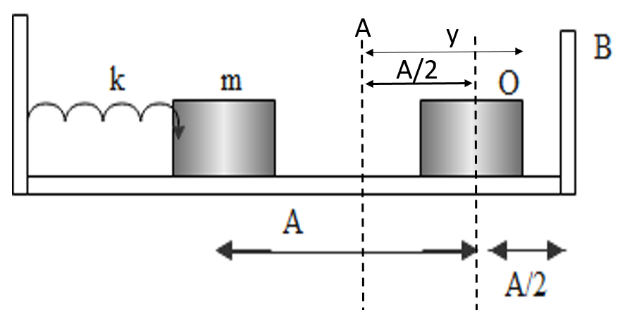
The period of motion from A to O is equal to quarter of the time period T of oscillation of mass spring system as here the total distance traveled during one harmonic motion will be,
$\begin{align}
& x=2\left( A+\dfrac{1}{2}A \right) \\
& x=3A \\
\end{align}$
Distance between point A and O is,
$\begin{align}
& y=\left( \dfrac{1}{4}A+\dfrac{1}{2}A \right) \\
& y=\dfrac{3}{4}A=\dfrac{x}{4} \\
\end{align}$
So,
${{t}_{AO}}=\dfrac{T}{4}$
$\Rightarrow {{t}_{AO}}=\dfrac{1}{4}\left[ 2\pi \sqrt{\dfrac{m}{k}} \right]$
$\therefore {{t}_{AO}}=\dfrac{\pi }{2}\sqrt{\dfrac{m}{k}}$
Since it is a SHM
$OB=OA\sin \dfrac{2\pi }{T}{{T}_{OB}}$
where, ${{t}_{OB}}$ is the time taken from O to B.
${{t}_{OB}}=\dfrac{T}{2\pi }{{\sin }^{-1}}\dfrac{\dfrac{A}{2}}{A}=\dfrac{\pi }{6}\sqrt{\dfrac{m}{k}}$
Hence total time is,
$t=2\left( {{t}_{_{AO}}}+{{t}_{OB}} \right)$
$\begin{align}
&\Rightarrow t=2\left( \dfrac{\pi }{2}\sqrt{\dfrac{m}{k}}+\dfrac{\pi }{6}\sqrt{\dfrac{m}{k}} \right) \\
&\Rightarrow t=\dfrac{4\pi }{3}\sqrt{\dfrac{m}{k}} \\
\end{align}$
Hence, option (A) is correct.
Additional information: When the value of the spring constant increases, that will decrease the time period since these two quantities are inversely proportional. And the time period increases with increase in mass since it is directly proportional.
Thus the period is inversely proportional to the square root of spring constant and directly proportional to the square root of the mass of the block. . The time period depends upon these two factors. It doesn’t depend on the amplitude. Thus the period of oscillation is the number of oscillations in the total time taken.
According to Hooke’s law the force is directly proportional to the displacement. Here k the spring constant is the proportionality constant.
Note: Thus the period is inversely proportional to the square root of spring constant and directly proportional to the square root of the mass of the block. . The time period depends upon these two factors. It doesn’t depend on the amplitude. Thus the period of oscillation is the number of oscillations in the total time taken. When the value of the spring constant increases, that will decrease the time period since these two quantities are inversely proportional. And the time period increases with increase in mass since it is directly proportional.
Complete step-by-step solution
$T=2\pi \sqrt{\dfrac{m}{k}}$
The period of motion from A to O is equal to quarter of the time period T of oscillation of mass spring system as here the total distance traveled during one harmonic motion will be,
$\begin{align}
& x=2\left( A+\dfrac{1}{2}A \right) \\
& x=3A \\
\end{align}$
Distance between point A and O is,
$\begin{align}
& y=\left( \dfrac{1}{4}A+\dfrac{1}{2}A \right) \\
& y=\dfrac{3}{4}A=\dfrac{x}{4} \\
\end{align}$
So,
${{t}_{AO}}=\dfrac{T}{4}$
$\Rightarrow {{t}_{AO}}=\dfrac{1}{4}\left[ 2\pi \sqrt{\dfrac{m}{k}} \right]$
$\therefore {{t}_{AO}}=\dfrac{\pi }{2}\sqrt{\dfrac{m}{k}}$
Since it is a SHM
$OB=OA\sin \dfrac{2\pi }{T}{{T}_{OB}}$
where, ${{t}_{OB}}$ is the time taken from O to B.
${{t}_{OB}}=\dfrac{T}{2\pi }{{\sin }^{-1}}\dfrac{\dfrac{A}{2}}{A}=\dfrac{\pi }{6}\sqrt{\dfrac{m}{k}}$
Hence total time is,
$t=2\left( {{t}_{_{AO}}}+{{t}_{OB}} \right)$
$\begin{align}
&\Rightarrow t=2\left( \dfrac{\pi }{2}\sqrt{\dfrac{m}{k}}+\dfrac{\pi }{6}\sqrt{\dfrac{m}{k}} \right) \\
&\Rightarrow t=\dfrac{4\pi }{3}\sqrt{\dfrac{m}{k}} \\
\end{align}$
Hence, option (A) is correct.
Additional information: When the value of the spring constant increases, that will decrease the time period since these two quantities are inversely proportional. And the time period increases with increase in mass since it is directly proportional.
Thus the period is inversely proportional to the square root of spring constant and directly proportional to the square root of the mass of the block. . The time period depends upon these two factors. It doesn’t depend on the amplitude. Thus the period of oscillation is the number of oscillations in the total time taken.
According to Hooke’s law the force is directly proportional to the displacement. Here k the spring constant is the proportionality constant.
Note: Thus the period is inversely proportional to the square root of spring constant and directly proportional to the square root of the mass of the block. . The time period depends upon these two factors. It doesn’t depend on the amplitude. Thus the period of oscillation is the number of oscillations in the total time taken. When the value of the spring constant increases, that will decrease the time period since these two quantities are inversely proportional. And the time period increases with increase in mass since it is directly proportional.
Recently Updated Pages
Master Class 11 Computer Science: Engaging Questions & Answers for Success

Master Class 11 Business Studies: Engaging Questions & Answers for Success
Master Class 11 Economics: Engaging Questions & Answers for Success
Master Class 11 English: Engaging Questions & Answers for Success
Master Class 11 Maths: Engaging Questions & Answers for Success
Master Class 11 Biology: Engaging Questions & Answers for Success
Trending doubts
One Metric ton is equal to kg A 10000 B 1000 C 100 class 11 physics CBSE
There are 720 permutations of the digits 1 2 3 4 5 class 11 maths CBSE
Discuss the various forms of bacteria class 11 biology CBSE
Draw a diagram of a plant cell and label at least eight class 11 biology CBSE
State the laws of reflection of light
Explain zero factorial class 11 maths CBSE