




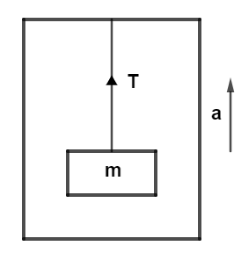
A block of mass $m$ is suspended by a light thread from an elevator. The elevator starts from rest and is accelerating upwards with uniform acceleration $a$. The work done by tension on the block during the first time $t$ seconds is:
A. $\dfrac{m}{2}(g + a)a{t^2}$
B. $\dfrac{m}{2}(g - a)a{t^2}$
C. $\dfrac{m}{2}ga{t^2}$
D. $0$
Answer
 Verified
546.9k+ views
Hint: In order to solve this question we need to understand pseudo forces. Pseudo forces are those forces which originate due to change in frame of reference, these are not the actual forces rather they are imposed to make the newton’s law valid in all inertial frames of reference. However it is only true when the frames move with non-relativistic velocity with respect to each other.
Complete step by step answer:
First we set up a frame of reference in the elevator itself then from pseudo force theorem the applied acceleration of lift would be in the opposite direction for the block. So net downward force on block in elevator frame of reference is $m(g + a)$ where m is mass of block, g is acceleration due to gravity and $(g + a)$ is net acceleration of block in elevator frame of reference.
So in equilibrium case tension would be equal to $T = m(g + a)$.
Now in time “t” vertical distance covered by the block is $y = ut + \dfrac{1}{2}a{t^2}$.
Since initial speed is $0$ so distance is $y = \dfrac{1}{2}a{t^2}$.
Work done by applied force is given by $W = T.y$
Now since both tension and displacement are in same direction so $W = Ty$
On Putting values we get $W = \dfrac{1}{2}m(g + a)a{t^2}$
So the correct option is A.
Note: It should be remembered that in this question work energy theorem could also be applied which states that work done by any mechanical force is equal to change in kinetic energy of the body. Also the answer would be incorrect if the acceleration of lift is relative then the length of lift would be contracted for the observer on ground which is in rest frame.
Complete step by step answer:
First we set up a frame of reference in the elevator itself then from pseudo force theorem the applied acceleration of lift would be in the opposite direction for the block. So net downward force on block in elevator frame of reference is $m(g + a)$ where m is mass of block, g is acceleration due to gravity and $(g + a)$ is net acceleration of block in elevator frame of reference.
So in equilibrium case tension would be equal to $T = m(g + a)$.
Now in time “t” vertical distance covered by the block is $y = ut + \dfrac{1}{2}a{t^2}$.
Since initial speed is $0$ so distance is $y = \dfrac{1}{2}a{t^2}$.
Work done by applied force is given by $W = T.y$
Now since both tension and displacement are in same direction so $W = Ty$
On Putting values we get $W = \dfrac{1}{2}m(g + a)a{t^2}$
So the correct option is A.
Note: It should be remembered that in this question work energy theorem could also be applied which states that work done by any mechanical force is equal to change in kinetic energy of the body. Also the answer would be incorrect if the acceleration of lift is relative then the length of lift would be contracted for the observer on ground which is in rest frame.
Recently Updated Pages
Master Class 11 English: Engaging Questions & Answers for Success

Master Class 11 Social Science: Engaging Questions & Answers for Success
Master Class 11 Maths: Engaging Questions & Answers for Success
Master Class 11 Biology: Engaging Questions & Answers for Success
Master Class 11 Physics: Engaging Questions & Answers for Success
Master Class 11 Chemistry: Engaging Questions & Answers for Success
Trending doubts
One Metric ton is equal to kg A 10000 B 1000 C 100 class 11 physics CBSE
Difference Between Prokaryotic Cells and Eukaryotic Cells
1 ton equals to A 100 kg B 1000 kg C 10 kg D 10000 class 11 physics CBSE
Find the value of the expression given below sin 30circ class 11 maths CBSE
Two of the body parts which do not appear in MRI are class 11 biology CBSE
Draw a diagram of a plant cell and label at least eight class 11 biology CBSE