




A block of mass m is placed on another block of mass M, which itself is lying on a horizontal surface. The coefficient of friction between two blocks is u and that between the block of mass M and the horizontal surface is u. What is maximum horizontal force can be applied to the lower block so that the two blocks move without separation?
A. $(M + m({\mu _2} - {\mu _1})g$
B. $(M - m)({\mu _2} - {\mu _1})g$
C. $(M - m)({\mu _2} - \mu )g$
D. $(M + m)({\mu _2} - {\mu _1})g$
Answer
 Verified
571.9k+ views
Hint: Concept of laws of motion and friction force. As the total force acts on the combined mass that is M+ m, So it gives it net acceleration but only the resistive force acting here will be the friction force that between mass M and the horizontal surface.
Complete step by step solution:
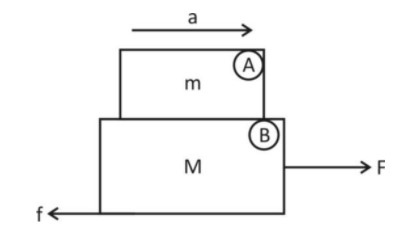
Let us consider two block, $A$and $B$as shown in figure with mass $M$
Now, according to the question the force applied $F$should be such that the upper block does not move
i.e Force applied , should be more than the limiting friction
Limiting friction for upper block, $A = {\mu _1}R$
Now, we know that $R = mg$
So,
Limiting friction $ = {\mu _1}mg$
Now, for non slipping condition,
If $ \leqslant {\mu _1}mg$
$ma = {\mu _1}mg$ (Maximum force $f = ma$for upper block)
$ \Rightarrow a = {M_1}g$ ….. (i)
Where a is the net acceleration of the system.
$F - {\mu _2}R' = (M + m)a$ ….. (ii)
Where $R' = (M + m)g$
So, equation (ii) becomes
\[F - {\mu _2}(M + m)g = (M + m)a\]
\[F = (M + m)a + (M + m){\mu _2}g\]
$F = (M + m)(a + {\mu _2}g)$
From (i), $a = {M_1}g$
So, $F = (M + m)({\mu _1}g + {\mu _2}g)$
$F = (M + m)({\mu _1} + {\mu _2})$g
Hence the correct answer is D.
Note: Here we have to solve using free body diagram for upper block from where it comes $f = {\mu _1}mg$. Also for non-slipping condition, maximum friction acting is limiting friction which is maximum value of static friction after which the body starts moving.
Complete step by step solution:
Let us consider two block, $A$and $B$as shown in figure with mass $M$
Now, according to the question the force applied $F$should be such that the upper block does not move
i.e Force applied , should be more than the limiting friction
Limiting friction for upper block, $A = {\mu _1}R$
Now, we know that $R = mg$
So,
Limiting friction $ = {\mu _1}mg$
Now, for non slipping condition,
If $ \leqslant {\mu _1}mg$
$ma = {\mu _1}mg$ (Maximum force $f = ma$for upper block)
$ \Rightarrow a = {M_1}g$ ….. (i)
Where a is the net acceleration of the system.
$F - {\mu _2}R' = (M + m)a$ ….. (ii)
Where $R' = (M + m)g$
So, equation (ii) becomes
\[F - {\mu _2}(M + m)g = (M + m)a\]
\[F = (M + m)a + (M + m){\mu _2}g\]
$F = (M + m)(a + {\mu _2}g)$
From (i), $a = {M_1}g$
So, $F = (M + m)({\mu _1}g + {\mu _2}g)$
$F = (M + m)({\mu _1} + {\mu _2})$g
Hence the correct answer is D.
Note: Here we have to solve using free body diagram for upper block from where it comes $f = {\mu _1}mg$. Also for non-slipping condition, maximum friction acting is limiting friction which is maximum value of static friction after which the body starts moving.
Recently Updated Pages
Basicity of sulphurous acid and sulphuric acid are

Master Class 11 English: Engaging Questions & Answers for Success
Master Class 11 Physics: Engaging Questions & Answers for Success
Master Class 11 Computer Science: Engaging Questions & Answers for Success
Master Class 11 Chemistry: Engaging Questions & Answers for Success
Master Class 11 Social Science: Engaging Questions & Answers for Success
Trending doubts
Difference Between Prokaryotic Cells and Eukaryotic Cells
Two of the body parts which do not appear in MRI are class 11 biology CBSE
One Metric ton is equal to kg A 10000 B 1000 C 100 class 11 physics CBSE
10 examples of friction in our daily life
Draw a diagram of nephron and explain its structur class 11 biology CBSE
What will happen if the mucus is not secreted by the class 11 biology CBSE