




A block of mass $ m $ is kept on a platform which starts from rest with a constant acceleration $ \dfrac{g}{2} $ upwards, as shown in the figure. Work done by normal reaction on block in time $ t $ is _____?
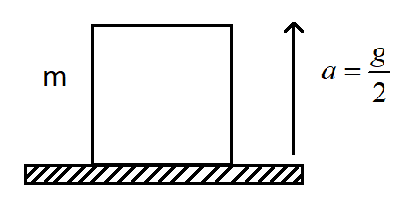
(A) 0
(B) $ \dfrac{{3m{g^2}{t^2}}}{8} $
(C) $ - \dfrac{{m{g^2}{t^2}}}{8} $
(D) $ \dfrac{{m{g^2}{t^2}}}{8} $
Answer
 Verified
612.3k+ views
Hint : We need to first draw the free body diagram of the mass $ m $ and from here we can find the value of the normal reaction force that is acting on the mass. Now using the equation of motion we can find the displacement of the body. Since the force and displacement will be in the same direction, so the work done will be the product of the force and displacement.
Formula Used: In this solution we will be using the following formula,
$\Rightarrow F = ma $
where $ F $ is the net force acting on the body
$ m $ is the mass of the body and $ a $ is the acceleration of the body.
$\Rightarrow S = ut + \dfrac{1}{2}a{t^2} $
where $ S $ is the displacement, $ u $ is the initial velocity and $ t $ is the time.
Complete step by step answer
To solve this problem, we need to first draw the free body diagram of the mass m. So we have,
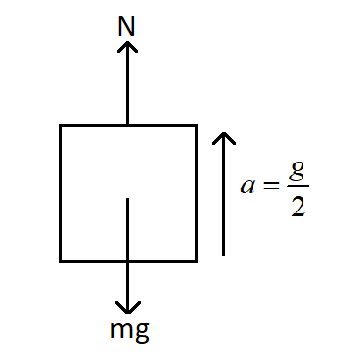
From the diagram we can see that the normal reaction force is acting on the body in an upward direction and the weight of the body is acting in the downward direction. The net acceleration is produced in the body in the upward direction. Hence we can write,
$\Rightarrow N - mg = ma $
In the question we are given $ a = \dfrac{g}{2} $ . Therefore substituting we get,
$\Rightarrow N - mg = m\dfrac{g}{2} $
Keeping only the $ N $ in the LHS we get,
$\Rightarrow N = \dfrac{{mg}}{2} + mg $
Therefore we have,
$\Rightarrow N = \dfrac{{3mg}}{2} $
This is the normal reaction force acting on the body. Now, to find the work done by this force we need to find the displacement of the body. The body is initially at rest so, $ u = 0 $ and the time is given in the question as $ t $ . So we can use the equation of motion, $ S = ut + \dfrac{1}{2}a{t^2} $ . Substituting we get,
$\Rightarrow S = 0 + \dfrac{1}{2} \times \dfrac{g}{2}{t^2} $
Hence we get the displacement as,
$\Rightarrow S = \dfrac{{g{t^2}}}{4} $
The work done by a force is given by the formula, $ W = FS\cos \theta $
Now since the normal reaction force and the displacement are in the same direction so $ \theta $ is zero. Hence we have, $ W = FS $
Substituting the $ N = \dfrac{{3mg}}{2} $ in place of $ F $ and $ S = \dfrac{{g{t^2}}}{4} $ in place of the displacement we get,
$\Rightarrow W = \dfrac{{3mg}}{2} \times \dfrac{{g{t^2}}}{4} $
On calculating we get,
$\Rightarrow W = \dfrac{{3m{g^2}{t^2}}}{8} $
So we get the work done as, $ \dfrac{{3m{g^2}{t^2}}}{8} $ . So the correct answer is option (B).
Note
A free body diagram is a graphical illustration of a diagram depicting the forces that are acting on the body and the resulting momentum of the body. The forces are depicted using straight lines pointing towards the direction of the force.
Formula Used: In this solution we will be using the following formula,
$\Rightarrow F = ma $
where $ F $ is the net force acting on the body
$ m $ is the mass of the body and $ a $ is the acceleration of the body.
$\Rightarrow S = ut + \dfrac{1}{2}a{t^2} $
where $ S $ is the displacement, $ u $ is the initial velocity and $ t $ is the time.
Complete step by step answer
To solve this problem, we need to first draw the free body diagram of the mass m. So we have,
From the diagram we can see that the normal reaction force is acting on the body in an upward direction and the weight of the body is acting in the downward direction. The net acceleration is produced in the body in the upward direction. Hence we can write,
$\Rightarrow N - mg = ma $
In the question we are given $ a = \dfrac{g}{2} $ . Therefore substituting we get,
$\Rightarrow N - mg = m\dfrac{g}{2} $
Keeping only the $ N $ in the LHS we get,
$\Rightarrow N = \dfrac{{mg}}{2} + mg $
Therefore we have,
$\Rightarrow N = \dfrac{{3mg}}{2} $
This is the normal reaction force acting on the body. Now, to find the work done by this force we need to find the displacement of the body. The body is initially at rest so, $ u = 0 $ and the time is given in the question as $ t $ . So we can use the equation of motion, $ S = ut + \dfrac{1}{2}a{t^2} $ . Substituting we get,
$\Rightarrow S = 0 + \dfrac{1}{2} \times \dfrac{g}{2}{t^2} $
Hence we get the displacement as,
$\Rightarrow S = \dfrac{{g{t^2}}}{4} $
The work done by a force is given by the formula, $ W = FS\cos \theta $
Now since the normal reaction force and the displacement are in the same direction so $ \theta $ is zero. Hence we have, $ W = FS $
Substituting the $ N = \dfrac{{3mg}}{2} $ in place of $ F $ and $ S = \dfrac{{g{t^2}}}{4} $ in place of the displacement we get,
$\Rightarrow W = \dfrac{{3mg}}{2} \times \dfrac{{g{t^2}}}{4} $
On calculating we get,
$\Rightarrow W = \dfrac{{3m{g^2}{t^2}}}{8} $
So we get the work done as, $ \dfrac{{3m{g^2}{t^2}}}{8} $ . So the correct answer is option (B).
Note
A free body diagram is a graphical illustration of a diagram depicting the forces that are acting on the body and the resulting momentum of the body. The forces are depicted using straight lines pointing towards the direction of the force.
Recently Updated Pages
Master Class 11 English: Engaging Questions & Answers for Success

Master Class 11 Social Science: Engaging Questions & Answers for Success
Master Class 11 Maths: Engaging Questions & Answers for Success
Master Class 11 Biology: Engaging Questions & Answers for Success
Master Class 11 Physics: Engaging Questions & Answers for Success
Master Class 11 Chemistry: Engaging Questions & Answers for Success
Trending doubts
One Metric ton is equal to kg A 10000 B 1000 C 100 class 11 physics CBSE
Difference Between Prokaryotic Cells and Eukaryotic Cells
1 ton equals to A 100 kg B 1000 kg C 10 kg D 10000 class 11 physics CBSE
Find the value of the expression given below sin 30circ class 11 maths CBSE
Two of the body parts which do not appear in MRI are class 11 biology CBSE
Draw a diagram of a plant cell and label at least eight class 11 biology CBSE