




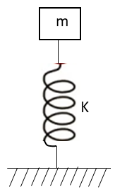
A block of mass \[m\] is attached to a spring of force constant \[k\] whose other end is fixed to a horizontal surface. Initially the spring is in its natural length and the block is released from rest. The average force acting on the surface by the spring till the instant when the block has zero acceleration for the first time is:
A. \[\dfrac{{mg}}{\pi }\]
B. \[\dfrac{{2mg}}{\pi }\]
C. \[\dfrac{{3mg}}{\pi }\]
D. \[\dfrac{{4mg}}{\pi }\]
Answer
 Verified
580.5k+ views
Hint:Calculate the value of the spring constant of the spring. Use the law of conservation of energy for the block at the mean position and at extreme position and derive the relation for the time period of the block in terms of velocity of the block at the extreme position. Then use the formula for average force in terms of change in momentum of the block and derive the formula for the average force when the acceleration is zero.
Formulae used:
The spring force \[{F_S}\] is given by
\[{F_S} = kx\] …… (1)
Here, \[k\] is the spring constant and \[x\] is the displacement of the spring.
The spring energy \[{K_S}\] is given by
\[{K_S} = \dfrac{1}{2}k{x^2}\] …… (2)
Here, \[k\] is the spring constant and \[x\] is the displacement of the spring.
The kinetic energy \[K\] of an object is given by
\[K = \dfrac{1}{2}m{v^2}\] …… (3)
Here, \[m\] is the mass of the object and \[v\] is the velocity of the object.
The potential energy \[U\] of an object is
\[U = mgh\] …… (4)
Here, \[m\] is the mass of the object, \[g\] is acceleration due to gravity and \[h\] is the height of the object from the ground.
The time period \[T\] of oscillation of a spring is
\[T = 2\pi \sqrt {\dfrac{m}{k}} \] …… (5)
Here, \[m\] is the mass of the spring and \[k\] is spring constant.
The average force \[{F_{avg}}\] acting on an object is
\[{F_{avg}} = \dfrac{{\Delta P}}{t}\] …… (6)
Here, \[\Delta P\] is the change in momentum of the object and \[t\] is the time.
Complete step by step answer:
We have given that the mass of the block attached to the spring is \[m\] and the spring constant of the spring is \[k\].We are asked to calculate the average force acting on the horizontal surface when the block has zero acceleration.Initially the spring is in its natural length where the acceleration of the block is maximum. The block will have zero acceleration when the spring is in the equilibrium position.
Let \[x\] be the displacement of the spring and hence the block equilibrium position.At this equilibrium position, the weight of the block is balanced by the spring force acting on the block.
\[kx = mg\]
\[ \Rightarrow x = \dfrac{{mg}}{k}\]
Let us now apply the law of conservation of energy to the block at the mean and extreme position.The sum of kinetic energy of the block and spring energy at mean position is equal to potential energy at extreme position.
\[\dfrac{1}{2}m{v^2} + \dfrac{1}{2}k{x^2} = mgx\]
Substitute \[\dfrac{{mg}}{k}\] for \[x\] in the above equation.
\[\dfrac{1}{2}m{v^2} + \dfrac{1}{2}k{\left( {\dfrac{{mg}}{k}} \right)^2} = mg\left( {\dfrac{{mg}}{k}} \right)\]
\[ \Rightarrow \dfrac{1}{2}m{v^2} + \dfrac{{{m^2}{g^2}}}{{2k}} = \dfrac{{{m^2}{g^2}}}{k}\]
\[ \Rightarrow \dfrac{1}{2}m{v^2} = \dfrac{{{m^2}{g^2}}}{k} - \dfrac{{{m^2}{g^2}}}{{2k}}\]
\[ \Rightarrow v = g\sqrt {\dfrac{m}{k}} \]
Substitute \[\dfrac{T}{{2\pi }}\] for \[\sqrt {\dfrac{m}{k}} \] in the above equation.
\[ \Rightarrow v = \dfrac{{Tg}}{{2\pi }}\]
\[ \Rightarrow T = \dfrac{{2\pi v}}{g}\]
The initial linear momentum of the block is zero as it is at rest initially. Hence, change in linear momentum of the block is
\[\Delta P = mv\]
Let us now calculate the average force on the block when its acceleration is zero.
Substitute \[mv\] for \[\Delta P\] and \[\dfrac{T}{4}\] for \[t\] in equation (6).
\[{F_{avg}} = \dfrac{{mv}}{{\dfrac{T}{4}}}\]
\[ \Rightarrow {F_{avg}} = \dfrac{{4mv}}{T}\]
Substitute \[\dfrac{{2\pi v}}{g}\] for \[T\] in the above equation.
\[{F_{avg}} = \dfrac{{4mv}}{{\dfrac{{2\pi v}}{g}}}\]
\[ \therefore {F_{avg}} = \dfrac{{2mg}}{\pi }\]
Therefore, the average force when the acceleration of the block is zero is \[\dfrac{{2mg}}{\pi }\].
Hence, the correct option is B.
Note: The students should not forget to use the time one fourth of the time period of oscillation of the block because the time required for the block attached to the spring to reach extreme position from the mean position is one fourth of the total time period of oscillation of the spring. Hence, the students should be careful while determining the time for travelling to the position where the acceleration is zero.
Formulae used:
The spring force \[{F_S}\] is given by
\[{F_S} = kx\] …… (1)
Here, \[k\] is the spring constant and \[x\] is the displacement of the spring.
The spring energy \[{K_S}\] is given by
\[{K_S} = \dfrac{1}{2}k{x^2}\] …… (2)
Here, \[k\] is the spring constant and \[x\] is the displacement of the spring.
The kinetic energy \[K\] of an object is given by
\[K = \dfrac{1}{2}m{v^2}\] …… (3)
Here, \[m\] is the mass of the object and \[v\] is the velocity of the object.
The potential energy \[U\] of an object is
\[U = mgh\] …… (4)
Here, \[m\] is the mass of the object, \[g\] is acceleration due to gravity and \[h\] is the height of the object from the ground.
The time period \[T\] of oscillation of a spring is
\[T = 2\pi \sqrt {\dfrac{m}{k}} \] …… (5)
Here, \[m\] is the mass of the spring and \[k\] is spring constant.
The average force \[{F_{avg}}\] acting on an object is
\[{F_{avg}} = \dfrac{{\Delta P}}{t}\] …… (6)
Here, \[\Delta P\] is the change in momentum of the object and \[t\] is the time.
Complete step by step answer:
We have given that the mass of the block attached to the spring is \[m\] and the spring constant of the spring is \[k\].We are asked to calculate the average force acting on the horizontal surface when the block has zero acceleration.Initially the spring is in its natural length where the acceleration of the block is maximum. The block will have zero acceleration when the spring is in the equilibrium position.
Let \[x\] be the displacement of the spring and hence the block equilibrium position.At this equilibrium position, the weight of the block is balanced by the spring force acting on the block.
\[kx = mg\]
\[ \Rightarrow x = \dfrac{{mg}}{k}\]
Let us now apply the law of conservation of energy to the block at the mean and extreme position.The sum of kinetic energy of the block and spring energy at mean position is equal to potential energy at extreme position.
\[\dfrac{1}{2}m{v^2} + \dfrac{1}{2}k{x^2} = mgx\]
Substitute \[\dfrac{{mg}}{k}\] for \[x\] in the above equation.
\[\dfrac{1}{2}m{v^2} + \dfrac{1}{2}k{\left( {\dfrac{{mg}}{k}} \right)^2} = mg\left( {\dfrac{{mg}}{k}} \right)\]
\[ \Rightarrow \dfrac{1}{2}m{v^2} + \dfrac{{{m^2}{g^2}}}{{2k}} = \dfrac{{{m^2}{g^2}}}{k}\]
\[ \Rightarrow \dfrac{1}{2}m{v^2} = \dfrac{{{m^2}{g^2}}}{k} - \dfrac{{{m^2}{g^2}}}{{2k}}\]
\[ \Rightarrow v = g\sqrt {\dfrac{m}{k}} \]
Substitute \[\dfrac{T}{{2\pi }}\] for \[\sqrt {\dfrac{m}{k}} \] in the above equation.
\[ \Rightarrow v = \dfrac{{Tg}}{{2\pi }}\]
\[ \Rightarrow T = \dfrac{{2\pi v}}{g}\]
The initial linear momentum of the block is zero as it is at rest initially. Hence, change in linear momentum of the block is
\[\Delta P = mv\]
Let us now calculate the average force on the block when its acceleration is zero.
Substitute \[mv\] for \[\Delta P\] and \[\dfrac{T}{4}\] for \[t\] in equation (6).
\[{F_{avg}} = \dfrac{{mv}}{{\dfrac{T}{4}}}\]
\[ \Rightarrow {F_{avg}} = \dfrac{{4mv}}{T}\]
Substitute \[\dfrac{{2\pi v}}{g}\] for \[T\] in the above equation.
\[{F_{avg}} = \dfrac{{4mv}}{{\dfrac{{2\pi v}}{g}}}\]
\[ \therefore {F_{avg}} = \dfrac{{2mg}}{\pi }\]
Therefore, the average force when the acceleration of the block is zero is \[\dfrac{{2mg}}{\pi }\].
Hence, the correct option is B.
Note: The students should not forget to use the time one fourth of the time period of oscillation of the block because the time required for the block attached to the spring to reach extreme position from the mean position is one fourth of the total time period of oscillation of the spring. Hence, the students should be careful while determining the time for travelling to the position where the acceleration is zero.
Recently Updated Pages
Master Class 11 Social Science: Engaging Questions & Answers for Success

Master Class 11 Physics: Engaging Questions & Answers for Success
Master Class 11 Maths: Engaging Questions & Answers for Success
Master Class 11 Economics: Engaging Questions & Answers for Success
Master Class 11 Computer Science: Engaging Questions & Answers for Success
Master Class 11 Chemistry: Engaging Questions & Answers for Success
Trending doubts
One Metric ton is equal to kg A 10000 B 1000 C 100 class 11 physics CBSE
There are 720 permutations of the digits 1 2 3 4 5 class 11 maths CBSE
1 Quintal is equal to a 110 kg b 10 kg c 100kg d 1000 class 11 physics CBSE
State and prove Bernoullis theorem class 11 physics CBSE
Difference Between Prokaryotic Cells and Eukaryotic Cells
Which among the following are examples of coming together class 11 social science CBSE