




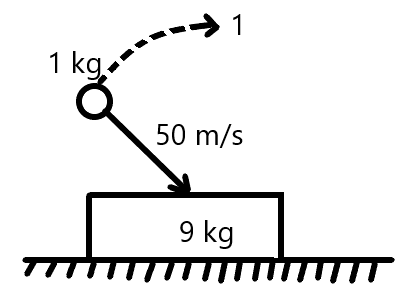
A block of mass $ 9\,kg $ is lying on a rough horizontal surface. A particle of mass $ 1\,kg $ strikes the block with a speed of $ 50\,m{s^{ - 1}} $ at an angle of $ 37 $ with the vertical and sticks to it. The frictional coefficient between the ground and the block is $ \mu = 0.4 $ . Find the velocity of the combined system just after the collision assuming limiting friction coefficient between the block and the ground after the collision?
Answer
 Verified
544.8k+ views
Hint : Here, in the solution we will consider two cases. In the first case, the angular velocity of the block will be zero. On the other hand, in the second case, the angular velocity of the block will be $ $ 0.4\, $ $ . Here, we will use the change in momentum relation to find the velocity of the combined system.
Complete Step By Step Answer:
Case 1: if $ \mu = 0 $
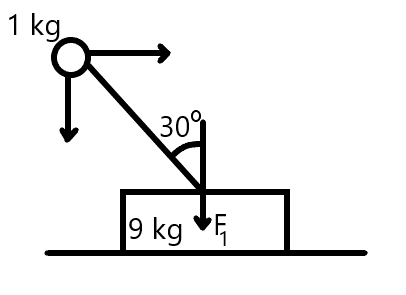
Then the momentum will change by the block in collision and is given by
$ {f_2}\Delta t = 9V $
Now, the momentum conservation in x-direction is given by
$ 1 \times 50\,\sin 37^\circ = \left( {9 + 1} \right)V $
$ \Rightarrow \,V = 3\,m{\operatorname{s} ^{ - 1}} $
Now, putting this value in the above equation we get
$ {f_2}\Delta t = 9 \times 3 $
$ \Rightarrow \,{f_2}\Delta t = 27 $
Now, the change in momentum of the block in y-direction by the ball is given by
$ {f_1}\Delta t = 30\,\cos 37^\circ $
$ \Rightarrow \,{f_1}\Delta t = 40 $
Case 2: when collision time $ \Delta t $ will be very small than $ \mu = 0.4 $ .
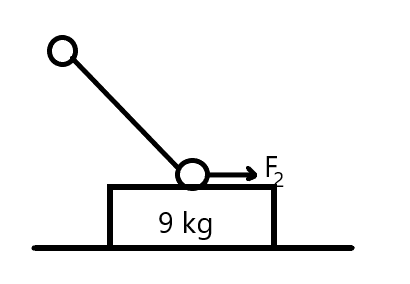
Now, the frictional force acting on the block is, $ {f_s} = \left( {{f_1} + \log } \right)\mu $
Now in this case, the change in momentum of the block in x-direction will be $ 9V' $ and is given by
$ \left( {{f_2} - {f_s}} \right)\Delta t = 9V' $
$ \Rightarrow \,\left( {{f_2} - \left( {{f_1} + \log } \right)\mu } \right)\Delta t = 9V' $
$ \Rightarrow \,\left( {{f_2}\Delta t - \left( {{f_1}\Delta t + \log \Delta t} \right)\mu } \right) = 9V' $
$ \Rightarrow \,27 - \left( {40} \right)\left( {0.4} \right) = 9V' $
$ \Rightarrow \,27 - 16 = 9V' $
$ \Rightarrow \,11 = 9V' $
$ \Rightarrow \,V' = \dfrac{{11}}{9} $
$ \Rightarrow \,V' \simeq 1.2\,m{s^{ - 1}} $
Therefore, the velocity of the combined system just after the collision will be approximately equal to $ 1.2\,m{s^{ - 1}} $ .
Note :
Here, $ \mu = 0 $ is the value of angular velocity before the collision and $ \mu = 0.4 $ is the value of the angular velocity after the collision. That is why, we have considered two cases here, that is, the case before collision and the case after collision. Also, the force $ {F_1} $ is in perpendicular direction and the force $ {F_2} $ is in horizontal direction.
Complete Step By Step Answer:
Case 1: if $ \mu = 0 $
Then the momentum will change by the block in collision and is given by
$ {f_2}\Delta t = 9V $
Now, the momentum conservation in x-direction is given by
$ 1 \times 50\,\sin 37^\circ = \left( {9 + 1} \right)V $
$ \Rightarrow \,V = 3\,m{\operatorname{s} ^{ - 1}} $
Now, putting this value in the above equation we get
$ {f_2}\Delta t = 9 \times 3 $
$ \Rightarrow \,{f_2}\Delta t = 27 $
Now, the change in momentum of the block in y-direction by the ball is given by
$ {f_1}\Delta t = 30\,\cos 37^\circ $
$ \Rightarrow \,{f_1}\Delta t = 40 $
Case 2: when collision time $ \Delta t $ will be very small than $ \mu = 0.4 $ .
Now, the frictional force acting on the block is, $ {f_s} = \left( {{f_1} + \log } \right)\mu $
Now in this case, the change in momentum of the block in x-direction will be $ 9V' $ and is given by
$ \left( {{f_2} - {f_s}} \right)\Delta t = 9V' $
$ \Rightarrow \,\left( {{f_2} - \left( {{f_1} + \log } \right)\mu } \right)\Delta t = 9V' $
$ \Rightarrow \,\left( {{f_2}\Delta t - \left( {{f_1}\Delta t + \log \Delta t} \right)\mu } \right) = 9V' $
$ \Rightarrow \,27 - \left( {40} \right)\left( {0.4} \right) = 9V' $
$ \Rightarrow \,27 - 16 = 9V' $
$ \Rightarrow \,11 = 9V' $
$ \Rightarrow \,V' = \dfrac{{11}}{9} $
$ \Rightarrow \,V' \simeq 1.2\,m{s^{ - 1}} $
Therefore, the velocity of the combined system just after the collision will be approximately equal to $ 1.2\,m{s^{ - 1}} $ .
Note :
Here, $ \mu = 0 $ is the value of angular velocity before the collision and $ \mu = 0.4 $ is the value of the angular velocity after the collision. That is why, we have considered two cases here, that is, the case before collision and the case after collision. Also, the force $ {F_1} $ is in perpendicular direction and the force $ {F_2} $ is in horizontal direction.
Recently Updated Pages
Master Class 11 Computer Science: Engaging Questions & Answers for Success

Master Class 11 Business Studies: Engaging Questions & Answers for Success
Master Class 11 Economics: Engaging Questions & Answers for Success
Master Class 11 English: Engaging Questions & Answers for Success
Master Class 11 Maths: Engaging Questions & Answers for Success
Master Class 11 Biology: Engaging Questions & Answers for Success
Trending doubts
One Metric ton is equal to kg A 10000 B 1000 C 100 class 11 physics CBSE
There are 720 permutations of the digits 1 2 3 4 5 class 11 maths CBSE
Discuss the various forms of bacteria class 11 biology CBSE
Draw a diagram of a plant cell and label at least eight class 11 biology CBSE
State the laws of reflection of light
Explain zero factorial class 11 maths CBSE