




A block of mass \[50kg\] is pulled up a slope with constant speed by applying an external force of \[20kgf\] parallel to the slope. The block moves through a distance of \[4m\] along the slope.
What is the work done by the external applied force?
What is the energy stored when it reaches the vertical height of \[3m\] (\[g = 10\dfrac{m}{{{s^2}}}\])
Answer
 Verified
582.3k+ views
Hint: The block is under the effect of two forces. The constant force moves it up the slope and its weight increases its potential energy. The work done is the product of force and displacement and potential energy is the product of weight and height of the body. Substituting corresponding values, we can calculate both work and potential of the body.
Formula used:
\[
W = Fx \\
P = F'h \\
\]
Complete step by step solution:
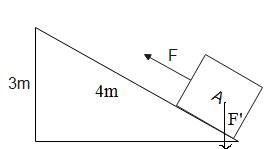
In the given figure, \[F\] is the constant force while \[F'\] is the weight of the block.
The work done is given by-
\[W = Fx\]
Here, \[W\] is the work done
\[F\] is the force acting on the body
\[x\] is the displacement travelled by the body
\[
F = 20kgf = 20 \times 10N = 200N\left( {\therefore 1kgf = 10N} \right) \\
x = 4m \\
\]
Substituting given values in the above equation, we get,
\[W = 200 \times 4 = 800J\]
The work done on the block by the constant force is \[800J\]
The potential energy (P) of a body is given by-
\[P = F'h\]
\[F'\]is the weight of the body
\[h\]is the height
\[F' = 50kg = 50 \times 10 = 500N,h = 3m\]Substituting given values in the above equation, we get,
\[P = 500 \times 3 = 1500J\]
Note: The potential energy and work done have the same units. The potential of a body due to gravity is always negative. Work done is a scalar quantity. Both forces acting on the body are constant; hence the acceleration of the body will also be constant. Energy is the ability of a body to do work.
Formula used:
\[
W = Fx \\
P = F'h \\
\]
Complete step by step solution:
In the given figure, \[F\] is the constant force while \[F'\] is the weight of the block.
The work done is given by-
\[W = Fx\]
Here, \[W\] is the work done
\[F\] is the force acting on the body
\[x\] is the displacement travelled by the body
\[
F = 20kgf = 20 \times 10N = 200N\left( {\therefore 1kgf = 10N} \right) \\
x = 4m \\
\]
Substituting given values in the above equation, we get,
\[W = 200 \times 4 = 800J\]
The work done on the block by the constant force is \[800J\]
The potential energy (P) of a body is given by-
\[P = F'h\]
\[F'\]is the weight of the body
\[h\]is the height
\[F' = 50kg = 50 \times 10 = 500N,h = 3m\]Substituting given values in the above equation, we get,
\[P = 500 \times 3 = 1500J\]
Note: The potential energy and work done have the same units. The potential of a body due to gravity is always negative. Work done is a scalar quantity. Both forces acting on the body are constant; hence the acceleration of the body will also be constant. Energy is the ability of a body to do work.
Recently Updated Pages
Lysosomes are known as suicidal bags of cell why class 11 biology CBSE

Father s age is three times the sum of the ages of-class-11-maths-CBSE
Give a comparative account of the classes of kingdom class 11 biology CBSE
The ceiling of a long hall is 25m high What is the class 11 physics CBSE
Name the Largest and the Smallest Cell in the Human Body ?
Draw a welllabelled diagram of a plant cell class 11 biology CBSE
Trending doubts
Find the value of the expression given below sin 30circ class 11 maths CBSE
One Metric ton is equal to kg A 10000 B 1000 C 100 class 11 physics CBSE
Two of the body parts which do not appear in MRI are class 11 biology CBSE
10 examples of friction in our daily life
Proton was discovered by A Thomson B Rutherford C Chadwick class 11 chemistry CBSE
10 examples of diffusion in everyday life