




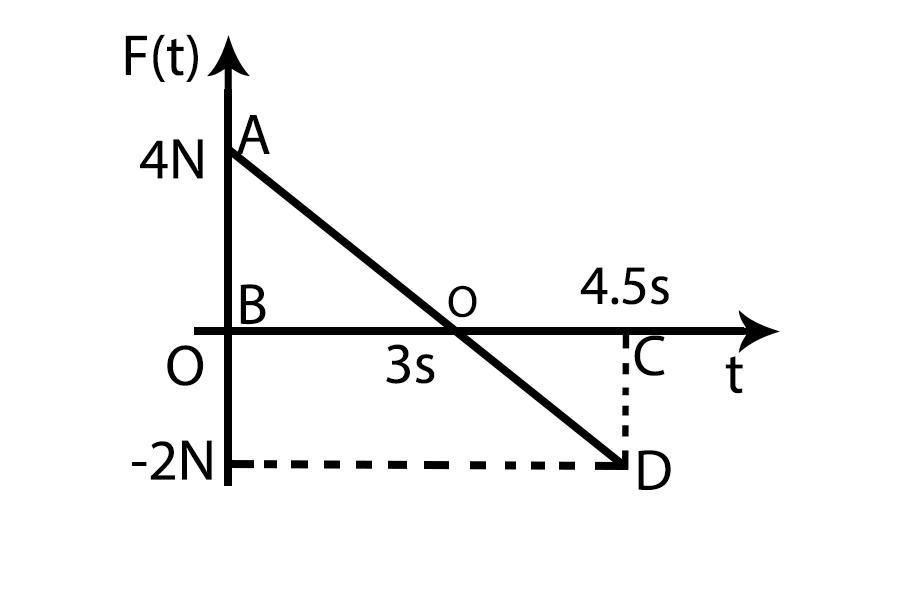
A block of mass 2 kg is free to move along the x-axis. It is at rest and from t=0 onwards it is subjected to a time-dependent force F (t) in the x direction. The force F (t) varies with t as shown in the figure. The kinetic energy of the block after 4.5 seconds is:
A.4.50 J
B.7.50 J
C.5.06 J
D.14.06 J
Answer
 Verified
603.9k+ views
Hint: In order to solve this question, carefully observe the given diagram the area under the F−t graph gives the change in momentum of the block. Then we can calculate the value of kinetic energy by using the relation between the kinetic energy and momentum.
Complete step by step answer:
Area under the F−t graph gives the change in momentum of the block.
Area A = Area of triangle ABO - Area of triangle DCO
Area= $\dfrac{1}{2}(base) (height)$
\begin{align*}
\therefore A &=\dfrac{1}{2}(4)\times (3) −\dfrac{1}{2}(2)\times (1.5)\\
&=4.5 Ns
\end{align*}
The Initial momentum of the block Pi=0
Using
\begin{align*}
A &= {p_{f - }}{p_i}\\
&=4.5-0\\
\Rightarrow &{p_f}=4.5 Ns\\
\end{align*}
Thus final kinetic energy of the block KE=$\dfrac{{{p_f}^2}}{{2m}}$
\begin{align*}
KE &= \dfrac{(4.5)^2}{2(2)}\\
&=5.06J
\end{align*}
Hence the correct option is C
Note:
Alternatively we can use the impulse relation
Given:
At t = 4.5 sec, $\mathop F\limits^ \to = - 2N$
Total Impulse is given by
$\begin{array}{l}
= \left[ {\dfrac{1}{2} \times 3 \times 4} \right] - \left[ {\dfrac{1}{2} \times 2 \times 1.5} \right]\\
\Rightarrow I = 6 - 1.5 = 4.5\,\,{\rm{SI}}\,{\rm{Unit}}
\end{array}$
Impulse = change in momentum
\begin{align*}
45 &= 2[v - 0]\\
v &= \dfrac{{45}}{2} = 2.25\,m{s^{ - 1}}\\
K.E &= \dfrac{1}{2} \times 2 \times {\left( {2.25} \right)^2}\\
&= 5.06\,J
\end{align*}
Complete step by step answer:
Area under the F−t graph gives the change in momentum of the block.
Area A = Area of triangle ABO - Area of triangle DCO
Area= $\dfrac{1}{2}(base) (height)$
\begin{align*}
\therefore A &=\dfrac{1}{2}(4)\times (3) −\dfrac{1}{2}(2)\times (1.5)\\
&=4.5 Ns
\end{align*}
The Initial momentum of the block Pi=0
Using
\begin{align*}
A &= {p_{f - }}{p_i}\\
&=4.5-0\\
\Rightarrow &{p_f}=4.5 Ns\\
\end{align*}
Thus final kinetic energy of the block KE=$\dfrac{{{p_f}^2}}{{2m}}$
\begin{align*}
KE &= \dfrac{(4.5)^2}{2(2)}\\
&=5.06J
\end{align*}
Hence the correct option is C
Note:
Alternatively we can use the impulse relation
Given:
At t = 4.5 sec, $\mathop F\limits^ \to = - 2N$
Total Impulse is given by
$\begin{array}{l}
= \left[ {\dfrac{1}{2} \times 3 \times 4} \right] - \left[ {\dfrac{1}{2} \times 2 \times 1.5} \right]\\
\Rightarrow I = 6 - 1.5 = 4.5\,\,{\rm{SI}}\,{\rm{Unit}}
\end{array}$
Impulse = change in momentum
\begin{align*}
45 &= 2[v - 0]\\
v &= \dfrac{{45}}{2} = 2.25\,m{s^{ - 1}}\\
K.E &= \dfrac{1}{2} \times 2 \times {\left( {2.25} \right)^2}\\
&= 5.06\,J
\end{align*}
Recently Updated Pages
Master Class 11 English: Engaging Questions & Answers for Success

Master Class 11 Social Science: Engaging Questions & Answers for Success
Master Class 11 Maths: Engaging Questions & Answers for Success
Master Class 11 Chemistry: Engaging Questions & Answers for Success
Master Class 11 Biology: Engaging Questions & Answers for Success
Master Class 11 Physics: Engaging Questions & Answers for Success
Trending doubts
One Metric ton is equal to kg A 10000 B 1000 C 100 class 11 physics CBSE
Difference Between Prokaryotic Cells and Eukaryotic Cells
Find the value of the expression given below sin 30circ class 11 maths CBSE
1 ton equals to A 100 kg B 1000 kg C 10 kg D 10000 class 11 physics CBSE
Two of the body parts which do not appear in MRI are class 11 biology CBSE
What are hard magnetic materials class 11 physics CBSE