




A block is kept on a inclined plane of inclination θ of length l .The velocity of particle at the bottom of inclined is (the coefficient of friction is μ)
A. $\sqrt {\left[ {2gl\left( {\mu \cos \theta - \sin \theta } \right)} \right]} $
B. $\sqrt {\left[ {2gl\left( {\sin \theta - \mu \cos \theta } \right)} \right]} $
C. $\sqrt {\left[ {2gl\left( {\sin \theta + \mu \cos \theta } \right)} \right]} $
D. $\sqrt {\left[ {2gl\left( {\cos \theta + \mu \sin \theta } \right)} \right]} $
Answer
 Verified
570.9k+ views
Hint: This question utilizes the concept of mechanics and friction. First we draw the free body diagram and find the total acceleration acting on the body. Using the acceleration, we then proceed to find out the velocity of the particle at the bottom of the inclined plane.
Formulae used:
${v^2} = {u^2} + 2aS$
where \[v\] is the final velocity, $u$ is the initial velocity, $a$ is the acceleration and $S$ is the distance covered.
$f = \mu N$
where $f$ is the frictional force, $\mu $ is the coefficient of friction and $N$ is the normal
Complete step by step answer:
According to the given question, angle of inclination is $\theta $, Length of the plane $S = l$, Coefficient of friction is $\mu $ and Initial velocity is $u = 0$. Let normal be $N$.A free body diagram is drawn to understand the question better.
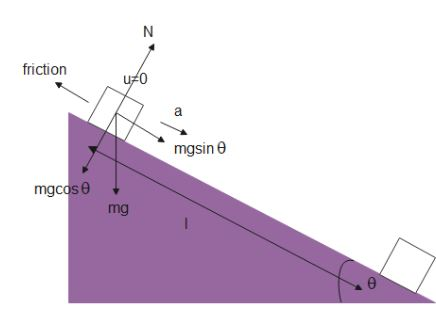
From the diagram, Total force on the block will be
$ \Rightarrow F = mg\sin \theta - f$
since $F = ma$ , we get
$ \Rightarrow a = \dfrac{{mg\sin \theta - f}}{m}$ -------(i)
where $f$ is the frictional force.
We know that
$f = \mu N$
From the figure,
$N = mg\cos \theta $
Thus, eq (i) becomes
$\Rightarrow a = \dfrac{{mg\sin \theta - \mu mg\cos \theta }}{m} \\
\Rightarrow a = \dfrac{{mg(\sin \theta - \mu \cos \theta )}}{m} \\ $
$ \Rightarrow a = g(\sin \theta - \mu \cos \theta )$ ----------------(ii)
Now, using the equation ${v^2} = {u^2} + 2aS$ and substituting the values, we have
$ \Rightarrow {v^2} = {(0)^2} + 2al$
Substituting the value of acceleration from eq (ii), we get
$\Rightarrow {v^2} = 2lg(\sin \theta - \mu \cos \theta ) \\
\therefore v = \sqrt {2gl(\sin \theta - \mu \cos \theta )} \\ $
Therefore, the correct option is (B).
Note: Be extra careful when resolving a vector in inclined planes. Many times, students mix up $\sin \theta $ and $\cos \theta $ . This results in wrong answers. Also, remember that we have been asked about the velocity in the bottom of the inclined plane, so do not use the formula $v = u + at$ to find the velocity.
Formulae used:
${v^2} = {u^2} + 2aS$
where \[v\] is the final velocity, $u$ is the initial velocity, $a$ is the acceleration and $S$ is the distance covered.
$f = \mu N$
where $f$ is the frictional force, $\mu $ is the coefficient of friction and $N$ is the normal
Complete step by step answer:
According to the given question, angle of inclination is $\theta $, Length of the plane $S = l$, Coefficient of friction is $\mu $ and Initial velocity is $u = 0$. Let normal be $N$.A free body diagram is drawn to understand the question better.
From the diagram, Total force on the block will be
$ \Rightarrow F = mg\sin \theta - f$
since $F = ma$ , we get
$ \Rightarrow a = \dfrac{{mg\sin \theta - f}}{m}$ -------(i)
where $f$ is the frictional force.
We know that
$f = \mu N$
From the figure,
$N = mg\cos \theta $
Thus, eq (i) becomes
$\Rightarrow a = \dfrac{{mg\sin \theta - \mu mg\cos \theta }}{m} \\
\Rightarrow a = \dfrac{{mg(\sin \theta - \mu \cos \theta )}}{m} \\ $
$ \Rightarrow a = g(\sin \theta - \mu \cos \theta )$ ----------------(ii)
Now, using the equation ${v^2} = {u^2} + 2aS$ and substituting the values, we have
$ \Rightarrow {v^2} = {(0)^2} + 2al$
Substituting the value of acceleration from eq (ii), we get
$\Rightarrow {v^2} = 2lg(\sin \theta - \mu \cos \theta ) \\
\therefore v = \sqrt {2gl(\sin \theta - \mu \cos \theta )} \\ $
Therefore, the correct option is (B).
Note: Be extra careful when resolving a vector in inclined planes. Many times, students mix up $\sin \theta $ and $\cos \theta $ . This results in wrong answers. Also, remember that we have been asked about the velocity in the bottom of the inclined plane, so do not use the formula $v = u + at$ to find the velocity.
Recently Updated Pages
Which will be the least stable resonating structure class 11 chemistry CBSE

How many 5 digit telephone numbers can be construc-class-11-maths-CBSE
How do you find the angle of the resultant vector class 11 physics CBSE
Draw labelled diagram of the following i Gram seed class 11 biology CBSE
1 Quintal is equal to a 110 kg b 10 kg c 100kg d 1000 class 11 physics CBSE
What is the need and importance of classification class 11 biology CBSE
Trending doubts
Find the value of the expression given below sin 30circ class 11 maths CBSE
One Metric ton is equal to kg A 10000 B 1000 C 100 class 11 physics CBSE
10 examples of friction in our daily life
Draw a diagram of a plant cell and label at least eight class 11 biology CBSE
Difference between physical and chemical change class 11 chemistry CBSE
Proton was discovered by A Thomson B Rutherford C Chadwick class 11 chemistry CBSE