




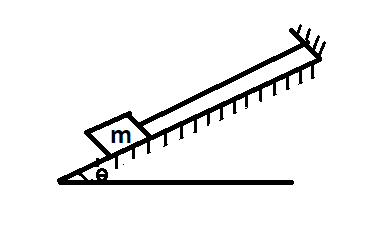
A block is in equilibrium. The tension in the string is $\left( {\mu < \tan \theta } \right)$
A. $mg\left( {\sin \theta - \mu \cos \theta } \right)$
B. $mg\left( {\sin \theta + \mu \cos \theta } \right)$
C. $mg\sin \theta $
D. Zero
Answer
 Verified
601.2k+ views
Hint: It is given in the question that the block is in equilibrium. An object will be at equilibrium when the linear momentum of its center of mass and the angular momentum about its center of mass will be constant. Here, we will resolve the weight $mg$ of the block to calculate the tension in the string.
Complete step by step answer:
Consider a block of mass $m$ which is attached to a rigid support. This block is placed on an inclined plane which is making an angle $\theta $ with the surface. Let $mg$ be the weight of the block.
Now, if we resolve the weight $mg$ of the block into two components
$mg\,\cos \theta $ which is perpendicular to the plane of the block.
$mg\,\sin \theta $ which is along the plane of the block.
Now, the force along the inclined plane will be zero. Also, the force which is perpendicular to the inclined plane is also zero.
Now, let us denote the force in the upward direction of the mass $m$ as $N$ .
Therefore, for the direction of friction, the tendency of the motion of block is given by
$N = mg\,\cos \theta $
Now, if we cut the wire with which the block is attached to a rigid support. Therefore, the mass will move downward due to gravity.
Now, the tendency of the relative motion is $\mu N$ and it is opposite to the acceleration due to gravity.
Therefore, the tension $T$ in the block is given by
$T = mg\,\sin \theta - \mu \,mg\,\cos \theta $
$ \Rightarrow \,T = mg\left( {\sin \theta - \mu \cos \theta } \right)$
Therefore, the tension in the string is $mg\left( {\sin \theta - \mu \cos \theta } \right)$ .
So, the correct answer is “Option A”.
Note:
When the system will be in equilibrium, therefore, the tension in the string will be pointed away from the mass, that is, in the direction of the string.
When the system will be in equilibrium, the sum of all the forces will be zero.
$ \Rightarrow \,\sum F = 0$
Complete step by step answer:
Consider a block of mass $m$ which is attached to a rigid support. This block is placed on an inclined plane which is making an angle $\theta $ with the surface. Let $mg$ be the weight of the block.
Now, if we resolve the weight $mg$ of the block into two components
$mg\,\cos \theta $ which is perpendicular to the plane of the block.
$mg\,\sin \theta $ which is along the plane of the block.
Now, the force along the inclined plane will be zero. Also, the force which is perpendicular to the inclined plane is also zero.
Now, let us denote the force in the upward direction of the mass $m$ as $N$ .
Therefore, for the direction of friction, the tendency of the motion of block is given by
$N = mg\,\cos \theta $
Now, if we cut the wire with which the block is attached to a rigid support. Therefore, the mass will move downward due to gravity.
Now, the tendency of the relative motion is $\mu N$ and it is opposite to the acceleration due to gravity.
Therefore, the tension $T$ in the block is given by
$T = mg\,\sin \theta - \mu \,mg\,\cos \theta $
$ \Rightarrow \,T = mg\left( {\sin \theta - \mu \cos \theta } \right)$
Therefore, the tension in the string is $mg\left( {\sin \theta - \mu \cos \theta } \right)$ .
So, the correct answer is “Option A”.
Note:
When the system will be in equilibrium, therefore, the tension in the string will be pointed away from the mass, that is, in the direction of the string.
When the system will be in equilibrium, the sum of all the forces will be zero.
$ \Rightarrow \,\sum F = 0$
Recently Updated Pages
Master Class 12 Economics: Engaging Questions & Answers for Success

Master Class 12 English: Engaging Questions & Answers for Success
Master Class 12 Social Science: Engaging Questions & Answers for Success
Master Class 12 Maths: Engaging Questions & Answers for Success
Master Class 12 Physics: Engaging Questions & Answers for Success
Master Class 11 Social Science: Engaging Questions & Answers for Success
Trending doubts
One Metric ton is equal to kg A 10000 B 1000 C 100 class 11 physics CBSE
Difference Between Prokaryotic Cells and Eukaryotic Cells
Two of the body parts which do not appear in MRI are class 11 biology CBSE
1 ton equals to A 100 kg B 1000 kg C 10 kg D 10000 class 11 physics CBSE
Draw a diagram of nephron and explain its structur class 11 biology CBSE
10 examples of friction in our daily life