




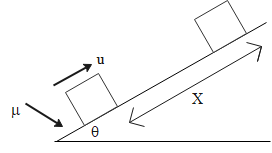
A block is given a speed u up the inclined plane as shown. Using the work energy theorem, find out X, when the block stops moving.
Answer
 Verified
617.1k+ views
Hint: According to the work energy theorem, the total work done by the system is equal to the change in kinetic energy of the system. The work done here is against gravity and the friction force of the surface to move the box from one position to another.
Complete step-by-step answer:
We are given a box. Let its mass be m kgs. It is given a speed up the inclined plane. Therefore, the initial velocity of the box is u. Since, the box eventually comes to rest after traveling a distance x, its final velocity is zero. Therefore, v = 0 and final kinetic energy is also zero. Hence, change in kinetic energy is given as
$
\Delta K = \dfrac{1}{2}m{{\text{v}}^2} - \dfrac{1}{2}m{u^2} \\
= 0 - \dfrac{1}{2}m{u^2} = - \dfrac{1}{2}m{u^2}{\text{ }}...{\text{(i)}} \\
$
Now the various forces acting on the box are as follows:
1. The force due to gravity. If we resolve the components of weight mg, the component acting along the inclined plane is
2. The force due to friction. The distance travelled by box before coming to rest is X. Therefore the frictional force acting on the box is given as
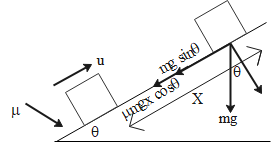
Now, according to the work energy theorem, the total work done by a system is equal to the change in its kinetic energy. Therefore, with the available information we can write the work energy theorem for box’s motion as follows.
${W_g} + {W_f} = \Delta K$
Substituting the equation (i), (ii) and (iii), we get
$
- mg\sin \theta - \mu mgx\sin \theta = - \dfrac{1}{2}m{u^2} \\
\Rightarrow \mu mgx\cos \theta = \dfrac{1}{2}m{u^2} - mg\sin \theta \\
\Rightarrow x = \dfrac{1}{{\mu mg\cos \theta }}\left( {\dfrac{1}{2}m{u^2} - mg\sin \theta } \right) \\
\\
$
Solving further, we get
$x = \dfrac{{{u^2}}}{{2g\left( {\sin \theta + \mu \cos \theta } \right)}}$
This is the required value of X.
Note: The two forces, one due to gravity and other due to friction, are trying to stop the motion of the box i.e. they are acting in opposite directions of the motion of the box, due to which their magnitude are taken to be negative.
Complete step-by-step answer:
We are given a box. Let its mass be m kgs. It is given a speed up the inclined plane. Therefore, the initial velocity of the box is u. Since, the box eventually comes to rest after traveling a distance x, its final velocity is zero. Therefore, v = 0 and final kinetic energy is also zero. Hence, change in kinetic energy is given as
$
\Delta K = \dfrac{1}{2}m{{\text{v}}^2} - \dfrac{1}{2}m{u^2} \\
= 0 - \dfrac{1}{2}m{u^2} = - \dfrac{1}{2}m{u^2}{\text{ }}...{\text{(i)}} \\
$
Now the various forces acting on the box are as follows:
1. The force due to gravity. If we resolve the components of weight mg, the component acting along the inclined plane is
${W_g} = - mg\sin \theta {\text{ }}...{\text{(ii)}}$.
2. The force due to friction. The distance travelled by box before coming to rest is X. Therefore the frictional force acting on the box is given as
${W_f} = - \mu mgx\cos \theta {\text{ }}...{\text{(iii)}}$
Now, according to the work energy theorem, the total work done by a system is equal to the change in its kinetic energy. Therefore, with the available information we can write the work energy theorem for box’s motion as follows.
${W_g} + {W_f} = \Delta K$
Substituting the equation (i), (ii) and (iii), we get
$
- mg\sin \theta - \mu mgx\sin \theta = - \dfrac{1}{2}m{u^2} \\
\Rightarrow \mu mgx\cos \theta = \dfrac{1}{2}m{u^2} - mg\sin \theta \\
\Rightarrow x = \dfrac{1}{{\mu mg\cos \theta }}\left( {\dfrac{1}{2}m{u^2} - mg\sin \theta } \right) \\
\\
$
Solving further, we get
$x = \dfrac{{{u^2}}}{{2g\left( {\sin \theta + \mu \cos \theta } \right)}}$
This is the required value of X.
Note: The two forces, one due to gravity and other due to friction, are trying to stop the motion of the box i.e. they are acting in opposite directions of the motion of the box, due to which their magnitude are taken to be negative.
Recently Updated Pages
Master Class 11 Social Science: Engaging Questions & Answers for Success

Master Class 11 Physics: Engaging Questions & Answers for Success
Master Class 11 Maths: Engaging Questions & Answers for Success
Master Class 11 Economics: Engaging Questions & Answers for Success
Master Class 11 Computer Science: Engaging Questions & Answers for Success
Master Class 11 Chemistry: Engaging Questions & Answers for Success
Trending doubts
One Metric ton is equal to kg A 10000 B 1000 C 100 class 11 physics CBSE
There are 720 permutations of the digits 1 2 3 4 5 class 11 maths CBSE
1 Quintal is equal to a 110 kg b 10 kg c 100kg d 1000 class 11 physics CBSE
State and prove Bernoullis theorem class 11 physics CBSE
Difference Between Prokaryotic Cells and Eukaryotic Cells
Which among the following are examples of coming together class 11 social science CBSE