




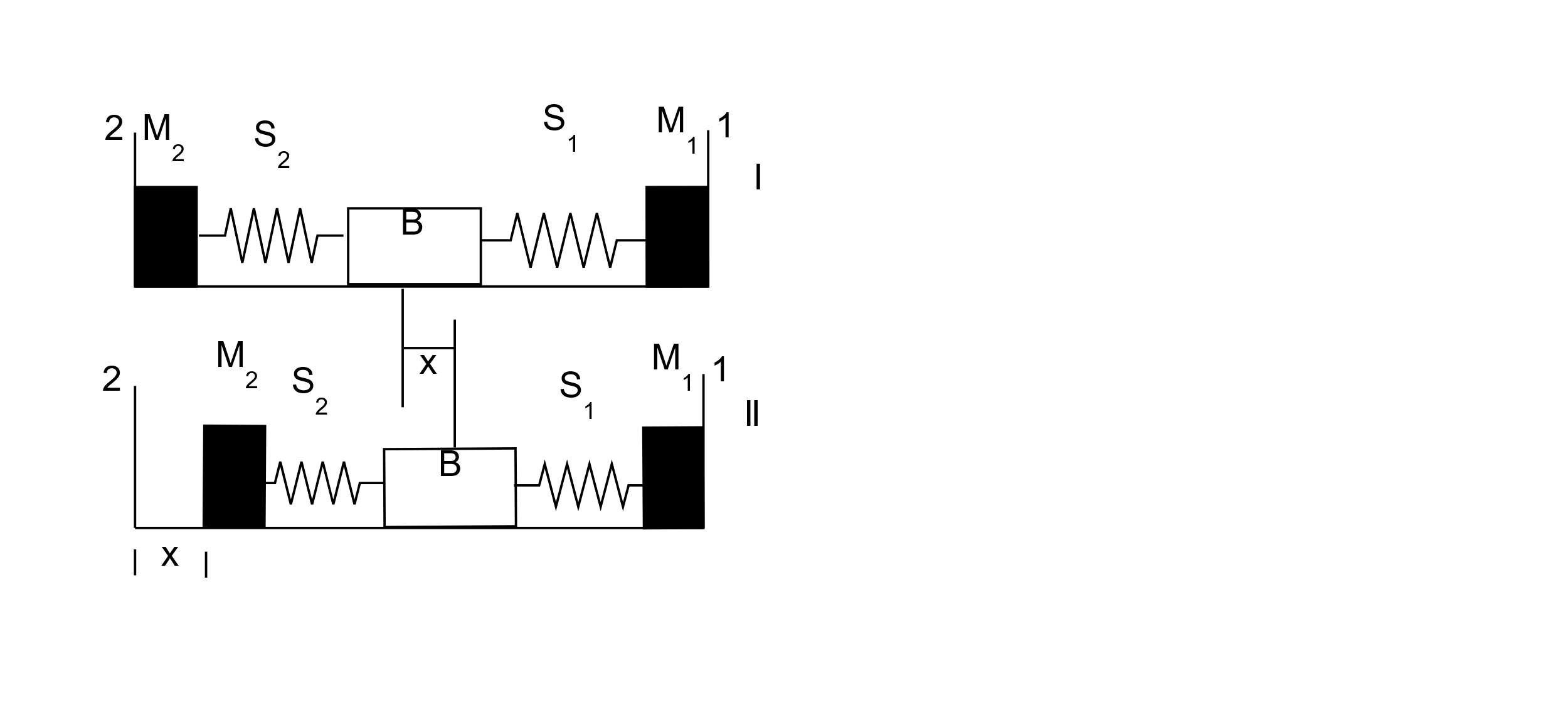
A block (B) is attached to two unstretched springs $ {S_1} $ and $ {S_2} $ with spring constants $ k $ and $ 4k $ respectively (see figure I).The other ends are attached to identical supports $ {M_1} $ and $ {M_2} $ not attached to the walls. The springs and supports have negligible mass. There is no friction anywhere. Block B is displaced towards wall $ 1 $ by a small distance x (figure II) and released. The block returns and moves a maximum distance y towards wall $ 2 $ . Displacements x and y are measured with respect to the equilibrium position of block B. The ratio $ \dfrac{y}{x} $ is:
(A) $ 4 $
(B) $ 2 $
(C) $ \dfrac{1}{2} $
(D) $ \dfrac{1}{4} $
Answer
 Verified
517.8k+ views
Hint: We are asked to find the ratio $ \dfrac{y}{x} $ . Let us start by redrawing the figure and adding the second displacement onto it. The new figures will give us a rough idea of the question. The velocity of the block in both cases is zero. Here we consider the energies of the spring instead of the velocity of the block.
Potential energy of a spring is given by the formula, $ PE = \dfrac{1}{2}k{x^2} $
Where $ k $ is known as the spring constant or the force constant
$ x $ is the distance from the equilibrium position
Complete answer:
We can start by considering the two diagrams as said in the question. The two diagrams (displacement with respect to x and displacement with respect to y) will be as follows
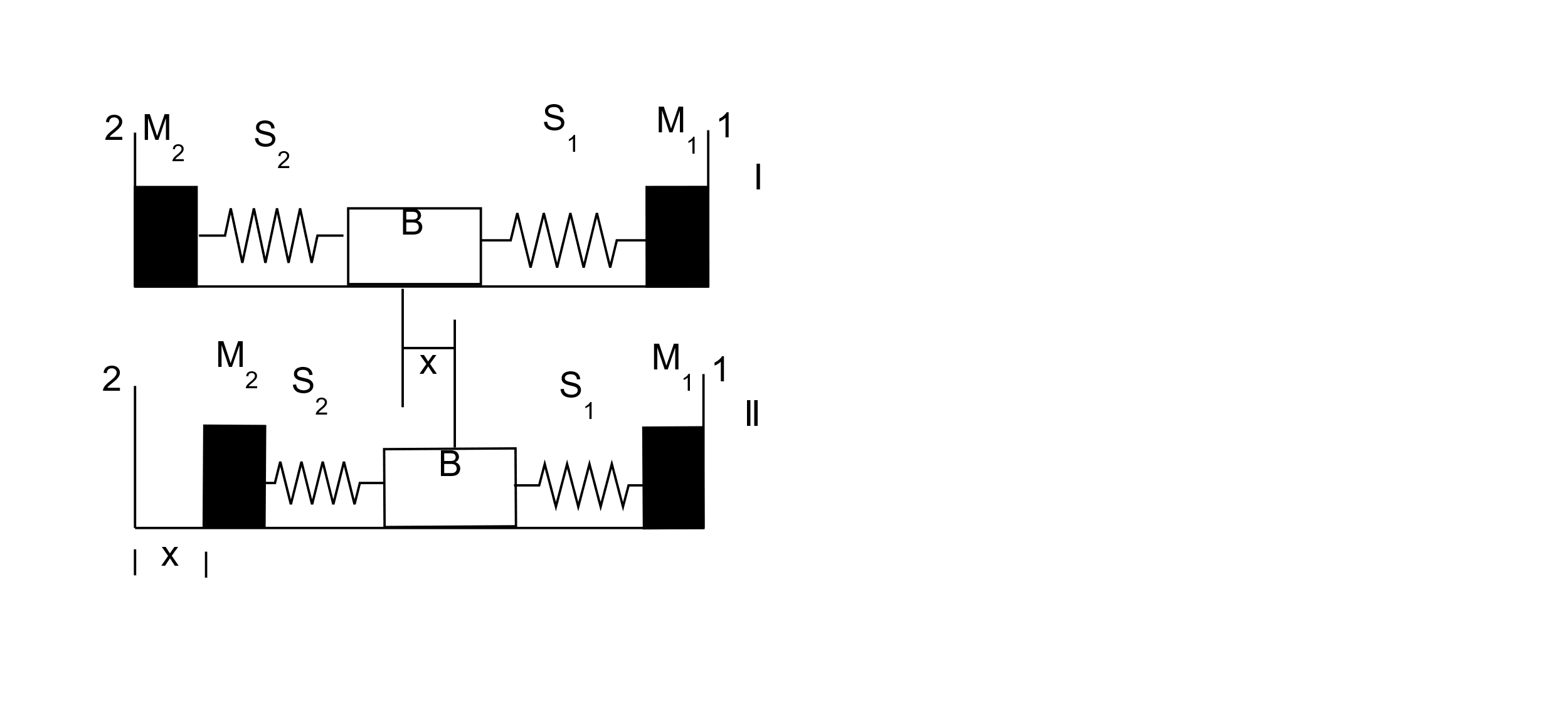
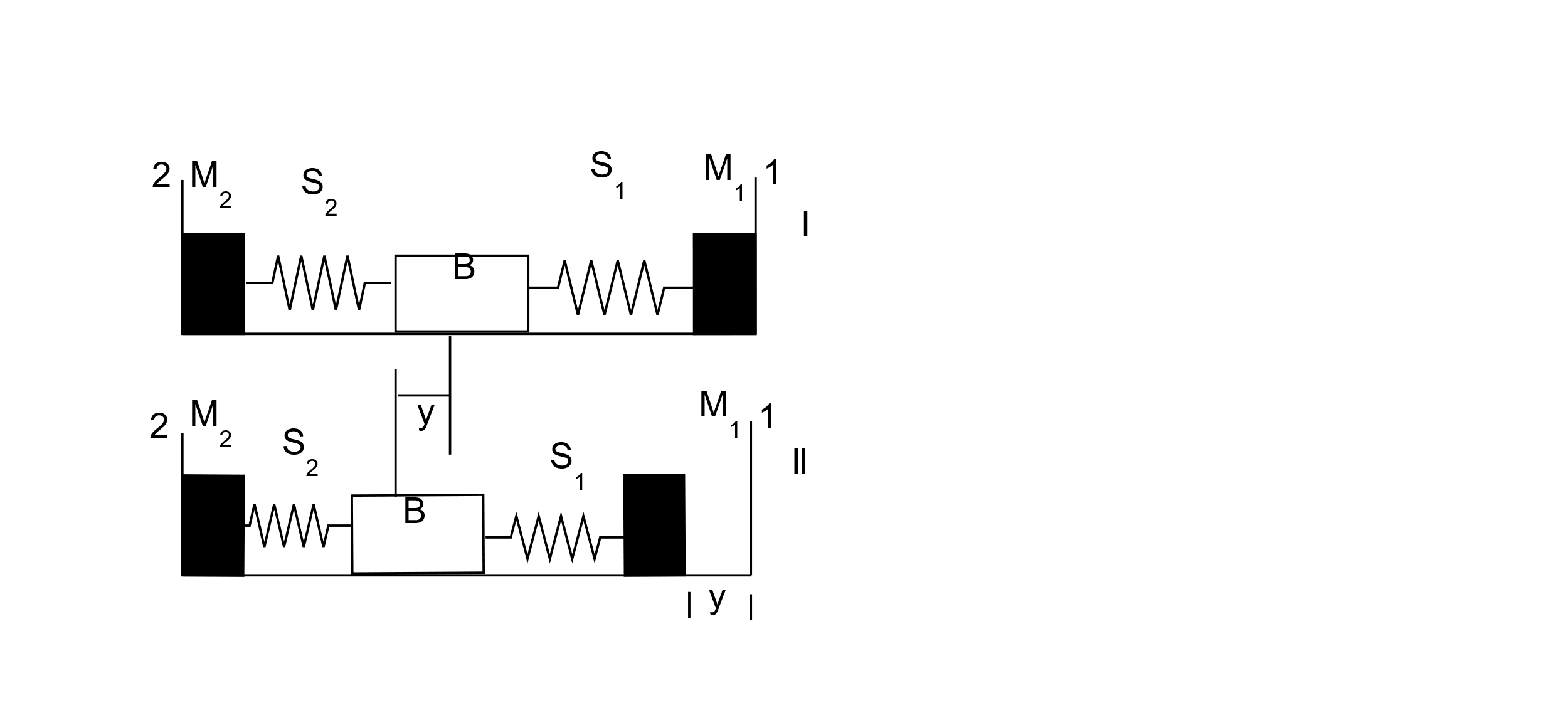
Now that we have the right diagrams with respect to the displacement x and y, we can move onto finding the ratio as asked. In order to do this, we need to establish a relationship so as to move forward. The velocity of the blocks is considered first, but the velocity of both cases is zero. Now we move onto potential energy of the spring
We can use the sum of kinetic energy and potential energy (total energy) here.
$ P{E_X} + K{E_X} = P{E_y} + K{E_y} $
The kinetic energy of the springs are zero hence we arrive at,
$ \dfrac{1}{2}k{x^2} + 0 = \dfrac{1}{2}k{y^2} + 0 $
But one of the spring constants (spring constant of the second displacement, y) is $ 4k $
Substituting that we get, $ \dfrac{1}{2}k{x^2} + 0 = \dfrac{1}{2}4k{y^2} + 0 $
We bring the like terms to one side and get $ \dfrac{{{y^2}}}{{{x^2}}} = \dfrac{1}{4} $
We can now take the square root of this equation to get the final answer as, $ \dfrac{y}{x} = \dfrac{1}{2} $
In conclusion, the right answer is option (C) $ \dfrac{1}{2} $ .
Note:
Spring constant or the force constant is derived by Hooke's law. Hooke's law, law of elasticity discovered by the English scientist Robert Hooke in 1660, states that, for relatively small deformations of an object, the displacement or size of the deformation is directly proportional to the deforming force or load.
Potential energy of a spring is given by the formula, $ PE = \dfrac{1}{2}k{x^2} $
Where $ k $ is known as the spring constant or the force constant
$ x $ is the distance from the equilibrium position
Complete answer:
We can start by considering the two diagrams as said in the question. The two diagrams (displacement with respect to x and displacement with respect to y) will be as follows
Now that we have the right diagrams with respect to the displacement x and y, we can move onto finding the ratio as asked. In order to do this, we need to establish a relationship so as to move forward. The velocity of the blocks is considered first, but the velocity of both cases is zero. Now we move onto potential energy of the spring
We can use the sum of kinetic energy and potential energy (total energy) here.
$ P{E_X} + K{E_X} = P{E_y} + K{E_y} $
The kinetic energy of the springs are zero hence we arrive at,
$ \dfrac{1}{2}k{x^2} + 0 = \dfrac{1}{2}k{y^2} + 0 $
But one of the spring constants (spring constant of the second displacement, y) is $ 4k $
Substituting that we get, $ \dfrac{1}{2}k{x^2} + 0 = \dfrac{1}{2}4k{y^2} + 0 $
We bring the like terms to one side and get $ \dfrac{{{y^2}}}{{{x^2}}} = \dfrac{1}{4} $
We can now take the square root of this equation to get the final answer as, $ \dfrac{y}{x} = \dfrac{1}{2} $
In conclusion, the right answer is option (C) $ \dfrac{1}{2} $ .
Note:
Spring constant or the force constant is derived by Hooke's law. Hooke's law, law of elasticity discovered by the English scientist Robert Hooke in 1660, states that, for relatively small deformations of an object, the displacement or size of the deformation is directly proportional to the deforming force or load.
Recently Updated Pages
Master Class 11 Social Science: Engaging Questions & Answers for Success

Master Class 11 English: Engaging Questions & Answers for Success
Master Class 11 Maths: Engaging Questions & Answers for Success
Master Class 11 Chemistry: Engaging Questions & Answers for Success
Master Class 11 Biology: Engaging Questions & Answers for Success
Master Class 11 Physics: Engaging Questions & Answers for Success
Trending doubts
Differentiate between an exothermic and an endothermic class 11 chemistry CBSE
One Metric ton is equal to kg A 10000 B 1000 C 100 class 11 physics CBSE
Difference Between Prokaryotic Cells and Eukaryotic Cells
There are 720 permutations of the digits 1 2 3 4 5 class 11 maths CBSE
Draw a diagram of a plant cell and label at least eight class 11 biology CBSE
1 Quintal is equal to a 110 kg b 10 kg c 100kg d 1000 class 11 physics CBSE