




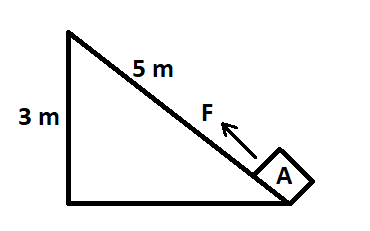
A block $$A$$ , whose weight is $200\,N$ , is pulled up a slope of length $5\,m$ by means of a constant force $F\left( { = 150\,N} \right)$ as illuminated in figure. By how much has the potential energy of the block $A$ increased?
Answer
 Verified
629.1k+ views
Hint: the potential energy is the energy that is stored by an object due to the new position relative to the position at zero. Here, in this above question, we first need to calculate the mass of the block. The increase in potential energy can be calculated by subtracting the potential energy at both positions.
Formula used:
Here, we will use Newton’s law of motion to calculate the mass of the block, which is shown below
$F = ma$
Here, $F$ is the force, $m$ is the mass of the force, and $a$ is the acceleration due to gravity.
Here, we will take weight instead of force.
Also, the potential energy of the block is given by
$P = mgh$
Here, $P$ is the potential energy, $m$ is the mass of the block, and $h$ is the height of the slope.
Complete step by step answer:
The above figure shows a slope of $5\,m$ on which a block $A$ is placed. The weight of this block is $200\,N$ . This slope is pulled by a force of $150\,N$ as shown in the figure. Also, the height of the slope is $3\,m$ . Now, to calculate the mass of the block, we will use Newton’s second law of motion which is shown below
$weight = mass \times acceleration\,due\,to\,gravity$
$ \Rightarrow \,200 = m \times 10$
$ \Rightarrow \,\dfrac{{200}}{{10}} = m$
$ \Rightarrow \,m = 20\,kg$
Now, to calculate the increase in potential energy of the block $A$ , we will first calculate the potential energy at the ground and then we will calculate the potential energy at the top on the slope.
Now, the potential at the ground is given below
${P_1} = m \times g \times h$
$ \Rightarrow \,{P_1} = 20 \times 10 \times 0$
$ \Rightarrow \,{P_1} = 0$
Now, the potential at the top of slope is given by
${P_2} = m \times g \times h$
$ \Rightarrow \,{P_2} = 20 \times 10 \times 3$
$ \Rightarrow \,{P_2} = 600\,Watt$
Now the increase in the potential energy of the block $A$ can be calculated by subtracting the potential at the ground from the potential at the top, which is shown below
$P = {P_2} - {P_1}$
$ \Rightarrow \,P = 600 - 0$
$ \Rightarrow \,P = 600\,Watt$
Hence, the increase in the potential energy of the block $A$ is $600\,Watt$ .
Note:
Here, it is important to calculate the potential at the ground because we need to calculate the increase in potential energy. The increase in potential energy will occur due to the change in the positions of the block. Therefore, by subtracting the potential energy at both positions, we can calculate the potential energy.
Formula used:
Here, we will use Newton’s law of motion to calculate the mass of the block, which is shown below
$F = ma$
Here, $F$ is the force, $m$ is the mass of the force, and $a$ is the acceleration due to gravity.
Here, we will take weight instead of force.
Also, the potential energy of the block is given by
$P = mgh$
Here, $P$ is the potential energy, $m$ is the mass of the block, and $h$ is the height of the slope.
Complete step by step answer:
The above figure shows a slope of $5\,m$ on which a block $A$ is placed. The weight of this block is $200\,N$ . This slope is pulled by a force of $150\,N$ as shown in the figure. Also, the height of the slope is $3\,m$ . Now, to calculate the mass of the block, we will use Newton’s second law of motion which is shown below
$weight = mass \times acceleration\,due\,to\,gravity$
$ \Rightarrow \,200 = m \times 10$
$ \Rightarrow \,\dfrac{{200}}{{10}} = m$
$ \Rightarrow \,m = 20\,kg$
Now, to calculate the increase in potential energy of the block $A$ , we will first calculate the potential energy at the ground and then we will calculate the potential energy at the top on the slope.
Now, the potential at the ground is given below
${P_1} = m \times g \times h$
$ \Rightarrow \,{P_1} = 20 \times 10 \times 0$
$ \Rightarrow \,{P_1} = 0$
Now, the potential at the top of slope is given by
${P_2} = m \times g \times h$
$ \Rightarrow \,{P_2} = 20 \times 10 \times 3$
$ \Rightarrow \,{P_2} = 600\,Watt$
Now the increase in the potential energy of the block $A$ can be calculated by subtracting the potential at the ground from the potential at the top, which is shown below
$P = {P_2} - {P_1}$
$ \Rightarrow \,P = 600 - 0$
$ \Rightarrow \,P = 600\,Watt$
Hence, the increase in the potential energy of the block $A$ is $600\,Watt$ .
Note:
Here, it is important to calculate the potential at the ground because we need to calculate the increase in potential energy. The increase in potential energy will occur due to the change in the positions of the block. Therefore, by subtracting the potential energy at both positions, we can calculate the potential energy.
Recently Updated Pages
Which will be the least stable resonating structure class 11 chemistry CBSE

How many 5 digit telephone numbers can be construc-class-11-maths-CBSE
How do you find the angle of the resultant vector class 11 physics CBSE
Draw labelled diagram of the following i Gram seed class 11 biology CBSE
What is the need and importance of classification class 11 biology CBSE
The way in which the sparrows expressed their sorrow class 11 english CBSE
Trending doubts
One Metric ton is equal to kg A 10000 B 1000 C 100 class 11 physics CBSE
Find the value of the expression given below sin 30circ class 11 maths CBSE
1 Quintal is equal to a 110 kg b 10 kg c 100kg d 1000 class 11 physics CBSE
Draw a diagram of nephron and explain its structur class 11 biology CBSE
10 examples of friction in our daily life
Proton was discovered by A Thomson B Rutherford C Chadwick class 11 chemistry CBSE