




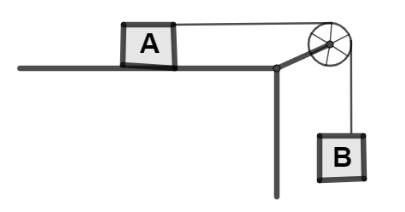
A block A of mass $7\,Kg$ is placed on a frictionless table A thread tied to it passes over a frictionless pulley and carries a body B of mass $3\,Kg$ at the other end. The acceleration of the system is (given $g = 10\,m{s^{ - 2}}$ )
A. $100\,m{s^{ - 2}}$
B. $3\,m{s^{ - 2}}$
C. $10\,m{s^{ - 2}}$
D. $30\,m{s^{ - 2}}$
Answer
 Verified
521.7k+ views
Hint: In order to solve this question, first we will name the various force acting on both the blocks when system is released to move, and then by balancing all the forces acting on each block we will find the magnitude of acceleration of the system and remember since both blocks are attached to a string then both block A and B will have same acceleration which will be the acceleration of the system.
Complete step by step answer:
Let a be the acceleration of the system and T be the tension force acting on the sting and block B will start to move in downward direction whereas block A will start to move in forward direction and these various forces are shown as in the diagram. Since tension is the force acting on the string ${m_B}g,{m_B}a$ are the forces on block B whereas ${m_A}a$ is the force acting on block A.
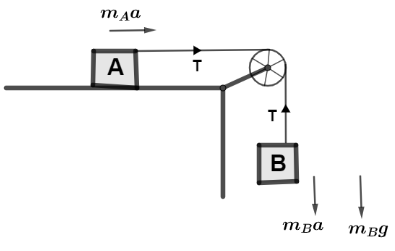
For block A the tension force is the only force which provide forward motion to block A so,
balancing both forces we have, $T = {m_A}a \to (i)$Now, for block B , from diagram we can see that, weight and motion force ${m_B}g,{m_B}a$ are acting in downward direction balanced by tension T acting on string which can be written as
${m_B}a = {m_B}g - T \to (ii)$
From equation(i) put the value of $T = {m_A}a$ we get,
$\Rightarrow ({m_B} + {m_A})a = {m_B}g$
now, as we have
${m_B} = 3Kg$
$\Rightarrow {m_A} = 7Kg$
$\Rightarrow g = 10\,m{s^{ - 2}}$
putting the values in equation $({m_B} + {m_A})a = {m_B}g$ we get,
$(10)a = 3(10)$
$\therefore a = 3\,m{s^{ - 2}}$
Hence, the correct option is B.
Note:It should be remembered that, the surface between table and block A is frictionless and pulley is also frictionless that’s why there is no frictional force acting in whole system and force is a vector quantity so to solve such problems, always draw the various forces acting on the body with their directions and then solve for the required parameters.
Complete step by step answer:
Let a be the acceleration of the system and T be the tension force acting on the sting and block B will start to move in downward direction whereas block A will start to move in forward direction and these various forces are shown as in the diagram. Since tension is the force acting on the string ${m_B}g,{m_B}a$ are the forces on block B whereas ${m_A}a$ is the force acting on block A.
For block A the tension force is the only force which provide forward motion to block A so,
balancing both forces we have, $T = {m_A}a \to (i)$Now, for block B , from diagram we can see that, weight and motion force ${m_B}g,{m_B}a$ are acting in downward direction balanced by tension T acting on string which can be written as
${m_B}a = {m_B}g - T \to (ii)$
From equation(i) put the value of $T = {m_A}a$ we get,
$\Rightarrow ({m_B} + {m_A})a = {m_B}g$
now, as we have
${m_B} = 3Kg$
$\Rightarrow {m_A} = 7Kg$
$\Rightarrow g = 10\,m{s^{ - 2}}$
putting the values in equation $({m_B} + {m_A})a = {m_B}g$ we get,
$(10)a = 3(10)$
$\therefore a = 3\,m{s^{ - 2}}$
Hence, the correct option is B.
Note:It should be remembered that, the surface between table and block A is frictionless and pulley is also frictionless that’s why there is no frictional force acting in whole system and force is a vector quantity so to solve such problems, always draw the various forces acting on the body with their directions and then solve for the required parameters.
Recently Updated Pages
Master Class 11 Social Science: Engaging Questions & Answers for Success

Master Class 11 English: Engaging Questions & Answers for Success
Master Class 11 Maths: Engaging Questions & Answers for Success
Master Class 11 Chemistry: Engaging Questions & Answers for Success
Master Class 11 Biology: Engaging Questions & Answers for Success
Master Class 11 Physics: Engaging Questions & Answers for Success
Trending doubts
Differentiate between an exothermic and an endothermic class 11 chemistry CBSE
One Metric ton is equal to kg A 10000 B 1000 C 100 class 11 physics CBSE
Difference Between Prokaryotic Cells and Eukaryotic Cells
There are 720 permutations of the digits 1 2 3 4 5 class 11 maths CBSE
Two of the body parts which do not appear in MRI are class 11 biology CBSE
Which gas is abundant in air class 11 chemistry CBSE