




A block ‘a’ of mass 2kg rests on another block ‘b’ of mass 8kg which rests on a horizontal floor. The coefficient of friction between a and b is 0.2 and that of between b and the floor is 0.5. When a horizontal force of 25N is applied on block b, the force of friction between a and b is:
A. 0 N
B. 6 N
C. 7 N
D. 8 N
Answer
 Verified
595.2k+ views
Hint: Limiting friction is the maximum value of friction or the minimum value of external force that is needed to move a body or just to start motion. If anyway external force is less than the value of limiting friction, the body won’t move. That means it’ll still be in equilibrium until force more than limiting friction value is applied. Equilibrium means net force will be zero and hence frictional force will be equal and opposite to the external force until the body starts moving.
Formula used:
Frictional force ($f$) = External force applied ($F_{ext}$) [ if $F_{ext}$< limiting friction ]
Limiting friction = $N \times \mu$ [where $N$ is normal and $\mu$ is coefficient of friction]
Complete step-by-step answer:
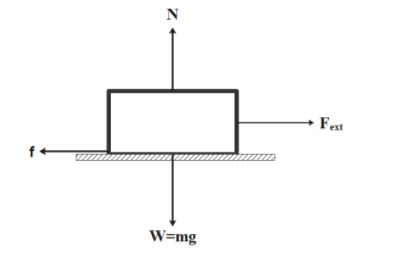
First of all calculate the value of friction for the system (System means both blocks combined) because the upper block will move only when the lower block starts moving. The value of the Normal reaction for the lower block will be the sum of weights of both the blocks. Hence limiting value of friction will be:
$f_{lim}= \mu \times (8g+2g)$ [ where g is the acceleration due to gravity ]
$f_{lim} = 0.5 \times 10g$
Taking $g=10ms^{-2}$
$f_{lim}=50N$
But, $F_{ext}=25N$
Hence $F_{ext}\ < \ f_{lim}$
So, the Frictional force acting between block b and the floor is 25N. But we’re asked about the frictional force between block a and b, so as the block b isn’t moving hence block a is also not moving. It implies that block a is also in equilibrium and since there’s no external force acting onto block a, hence force of friction between block a and b will also be 0 N.
So, the correct answer is “Option A”.
Note: To avoid the mistake in the questions involving friction, the student should always go first for limiting friction value to know that even if there's motion or not. However, if an external force is greater than the limiting friction value then it’s always beneficial to draw a free body diagram (FBD) and then apply equilibrium equations.
Formula used:
Frictional force ($f$) = External force applied ($F_{ext}$) [ if $F_{ext}$< limiting friction ]
Limiting friction = $N \times \mu$ [where $N$ is normal and $\mu$ is coefficient of friction]
Complete step-by-step answer:
First of all calculate the value of friction for the system (System means both blocks combined) because the upper block will move only when the lower block starts moving. The value of the Normal reaction for the lower block will be the sum of weights of both the blocks. Hence limiting value of friction will be:
$f_{lim}= \mu \times (8g+2g)$ [ where g is the acceleration due to gravity ]
$f_{lim} = 0.5 \times 10g$
Taking $g=10ms^{-2}$
$f_{lim}=50N$
But, $F_{ext}=25N$
Hence $F_{ext}\ < \ f_{lim}$
So, the Frictional force acting between block b and the floor is 25N. But we’re asked about the frictional force between block a and b, so as the block b isn’t moving hence block a is also not moving. It implies that block a is also in equilibrium and since there’s no external force acting onto block a, hence force of friction between block a and b will also be 0 N.
So, the correct answer is “Option A”.
Note: To avoid the mistake in the questions involving friction, the student should always go first for limiting friction value to know that even if there's motion or not. However, if an external force is greater than the limiting friction value then it’s always beneficial to draw a free body diagram (FBD) and then apply equilibrium equations.
Recently Updated Pages
Master Class 11 Computer Science: Engaging Questions & Answers for Success

Master Class 11 Business Studies: Engaging Questions & Answers for Success
Master Class 11 Economics: Engaging Questions & Answers for Success
Master Class 11 English: Engaging Questions & Answers for Success
Master Class 11 Maths: Engaging Questions & Answers for Success
Master Class 11 Biology: Engaging Questions & Answers for Success
Trending doubts
One Metric ton is equal to kg A 10000 B 1000 C 100 class 11 physics CBSE
There are 720 permutations of the digits 1 2 3 4 5 class 11 maths CBSE
Discuss the various forms of bacteria class 11 biology CBSE
Draw a diagram of a plant cell and label at least eight class 11 biology CBSE
State the laws of reflection of light
Explain zero factorial class 11 maths CBSE