




A bird is flying at a height of 3.6m above the surface of water and a fish is in the water at a depth of 1.2m. The apparent height of the bird to the fish is (\[{\mu _{water}} = \dfrac{4}{3}\])
A. 3.9 m
B. 4.8 m
C. 5.2 m
D. 6.0 m
Answer
 Verified
587.1k+ views
Hint:When the light ray travels from a rare medium to a denser medium, the path of light bends towards the normal. Due to the bending, the height of the bird will appear raised than the real height. The refractive index of the medium is the ratio of the apparent height to the real height.
Formula used:
\[\mu = \dfrac{{{h_A}}}{{{h_O}}}\]
Here, \[\mu \] is the refractive index of the medium, \[{h_A}\] is the apparent height of the object and \[{h_O}\] is the original height.
Complete step by step answer:
We know that when the light ray travels from a rare medium to a denser medium, the path of light bends towards the normal. The bending of light in the medium depends on the refractive index of the medium. Due to the bending of the light, the depth of the bottom surface of water appears changed. When the light ray from the bird travels from air to water it bends towards the normal and thus, the height of the bird appears raised to the fish. The following figure will ease our understanding.
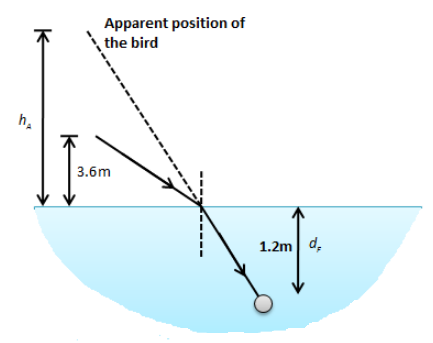
We can express the apparent height of the bird from the surface of water as,
\[\mu = \dfrac{{{h_A}}}{{{h_O}}}\]
Here, \[\mu \] is the refractive index of the water, \[{h_A}\] is the apparent height of the bird and \[{h_O}\] is the original height.
Substituting \[\mu = \dfrac{4}{3}\] and \[{h_O} = 3.6\,{\text{m}}\] in the above equation, we get,
\[\dfrac{4}{3} = \dfrac{{{h_A}}}{{3.6}}\]
\[ \Rightarrow {h_A} = 4.8\,{\text{m}}\]
This is the apparent height of the fish above the surface of the water. Therefore, the apparent height of the bird from the fish will be,
\[\therefore h = 4.8 + 1.2 = 6\,{\text{m}}\]
Thus, the apparent height of the bird to the fish is 6 m.
So, the correct answer is option D.
Note:If it is for the bird, the depth of the fish would appear different for the bird than the real depth due to the different refractive index of the water. While drawing the ray diagram, if the observer is the fish, the incident ray should be the light ray reflected from the bird towards the eye of the fish. Therefore, the incident ray travels from air to water. The opposite will be for the bird as an observer.
Formula used:
\[\mu = \dfrac{{{h_A}}}{{{h_O}}}\]
Here, \[\mu \] is the refractive index of the medium, \[{h_A}\] is the apparent height of the object and \[{h_O}\] is the original height.
Complete step by step answer:
We know that when the light ray travels from a rare medium to a denser medium, the path of light bends towards the normal. The bending of light in the medium depends on the refractive index of the medium. Due to the bending of the light, the depth of the bottom surface of water appears changed. When the light ray from the bird travels from air to water it bends towards the normal and thus, the height of the bird appears raised to the fish. The following figure will ease our understanding.
We can express the apparent height of the bird from the surface of water as,
\[\mu = \dfrac{{{h_A}}}{{{h_O}}}\]
Here, \[\mu \] is the refractive index of the water, \[{h_A}\] is the apparent height of the bird and \[{h_O}\] is the original height.
Substituting \[\mu = \dfrac{4}{3}\] and \[{h_O} = 3.6\,{\text{m}}\] in the above equation, we get,
\[\dfrac{4}{3} = \dfrac{{{h_A}}}{{3.6}}\]
\[ \Rightarrow {h_A} = 4.8\,{\text{m}}\]
This is the apparent height of the fish above the surface of the water. Therefore, the apparent height of the bird from the fish will be,
\[\therefore h = 4.8 + 1.2 = 6\,{\text{m}}\]
Thus, the apparent height of the bird to the fish is 6 m.
So, the correct answer is option D.
Note:If it is for the bird, the depth of the fish would appear different for the bird than the real depth due to the different refractive index of the water. While drawing the ray diagram, if the observer is the fish, the incident ray should be the light ray reflected from the bird towards the eye of the fish. Therefore, the incident ray travels from air to water. The opposite will be for the bird as an observer.
Recently Updated Pages
Master Class 12 Business Studies: Engaging Questions & Answers for Success

Master Class 12 Chemistry: Engaging Questions & Answers for Success
Master Class 12 Biology: Engaging Questions & Answers for Success
Class 12 Question and Answer - Your Ultimate Solutions Guide
Master Class 11 Social Science: Engaging Questions & Answers for Success
Master Class 11 Chemistry: Engaging Questions & Answers for Success
Trending doubts
Which are the Top 10 Largest Countries of the World?
Draw a labelled sketch of the human eye class 12 physics CBSE
Name the crygenes that control cotton bollworm and class 12 biology CBSE
Differentiate between homogeneous and heterogeneous class 12 chemistry CBSE
In a transcription unit the promoter is said to be class 12 biology CBSE
Sulphuric acid is known as the king of acids State class 12 chemistry CBSE