




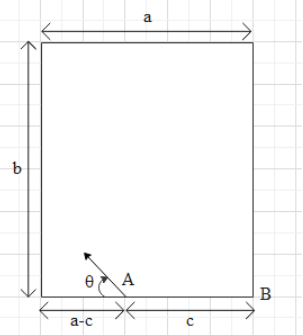
A billiard table whose length and width are as shown in the figure. A ball is placed at point A. At what angle $\theta $ the ball be projected so that after colliding with two walls, the ball will fall in the pocket B. Assume that all collisions are perfectly elastic (neglect friction).
$\text{A}\text{. }\theta ={{\cot }^{-1}}\left( \dfrac{2a-c}{2b} \right)$
$\text{B}\text{. }\theta ={{\tan }^{-1}}\left( \dfrac{2a-c}{2b} \right)$
$\text{C}\text{. }\theta ={{\cot }^{-1}}\left( \dfrac{c-a}{2b} \right)$
$\text{D}\text{. }\theta ={{\cot }^{-1}}\left( \dfrac{c-a}{b} \right)$
Answer
 Verified
602.1k+ views
Hint: When a particle collides elastically with a fixed surface making an angle $\theta $ with the normal to the surface, the angle with the normal after collision is $\theta $. Use this theory to solve the given question.
$\tan \theta =\dfrac{\text{opposite side}}{\text{adjacent side}}$
Complete answer:
Let us first understand what happens when a particle hits a rigid surface and there is a perfectly elastic collision.
Suppose a ball hits a fixed surface with a velocity u making an angle $\theta $ with the normal to the surface and a perfectly elastic collision takes place between the two. In this case, after the collision the ball will bounce back with the same velocity before the collision (i.e. u), making an angle $\theta $ with the normal to the surface.
Now when apply the same concept to the given situation, we the path of the ball will be as shown below:
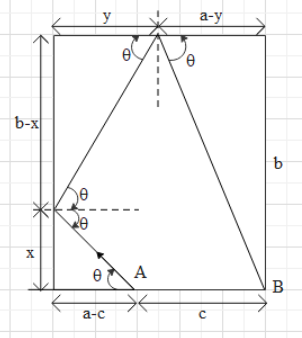
From $\Delta AGC$, we get that $\tan \theta =\dfrac{x}{a-c}$.
$\Rightarrow x=(a-c)\tan \theta $ ….. (i).
In $\Delta CED$, we get that $\tan \theta =\dfrac{b-x}{y}$ …. (ii).
Substitute the value of x from (i) in (ii).
$\Rightarrow \tan \theta =\dfrac{b-\left( (a-c)\tan \theta \right)}{y}$
$\Rightarrow y=\dfrac{b-\left( (a-c)\tan \theta \right)}{\tan \theta }$
$\Rightarrow y=\dfrac{b}{\tan \theta }-\dfrac{(a-c)\tan \theta }{\tan \theta }$
$\Rightarrow y=b\cot \theta -(a-c)$ …. (iii).
In $\Delta DFB$, we get that $\tan \theta =\dfrac{b}{a-y}$
Substitute the value of y from (iii).
$\Rightarrow \tan \theta =\dfrac{b}{a-\left( b\cot \theta -(a-c) \right)}$
$\Rightarrow \tan \theta =\dfrac{b}{a-\left( b\cot \theta -a+c \right)}$
$\Rightarrow \tan \theta =\dfrac{b}{a-b\cot \theta +a-c}$
$\Rightarrow \tan \theta =\dfrac{b}{2a-c-b\cot \theta }$
$\Rightarrow \cot \theta =\dfrac{2a-c-b\cot \theta }{b}$
$\Rightarrow \cot \theta =\dfrac{2a-c}{b}-\dfrac{b\cot \theta }{b}$
$\Rightarrow \cot \theta =\dfrac{2a-c}{b}-\cot \theta $
$\Rightarrow 2\cot \theta =\dfrac{2a-c}{b}$
$\Rightarrow \cot \theta =\dfrac{2a-c}{2b}$
$\Rightarrow \theta ={{\cot }^{-1}}\left( \dfrac{2a-c}{2b} \right)$
Hence, the correct option is A.
Note:
One of the mistakes that a student may perform while solving this question is that he or she may pre assume that the first collision of the ball with the edge of table will be at the midpoint of the edge and the value of x will be equal to b/2.
$\tan \theta =\dfrac{\text{opposite side}}{\text{adjacent side}}$
Complete answer:
Let us first understand what happens when a particle hits a rigid surface and there is a perfectly elastic collision.
Suppose a ball hits a fixed surface with a velocity u making an angle $\theta $ with the normal to the surface and a perfectly elastic collision takes place between the two. In this case, after the collision the ball will bounce back with the same velocity before the collision (i.e. u), making an angle $\theta $ with the normal to the surface.
Now when apply the same concept to the given situation, we the path of the ball will be as shown below:
From $\Delta AGC$, we get that $\tan \theta =\dfrac{x}{a-c}$.
$\Rightarrow x=(a-c)\tan \theta $ ….. (i).
In $\Delta CED$, we get that $\tan \theta =\dfrac{b-x}{y}$ …. (ii).
Substitute the value of x from (i) in (ii).
$\Rightarrow \tan \theta =\dfrac{b-\left( (a-c)\tan \theta \right)}{y}$
$\Rightarrow y=\dfrac{b-\left( (a-c)\tan \theta \right)}{\tan \theta }$
$\Rightarrow y=\dfrac{b}{\tan \theta }-\dfrac{(a-c)\tan \theta }{\tan \theta }$
$\Rightarrow y=b\cot \theta -(a-c)$ …. (iii).
In $\Delta DFB$, we get that $\tan \theta =\dfrac{b}{a-y}$
Substitute the value of y from (iii).
$\Rightarrow \tan \theta =\dfrac{b}{a-\left( b\cot \theta -(a-c) \right)}$
$\Rightarrow \tan \theta =\dfrac{b}{a-\left( b\cot \theta -a+c \right)}$
$\Rightarrow \tan \theta =\dfrac{b}{a-b\cot \theta +a-c}$
$\Rightarrow \tan \theta =\dfrac{b}{2a-c-b\cot \theta }$
$\Rightarrow \cot \theta =\dfrac{2a-c-b\cot \theta }{b}$
$\Rightarrow \cot \theta =\dfrac{2a-c}{b}-\dfrac{b\cot \theta }{b}$
$\Rightarrow \cot \theta =\dfrac{2a-c}{b}-\cot \theta $
$\Rightarrow 2\cot \theta =\dfrac{2a-c}{b}$
$\Rightarrow \cot \theta =\dfrac{2a-c}{2b}$
$\Rightarrow \theta ={{\cot }^{-1}}\left( \dfrac{2a-c}{2b} \right)$
Hence, the correct option is A.
Note:
One of the mistakes that a student may perform while solving this question is that he or she may pre assume that the first collision of the ball with the edge of table will be at the midpoint of the edge and the value of x will be equal to b/2.
Recently Updated Pages
Three beakers labelled as A B and C each containing 25 mL of water were taken A small amount of NaOH anhydrous CuSO4 and NaCl were added to the beakers A B and C respectively It was observed that there was an increase in the temperature of the solutions contained in beakers A and B whereas in case of beaker C the temperature of the solution falls Which one of the following statements isarecorrect i In beakers A and B exothermic process has occurred ii In beakers A and B endothermic process has occurred iii In beaker C exothermic process has occurred iv In beaker C endothermic process has occurred

Master Class 11 Social Science: Engaging Questions & Answers for Success
Master Class 11 Physics: Engaging Questions & Answers for Success
Master Class 11 Maths: Engaging Questions & Answers for Success
Master Class 11 Economics: Engaging Questions & Answers for Success
Master Class 11 Computer Science: Engaging Questions & Answers for Success
Three beakers labelled as A B and C each containing 25 mL of water were taken A small amount of NaOH anhydrous CuSO4 and NaCl were added to the beakers A B and C respectively It was observed that there was an increase in the temperature of the solutions contained in beakers A and B whereas in case of beaker C the temperature of the solution falls Which one of the following statements isarecorrect i In beakers A and B exothermic process has occurred ii In beakers A and B endothermic process has occurred iii In beaker C exothermic process has occurred iv In beaker C endothermic process has occurred
Master Class 11 Social Science: Engaging Questions & Answers for Success
Master Class 11 Physics: Engaging Questions & Answers for Success
Trending doubts
One Metric ton is equal to kg A 10000 B 1000 C 100 class 11 physics CBSE
There are 720 permutations of the digits 1 2 3 4 5 class 11 maths CBSE
State and prove Bernoullis theorem class 11 physics CBSE
Draw a diagram of a plant cell and label at least eight class 11 biology CBSE
Difference Between Prokaryotic Cells and Eukaryotic Cells
1 Quintal is equal to a 110 kg b 10 kg c 100kg d 1000 class 11 physics CBSE