




A billiard ball of mass m and radius r, when hit in a horizontal direction by a cue at height h above its center, acquired a linear velocity${v_ \circ }$. The angular velocity${\omega _ \circ }$acquired by the ball is:
A. $\dfrac{{5{v_ \circ }{r^2}}}{{2h}}$
B. $\dfrac{{2{v_ \circ }{r^2}}}{{5h}}$
C. $\dfrac{{2{v_ \circ }h}}{{5{r^2}}}$
D. $\dfrac{{5{v_ \circ }h}}{{2{r^2}}}$
E. $\dfrac{{5{v_ \circ }{h^2}}}{{2{r^2}}}$
Answer
 Verified
648.9k+ views
Hint: When a force acts on a body such that it gives it a rotational effect to the system then that acting force is known as torque. First, find torque that acts on the ball and equate it to height times the force that acts on it as well. Substitute the value of torque in terms of the moment of inertia and solve to obtain the required result.
Formula Used:
Torque,$\tau = I\alpha $
Moment of inertia of a spherical ball, $I = \dfrac{2}{5}m{r^2}$
Angular acceleration, $\alpha = \dfrac{{{\omega _ \circ }}}{t}$
Complete step-by-step answer:
Consider the following system of a spherical billiard ball of mass m and radius r, being hit by a force horizontal distance h above its center, as shown below:
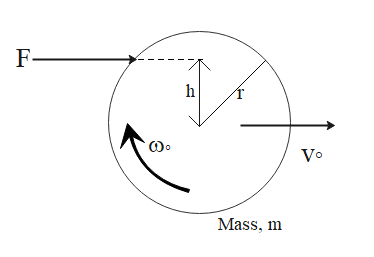
Clearly, the external force acting on the billiard ball results in Torque acting on the ball, this in turn makes the ball perform a rotating motion.
So the acting Torque on the ball can be given by:
$\eqalign{
& \tau = I\alpha \cdots \cdots \cdots \left( 1 \right) \cr
& {\text{where }}\tau {\text{ is the Torque,}} \cr
& I{\text{ is the moment of inertia of the ball,}} \cr
& \alpha {\text{ is the angular acceleration of the ball}}{\text{.}} \cr} $
But the Torque acting on the ball must also be equal to the product of the external acting force, f and the perpendicular distance between the line of action of force from the axis of rotation.
$ \Rightarrow \tau = F \times h \cdots \cdots \cdots \left( 2 \right)$
Equating equation (1) and (2), we get:
$\eqalign{
& F \times h = I\alpha \cr
& \Rightarrow Fh\sin {90^ \circ } = I\alpha \cr
& \Rightarrow Fh = I\alpha \cr
& \Rightarrow Fh = I\dfrac{{{\omega _ \circ }}}{t}{\text{ }}\left[ {\because \alpha = \dfrac{{{\omega _ \circ }}}{t}} \right] \cr} $
But we know that the Moment of inertia of a spherical ball, $I = \dfrac{2}{5}m{r^2}$
$ \Rightarrow Fh = \dfrac{2}{5}m{r^2}\dfrac{{{\omega _ \circ }}}{t}$
Also the applied force is equal to the product of mass and acceleration by Newton’s second law, so we get:
$\eqalign{
& mah = \dfrac{2}{5}m{r^2}\dfrac{{{\omega _ \circ }}}{t} \cr
& \Rightarrow m\dfrac{{{v_ \circ }}}{t}h = \dfrac{2}{5}m{r^2}\dfrac{{{\omega _ \circ }}}{t} \cr
& \Rightarrow {v_ \circ }h = \dfrac{2}{5}{r^2}{\omega _ \circ } \cr
& \therefore {\omega _ \circ } = \dfrac{{5{v_ \circ }h}}{{2{r^2}}} \cr} $
Therefore, the correct option is D. i.e., $\dfrac{{5{v_ \circ }{h^2}}}{{2{r^2}}}$.
Note: The moment of inertia can be calculated for any object as the product of the mass of the object and its radius of gyration. The radius of gyration is nothing but a point having a radial distance in the system such that if the entire mass of the object is concentrated at that point it will have the exact same moment of inertia as the entire object.
Formula Used:
Torque,$\tau = I\alpha $
Moment of inertia of a spherical ball, $I = \dfrac{2}{5}m{r^2}$
Angular acceleration, $\alpha = \dfrac{{{\omega _ \circ }}}{t}$
Complete step-by-step answer:
Consider the following system of a spherical billiard ball of mass m and radius r, being hit by a force horizontal distance h above its center, as shown below:
Clearly, the external force acting on the billiard ball results in Torque acting on the ball, this in turn makes the ball perform a rotating motion.
So the acting Torque on the ball can be given by:
$\eqalign{
& \tau = I\alpha \cdots \cdots \cdots \left( 1 \right) \cr
& {\text{where }}\tau {\text{ is the Torque,}} \cr
& I{\text{ is the moment of inertia of the ball,}} \cr
& \alpha {\text{ is the angular acceleration of the ball}}{\text{.}} \cr} $
But the Torque acting on the ball must also be equal to the product of the external acting force, f and the perpendicular distance between the line of action of force from the axis of rotation.
$ \Rightarrow \tau = F \times h \cdots \cdots \cdots \left( 2 \right)$
Equating equation (1) and (2), we get:
$\eqalign{
& F \times h = I\alpha \cr
& \Rightarrow Fh\sin {90^ \circ } = I\alpha \cr
& \Rightarrow Fh = I\alpha \cr
& \Rightarrow Fh = I\dfrac{{{\omega _ \circ }}}{t}{\text{ }}\left[ {\because \alpha = \dfrac{{{\omega _ \circ }}}{t}} \right] \cr} $
But we know that the Moment of inertia of a spherical ball, $I = \dfrac{2}{5}m{r^2}$
$ \Rightarrow Fh = \dfrac{2}{5}m{r^2}\dfrac{{{\omega _ \circ }}}{t}$
Also the applied force is equal to the product of mass and acceleration by Newton’s second law, so we get:
$\eqalign{
& mah = \dfrac{2}{5}m{r^2}\dfrac{{{\omega _ \circ }}}{t} \cr
& \Rightarrow m\dfrac{{{v_ \circ }}}{t}h = \dfrac{2}{5}m{r^2}\dfrac{{{\omega _ \circ }}}{t} \cr
& \Rightarrow {v_ \circ }h = \dfrac{2}{5}{r^2}{\omega _ \circ } \cr
& \therefore {\omega _ \circ } = \dfrac{{5{v_ \circ }h}}{{2{r^2}}} \cr} $
Therefore, the correct option is D. i.e., $\dfrac{{5{v_ \circ }{h^2}}}{{2{r^2}}}$.
Note: The moment of inertia can be calculated for any object as the product of the mass of the object and its radius of gyration. The radius of gyration is nothing but a point having a radial distance in the system such that if the entire mass of the object is concentrated at that point it will have the exact same moment of inertia as the entire object.
Recently Updated Pages
Master Class 11 English: Engaging Questions & Answers for Success

Master Class 11 Physics: Engaging Questions & Answers for Success
Master Class 11 Computer Science: Engaging Questions & Answers for Success
Master Class 11 Chemistry: Engaging Questions & Answers for Success
Master Class 11 Social Science: Engaging Questions & Answers for Success
Master Class 11 Accountancy: Engaging Questions & Answers for Success
Trending doubts
Difference Between Prokaryotic Cells and Eukaryotic Cells
Two of the body parts which do not appear in MRI are class 11 biology CBSE
One Metric ton is equal to kg A 10000 B 1000 C 100 class 11 physics CBSE
10 examples of friction in our daily life
Draw a diagram of nephron and explain its structur class 11 biology CBSE
Draw a diagram of a plant cell and label at least eight class 11 biology CBSE