




A bead of mass \[m\] can slide on a thin vertical rod, with sliding friction coefficient $\mu = 0.4$. The rod is translated horizontally with a constant acceleration $a$. For what value of $a$ will an observer on earth see equal horizontal and vertical components of the acceleration of the bead?
Answer
 Verified
557.4k+ views
Hint: This question is based on the concept of sliding friction. So, in this question first we need to find the value of the horizontal and the vertical component of force and with the help of it, we need to find the horizontal and the vertical component of acceleration. Then we will equate the two components, as they are given equal in the question.
Complete step by step answer:
The diagram of this question is,
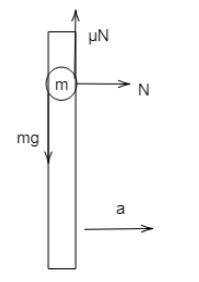
Given, the bead is sliding vertically down with friction which will oppose it.The following are the forces acting on the bead:
(A) The normal force $N$ exerted on it by the rod in the horizontal direction.
(B) The force of sliding friction $\mu N$ which acts vertically upward.
(C) Its weight $mg$ in the vertically downward direction.
Net force in the vertical direction ${F_V} = Mg - \mu N$.
Net force in the horizontal direction ${F_H} = Ma$.
The normal force is $N = ma$, as the normal force is acting in the horizontal direction.Now, we need the value of $a$ for which the observer on earth can see equal horizontal and vertical components of the acceleration of the bead. So, horizontal component of acceleration $ = $ vertical component of acceleration
$\dfrac{{Mg - \mu N}}{M} = \dfrac{{Ma}}{M}$
On putting $N = ma$,
$\dfrac{{Mg - \mu Ma}}{M} = \dfrac{{Ma}}{M}$
$\Rightarrow Mg - \mu Ma = Ma$
On cancelling $M$ on both the sides,
$g - \mu a = a$
$\Rightarrow a + \mu a = g$
On taking $a$ as common on LHS,
$a(1 + \mu ) = g$
$\Rightarrow a = \dfrac{g}{{1 + \mu }}$
We know that $g = 9.8\dfrac{m}{{{s^2}}}$ and $\mu = 0.4$(given),
$a = \dfrac{{9.8}}{{1 + 0.4}}$
$\Rightarrow a = \dfrac{{9.8}}{{1.4}}$
$\therefore a = 7\,{m}{s^2}$
Hence, the value of $a$ for which an observer on earth can see equal horizontal and vertical components of the acceleration of the bead is $a = 7\,{m}{s^2}$.
Note: Normal force is contact force. Normal force is also known as a normal reaction force. This force acts only when an object is in contact with another object. But if there is no contact between two objects then the normal force does not act. The SI unit of normal force is Newton.
Complete step by step answer:
The diagram of this question is,
Given, the bead is sliding vertically down with friction which will oppose it.The following are the forces acting on the bead:
(A) The normal force $N$ exerted on it by the rod in the horizontal direction.
(B) The force of sliding friction $\mu N$ which acts vertically upward.
(C) Its weight $mg$ in the vertically downward direction.
Net force in the vertical direction ${F_V} = Mg - \mu N$.
Net force in the horizontal direction ${F_H} = Ma$.
The normal force is $N = ma$, as the normal force is acting in the horizontal direction.Now, we need the value of $a$ for which the observer on earth can see equal horizontal and vertical components of the acceleration of the bead. So, horizontal component of acceleration $ = $ vertical component of acceleration
$\dfrac{{Mg - \mu N}}{M} = \dfrac{{Ma}}{M}$
On putting $N = ma$,
$\dfrac{{Mg - \mu Ma}}{M} = \dfrac{{Ma}}{M}$
$\Rightarrow Mg - \mu Ma = Ma$
On cancelling $M$ on both the sides,
$g - \mu a = a$
$\Rightarrow a + \mu a = g$
On taking $a$ as common on LHS,
$a(1 + \mu ) = g$
$\Rightarrow a = \dfrac{g}{{1 + \mu }}$
We know that $g = 9.8\dfrac{m}{{{s^2}}}$ and $\mu = 0.4$(given),
$a = \dfrac{{9.8}}{{1 + 0.4}}$
$\Rightarrow a = \dfrac{{9.8}}{{1.4}}$
$\therefore a = 7\,{m}{s^2}$
Hence, the value of $a$ for which an observer on earth can see equal horizontal and vertical components of the acceleration of the bead is $a = 7\,{m}{s^2}$.
Note: Normal force is contact force. Normal force is also known as a normal reaction force. This force acts only when an object is in contact with another object. But if there is no contact between two objects then the normal force does not act. The SI unit of normal force is Newton.
Recently Updated Pages
If x a + bt + ct2 where x is in meters and t is in class 11 physics CBSE

A car covers the first half distance between two places class 11 physics CBSE
The resultant of two vectors overrightarrow P and overrightarrow class 11 physics CBSE
Find the value of cos 135 class 11 maths CBSE
A mass M is held in place by an applied force F and class 11 physics CBSE
A solution of glucose in water is labelled as 10 dfracwv class 11 chemistry CBSE
Trending doubts
Find the value of the expression given below sin 30circ class 11 maths CBSE
One Metric ton is equal to kg A 10000 B 1000 C 100 class 11 physics CBSE
Draw a diagram of nephron and explain its structur class 11 biology CBSE
10 examples of friction in our daily life
Proton was discovered by A Thomson B Rutherford C Chadwick class 11 chemistry CBSE
Bond order ofO2 O2+ O2 and O22 is in order A O2 langle class 11 chemistry CBSE