




a balloon with mass ‘\[m\]’ is descending down with an acceleration ‘\[a\]’ (where \[a < g\]). How much mass should be removed from it so that it starts moving up with an acceleration ‘\[a\]’?
A. \[\dfrac{{2ma}}{{g + a}}\]
B. \[\dfrac{{2ma}}{{g - a}}\]
C. \[\dfrac{{ma}}{{g + a}}\]
D. \[\dfrac{{ma}}{{g - a}}\]
Answer
 Verified
629.7k+ views
Hint: Use Newton’s second law of motion. Apply Newton’s second law of motion to the balloon in the vertical direction by considering a force F resultant of all the forces like air resistance, thrust, etc acting on the balloon in both situations when the balloon is coming downward and going upward.
Formula used:
The expression for Newton’s second law of motion is
\[{F_{net}} = ma\] …… (1)
Here, \[{F_{net}}\] is the net force on the object, \[m\] is the mass of the object and \[a\] is the acceleration of the object.
Complete step by step answer:
The mass of the balloon is \[m\].
The balloon is coming down with an acceleration of \[a\]. A force \[F\] also acts on the balloon in the upward direction. But since the balloon is moving in a downward direction, the force \[F\] is less than the weight of the balloon \[mg\].
Apply Newton’s second law of motion to the balloon in the vertical direction.
\[mg - F = ma\] …… (2)
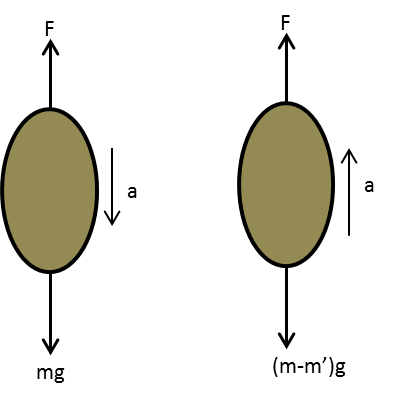
Suppose the mass \[m'\] is removed from the balloon. Hence, the weight of the balloon becomes \[\left( {m - m'} \right)g\].
The mass \[m'\] is removed from the balloon such that the force \[F\] becomes more than the weight \[\left( {m - m'} \right)g\] of the balloon and the balloon stars moving upward with an acceleration \[a\].
Apply Newton’s second law of motion to the balloon moving upward in vertical direction.
\[F - \left( {m - m'} \right)g = \left( {m - m'} \right)a\] …… (3)
Add equations (2) and (3) and solve it for \[m'\].
\[mg - F + F - \left( {m - m'} \right)g = ma + \left( {m - m'} \right)a\]
\[ \Rightarrow mg - mg + m'g = ma + ma - m'a\]
\[ \Rightarrow m'g = 2ma - m'a\]
\[ \Rightarrow m'g + m'a = 2ma\]
\[ \Rightarrow m'\left( {g + a} \right) = 2ma\]
\[ \therefore m' = \dfrac{{2ma}}{{g + a}}\]
Therefore, the mass that should be removed from the balloon is \[\dfrac{{2ma}}{{g + a}}\].
So, the correct answer is “Option A”.
Note:
The force F acting on the balloon when the balloon is going upward and coming downward is considered as resultant of the all forces like air resistance, thrust, etc acting on the balloon.
If the balloon is moving in a downward direction, the force \[F\] is less than the weight of the balloon \[mg\].
Formula used:
The expression for Newton’s second law of motion is
\[{F_{net}} = ma\] …… (1)
Here, \[{F_{net}}\] is the net force on the object, \[m\] is the mass of the object and \[a\] is the acceleration of the object.
Complete step by step answer:
The mass of the balloon is \[m\].
The balloon is coming down with an acceleration of \[a\]. A force \[F\] also acts on the balloon in the upward direction. But since the balloon is moving in a downward direction, the force \[F\] is less than the weight of the balloon \[mg\].
Apply Newton’s second law of motion to the balloon in the vertical direction.
\[mg - F = ma\] …… (2)
Suppose the mass \[m'\] is removed from the balloon. Hence, the weight of the balloon becomes \[\left( {m - m'} \right)g\].
The mass \[m'\] is removed from the balloon such that the force \[F\] becomes more than the weight \[\left( {m - m'} \right)g\] of the balloon and the balloon stars moving upward with an acceleration \[a\].
Apply Newton’s second law of motion to the balloon moving upward in vertical direction.
\[F - \left( {m - m'} \right)g = \left( {m - m'} \right)a\] …… (3)
Add equations (2) and (3) and solve it for \[m'\].
\[mg - F + F - \left( {m - m'} \right)g = ma + \left( {m - m'} \right)a\]
\[ \Rightarrow mg - mg + m'g = ma + ma - m'a\]
\[ \Rightarrow m'g = 2ma - m'a\]
\[ \Rightarrow m'g + m'a = 2ma\]
\[ \Rightarrow m'\left( {g + a} \right) = 2ma\]
\[ \therefore m' = \dfrac{{2ma}}{{g + a}}\]
Therefore, the mass that should be removed from the balloon is \[\dfrac{{2ma}}{{g + a}}\].
So, the correct answer is “Option A”.
Note:
The force F acting on the balloon when the balloon is going upward and coming downward is considered as resultant of the all forces like air resistance, thrust, etc acting on the balloon.
If the balloon is moving in a downward direction, the force \[F\] is less than the weight of the balloon \[mg\].
Recently Updated Pages
Master Class 11 English: Engaging Questions & Answers for Success

Master Class 11 Physics: Engaging Questions & Answers for Success
Master Class 11 Computer Science: Engaging Questions & Answers for Success
Master Class 11 Chemistry: Engaging Questions & Answers for Success
Master Class 11 Social Science: Engaging Questions & Answers for Success
Master Class 11 Accountancy: Engaging Questions & Answers for Success
Trending doubts
Difference Between Prokaryotic Cells and Eukaryotic Cells
Two of the body parts which do not appear in MRI are class 11 biology CBSE
One Metric ton is equal to kg A 10000 B 1000 C 100 class 11 physics CBSE
10 examples of friction in our daily life
Draw a diagram of nephron and explain its structur class 11 biology CBSE
Draw a diagram of a plant cell and label at least eight class 11 biology CBSE