




A ball P moving with a speed of v ms-1 collides with another identical ball Q moving with a speed 10ms-1 in the opposite direction. P comes to rest after the collision. If the coefficient of restitution is 0.6, the value of v is:
A) 30ms-1
B) 40ms-1
C) 50ms-1
D) 60ms-1
Answer
 Verified
591.3k+ views
Hint: This question can be solved by using the concept of conservation of momentum by using proper sign convention.
The coefficient of restitution is the ratio of the final to initial relative velocity between two objects after the collision.
Complete step by step answer:
Two balls P and Q are moving in a direction opposite to each other. Let the velocity of P is v ms-1 and velocity of Q is $10ms^{-1}$. These two balls P and Q are identical balls; they mean both are having the same mass. P will come to rest after the collision. The coefficient of restitution is e=0.6. The coefficient of restitution is the ratio of the final to initial relative velocity between two objects after the collision.
Let us understand by drawing a diagram as follows before collision and after collision.
Before collision:
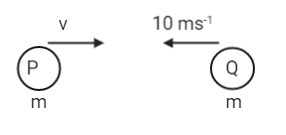
After collision:
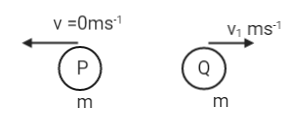
As per law of conservation of momentum, initial momentum equals to final momentum. $P_i=P_f$ –(i)
The initial and final momentum are given by
$P_i=\left(mv\right)_P-\left(mv\right)_Q$ (negative sign is due as both are opposite in direction.
$P_f=\left(mv\right)_P+\left(mv_1\right)_Q $
Now, substitute the same in equation (i)
$\left(mv\right)_P-\left(mv\right)_Q=\left(mv\right)_P+\left(mv_1\right)_Q$ Since P and Q are identical, we cancel the term m on both sides.
$ \left(v\right)_P-\left(v\right)_Q=\left(v\right)_P+\left(v_1\right)_Q$ After substituting the given values in the equation,
v-10=v_1 ------ (ii)
The coefficient of restitution is given by the ratio of the final momentum to initial momentum.
$e=\dfrac{v_1}{v-\left(-10\right)} $
$\implies$ 0.6=\dfrac{v_1}{v+10}
By cross multiplication,
$0.6\left(v+10\right)=v_1 $
$\implies$ 0.6v+6=v_1 ------(iii)
Substituting equation (iii) in (i)
v-10=0.6v+6
$\implies$ v-0.6v=6+10
$\implies$ 0.4v=16
$\therefore$ $v=\dfrac{16}{0.4}=40ms^{-1} $
Hence, option B is the correct answer.
So, the correct answer is “Option B”.
Note:
Coefficient of restitution varies from 0 to 1 where 1 would be a perfectly elastic collision. Actually, for a perfectly inelastic collision coefficient of restitution is zero, which is not possible in general.
The coefficient of restitution is the ratio of the final to initial relative velocity between two objects after the collision.
Complete step by step answer:
Two balls P and Q are moving in a direction opposite to each other. Let the velocity of P is v ms-1 and velocity of Q is $10ms^{-1}$. These two balls P and Q are identical balls; they mean both are having the same mass. P will come to rest after the collision. The coefficient of restitution is e=0.6. The coefficient of restitution is the ratio of the final to initial relative velocity between two objects after the collision.
Let us understand by drawing a diagram as follows before collision and after collision.
Before collision:
After collision:
As per law of conservation of momentum, initial momentum equals to final momentum. $P_i=P_f$ –(i)
The initial and final momentum are given by
$P_i=\left(mv\right)_P-\left(mv\right)_Q$ (negative sign is due as both are opposite in direction.
$P_f=\left(mv\right)_P+\left(mv_1\right)_Q $
Now, substitute the same in equation (i)
$\left(mv\right)_P-\left(mv\right)_Q=\left(mv\right)_P+\left(mv_1\right)_Q$ Since P and Q are identical, we cancel the term m on both sides.
$ \left(v\right)_P-\left(v\right)_Q=\left(v\right)_P+\left(v_1\right)_Q$ After substituting the given values in the equation,
v-10=v_1 ------ (ii)
The coefficient of restitution is given by the ratio of the final momentum to initial momentum.
$e=\dfrac{v_1}{v-\left(-10\right)} $
$\implies$ 0.6=\dfrac{v_1}{v+10}
By cross multiplication,
$0.6\left(v+10\right)=v_1 $
$\implies$ 0.6v+6=v_1 ------(iii)
Substituting equation (iii) in (i)
v-10=0.6v+6
$\implies$ v-0.6v=6+10
$\implies$ 0.4v=16
$\therefore$ $v=\dfrac{16}{0.4}=40ms^{-1} $
Hence, option B is the correct answer.
So, the correct answer is “Option B”.
Note:
Coefficient of restitution varies from 0 to 1 where 1 would be a perfectly elastic collision. Actually, for a perfectly inelastic collision coefficient of restitution is zero, which is not possible in general.
Recently Updated Pages
Basicity of sulphurous acid and sulphuric acid are

Master Class 11 Business Studies: Engaging Questions & Answers for Success
Master Class 11 Computer Science: Engaging Questions & Answers for Success
Master Class 11 Economics: Engaging Questions & Answers for Success
Master Class 11 Social Science: Engaging Questions & Answers for Success
Master Class 11 English: Engaging Questions & Answers for Success
Trending doubts
One Metric ton is equal to kg A 10000 B 1000 C 100 class 11 physics CBSE
What are the examples of C3 and C4 plants class 11 biology CBSE
State and prove Bernoullis theorem class 11 physics CBSE
Draw a diagram of a plant cell and label at least eight class 11 biology CBSE
10 examples of friction in our daily life
A body is said to be in dynamic equilibrium if A When class 11 physics CBSE