




A ball of mass m hits the floor with a speed v making an angle of incidence $\theta $ with the normal. The coefficient of restitution is e. The speed of reflected ball and the angle of reflection of the ball will be
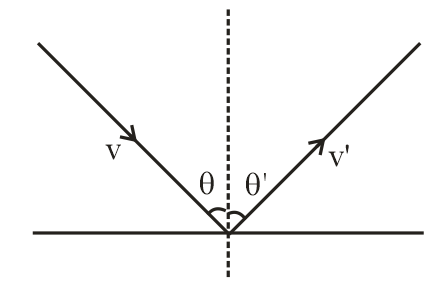
(A) $v' = v,\theta = \theta '$
(B) $v' = \dfrac{v}{2},\theta = 2\theta '$
(C) $v' = 2v,\theta = 2\theta '$
(D) $v' = \dfrac{{3v}}{2},\theta = \dfrac{{2\theta '}}{3}$
Answer
 Verified
579.9k+ views
Hint: In order to solve above from first apply the law of conservation of momentum in x-direction and make an equation between $v',v,\theta $ and $\theta '$.
After then write formula of coefficient of restitution e
i.e., e $ = $ velocity of separation $/$ velocity of approach
On putting the values ${v_{sep}}$ and ${v_{app}}$, we will get an equation between $v,v',\theta $ and $\theta '$.
Now on solving these 2 equations, we will get desired solution.
Complete step by step answer:
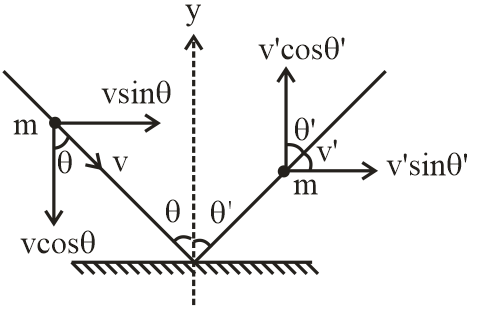
Given that a ball of mass m hits the floor i.e., collides with the floor and reflects back. So, we can use law of conservation of momentum i.e.,
Momentum before collision $ = $ Momentum after collision
We know that momentum is a vector quantity. So, we can use conservation law in both directions i.e., X and Y because the ball hits the ground at an angle $\theta $. Hence, from the diagram.
In x-direction
$mv\sin \theta = mv'\sin \theta '$
$v\sin \theta = v'\sin \theta '$ …..(1)
Here gravity acts on the ball that’s why we can not consider conservation of momentum is y-direction.
Here, coefficient of restitution is also given
i.e., e $ = $ velocity of separation $/$ velocity of approach
Here
${v_{sep}} = v'\cos \theta '$
${v_{app}} = v\cos \theta $
So, $e = \dfrac{{v'\cos \theta '}}{{v\cos \theta }}$
$v'\cos \theta ' = ev\cos \theta $ …..(2)
Now, equation ${(1)^2} + {(2)^2}$
${(v\sin \theta )^2} + {(ev\cos \theta )^2} = {(v'\sin \theta ')^2} + {(v'\cos \theta ')^2}$
$\implies {v^2}{\sin ^2}\theta + {e^2}{v^2}{\cos ^2}\theta = v{'^2}{\sin ^2}\theta ' + v{'^2}{\cos ^2}\theta '$
$\implies {v^2}({\sin ^2}\theta + {e^2}{\cos ^2}\theta ) = v{'^2}({\sin ^2}\theta ' + {\cos ^2}\theta ')$
$\because {\sin ^2}\theta ' + {\cos ^2}\theta ' = 1$
$\implies v{'^2} = {v^2}({\sin ^2}\theta + {e^2}{\cos ^2}\theta )$
$\implies v' = \sqrt {{v^2}({{\sin }^2}\theta + {e^2}{{\cos }^2}\theta )} $
$\implies v' = v\sqrt {{{\sin }^2}\theta + {e^2}{{\cos }^2}\theta } $ …..(3)
For elastic collision $e = 1$ …..(4)
So, $v' = v\sqrt {{{\sin }^2}\theta + {{\cos }^2}\theta } $
$\therefore v' = v$ …..(5)
Now from equation 2, 4 and 5
$v'\cos \theta ' = (1)v'\cos \theta $
$\implies \cos \theta ' = \cos \theta $
$ \Rightarrow \theta ' = \theta $ …..(6)
Hence from equation 5 and 6 we conclude that reflected angle and velocity is same as incident i.e.,
$v' = v,\theta ' = \theta $
So, the correct answer is “Option A”.
Note:
In many problems of collision, we can not get a final answer using only the law of momentum conservation. In that case we have to use the law of energy conservation also.
In elastic collision cases, we can also use the law of kinetic energy conservation also.
After then write formula of coefficient of restitution e
i.e., e $ = $ velocity of separation $/$ velocity of approach
On putting the values ${v_{sep}}$ and ${v_{app}}$, we will get an equation between $v,v',\theta $ and $\theta '$.
Now on solving these 2 equations, we will get desired solution.
Complete step by step answer:
Given that a ball of mass m hits the floor i.e., collides with the floor and reflects back. So, we can use law of conservation of momentum i.e.,
Momentum before collision $ = $ Momentum after collision
We know that momentum is a vector quantity. So, we can use conservation law in both directions i.e., X and Y because the ball hits the ground at an angle $\theta $. Hence, from the diagram.
In x-direction
$mv\sin \theta = mv'\sin \theta '$
$v\sin \theta = v'\sin \theta '$ …..(1)
Here gravity acts on the ball that’s why we can not consider conservation of momentum is y-direction.
Here, coefficient of restitution is also given
i.e., e $ = $ velocity of separation $/$ velocity of approach
Here
${v_{sep}} = v'\cos \theta '$
${v_{app}} = v\cos \theta $
So, $e = \dfrac{{v'\cos \theta '}}{{v\cos \theta }}$
$v'\cos \theta ' = ev\cos \theta $ …..(2)
Now, equation ${(1)^2} + {(2)^2}$
${(v\sin \theta )^2} + {(ev\cos \theta )^2} = {(v'\sin \theta ')^2} + {(v'\cos \theta ')^2}$
$\implies {v^2}{\sin ^2}\theta + {e^2}{v^2}{\cos ^2}\theta = v{'^2}{\sin ^2}\theta ' + v{'^2}{\cos ^2}\theta '$
$\implies {v^2}({\sin ^2}\theta + {e^2}{\cos ^2}\theta ) = v{'^2}({\sin ^2}\theta ' + {\cos ^2}\theta ')$
$\because {\sin ^2}\theta ' + {\cos ^2}\theta ' = 1$
$\implies v{'^2} = {v^2}({\sin ^2}\theta + {e^2}{\cos ^2}\theta )$
$\implies v' = \sqrt {{v^2}({{\sin }^2}\theta + {e^2}{{\cos }^2}\theta )} $
$\implies v' = v\sqrt {{{\sin }^2}\theta + {e^2}{{\cos }^2}\theta } $ …..(3)
For elastic collision $e = 1$ …..(4)
So, $v' = v\sqrt {{{\sin }^2}\theta + {{\cos }^2}\theta } $
$\therefore v' = v$ …..(5)
Now from equation 2, 4 and 5
$v'\cos \theta ' = (1)v'\cos \theta $
$\implies \cos \theta ' = \cos \theta $
$ \Rightarrow \theta ' = \theta $ …..(6)
Hence from equation 5 and 6 we conclude that reflected angle and velocity is same as incident i.e.,
$v' = v,\theta ' = \theta $
So, the correct answer is “Option A”.
Note:
In many problems of collision, we can not get a final answer using only the law of momentum conservation. In that case we have to use the law of energy conservation also.
In elastic collision cases, we can also use the law of kinetic energy conservation also.
Recently Updated Pages
Master Class 11 Computer Science: Engaging Questions & Answers for Success

Master Class 11 Business Studies: Engaging Questions & Answers for Success
Master Class 11 Economics: Engaging Questions & Answers for Success
Master Class 11 English: Engaging Questions & Answers for Success
Master Class 11 Maths: Engaging Questions & Answers for Success
Master Class 11 Biology: Engaging Questions & Answers for Success
Trending doubts
One Metric ton is equal to kg A 10000 B 1000 C 100 class 11 physics CBSE
There are 720 permutations of the digits 1 2 3 4 5 class 11 maths CBSE
Discuss the various forms of bacteria class 11 biology CBSE
Draw a diagram of a plant cell and label at least eight class 11 biology CBSE
State the laws of reflection of light
Explain zero factorial class 11 maths CBSE