




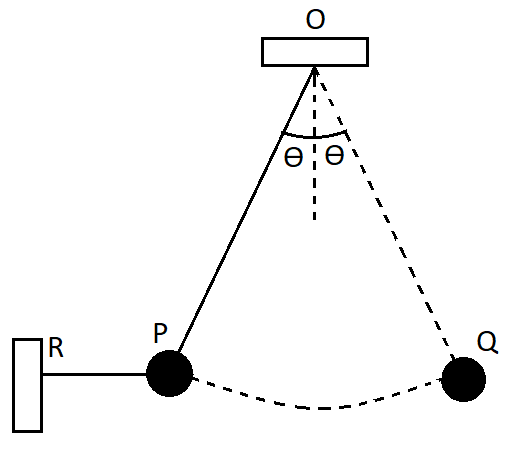
A ball of mass $1kg$ is at rest in position P by means of two light strings OP and RP. The string RP is now cut and the ball swings to position Q. Find the tensions in the string in position OP (when RP was not cut) and OQ (when RP was cut ). (Take $g = 10m/{s^2}$).
Answer
 Verified
620.7k+ views
Hint
We need to draw the free body diagram in both the cases on the ball. Then as in both the cases the ball is at rest, the total force on the ball will be zero. So equating the forces in the two cases, we get the tension in the string.
In this solution, we will be using the following formula,
$\Rightarrow {F_{net}} = ma$
Where ${F_{net}}$ is the net force acting on the body of mass $m$, causing an acceleration $a$.
Complete step by step answer
To find the tension in the first case, we first need to draw the free body diagram for the first case. In this case, the ball is at rest. So the total forces acting on the ball will cancel out each other. Now the forces are the force of tension along the string OP and the mass of the ball in the downward direction. So we can draw the figure as,
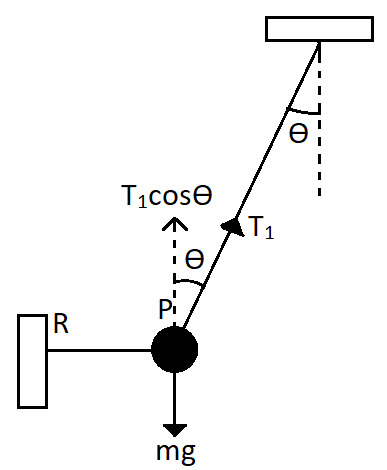
Here we have taken the tension in the string as ${T_1}$. So the cosine component of the tension ${T_1}$ will be balancing the weight of the ball in order for the net force on the ball to be zero.
So we can write the equation of motion of the ball as,
$\Rightarrow{T_1}\cos \theta - mg = 0$
We can take the $mg$ to the RHS of the equation and have
$\Rightarrow{T_1}\cos \theta = mg$
To find the tension ${T_1}$ we take the $\cos \theta $ to the other side.
So we get,
$\Rightarrow{T_1} = \dfrac{{mg}}{{\cos \theta }}$
Now by substituting the values, $m = 1kg$, $g = 10m/{s^2}$ and the angle $\theta = 45^\circ $. Then we get
$\Rightarrow{T_1} = \dfrac{{1 \times 10}}{{\cos 45^\circ }}$
The value of $\cos 45^\circ $ is $\dfrac{1}{{\sqrt 2 }}$
So substituting,
$\Rightarrow{T_1} = \dfrac{{10}}{{\dfrac{1}{{\sqrt 2 }}}}$
Hence, on calculating, we have the tension in the first case as,
$\Rightarrow{T_1} = 10\sqrt 2 N$
For the second case when the string is cut and the ball reaches the position Q, the ball will again come to rest momentarily. So the net force acting on the body will be zero. Therefore, we can draw the free body diagram using the tension and the mass of the ball as,
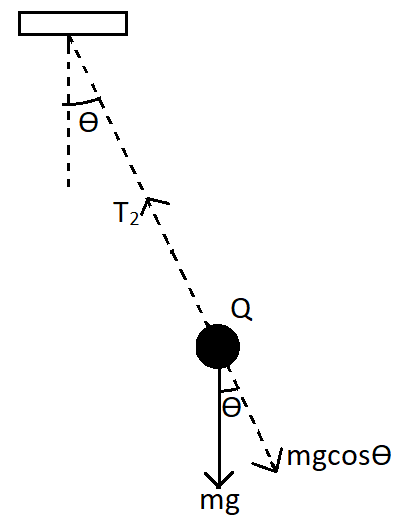
Here we have the tension as ${T_2}$ and mass of the body $mg$ acting downwards. Since the total force is zero, the cosine component of the mass will be balancing the tension.
$\Rightarrow{T_2} - mg\cos \theta = 0$
Therefore, we can write by taking $mg\cos \theta $ to the RHS we get
$\Rightarrow{T_2} = mg\cos \theta $
By substituting $m = 1kg$, $g = 10m/{s^2}$ and $\theta = 45^\circ $, then we get the value of the tension as,
$\Rightarrow{T_2} = 1 \times 10\cos 45^\circ $
The value of $\cos 45^\circ $ is $\dfrac{1}{{\sqrt 2 }}$
So substituting we get
$\Rightarrow{T_2} = \dfrac{{1 \times 10}}{{\sqrt 2 }}$
Therefore, on multiplying $\sqrt 2 $ in numerator and denominator we get,
$\Rightarrow{T_2} = \dfrac{{10\sqrt 2 }}{2}$
On cancelling 2 we get
$\Rightarrow{T_2} = 5\sqrt 2 N$
So this is the tension in the string in the second case.
Note
Free body diagrams in physics are used to visualize the applied forces and the resulting actions on a body due to those forces. They consist of a simple version of the body and the forces drawn with straight line arrows. And the momentums are drawn with curved lines if necessary to depict the direction of motion of the body.
We need to draw the free body diagram in both the cases on the ball. Then as in both the cases the ball is at rest, the total force on the ball will be zero. So equating the forces in the two cases, we get the tension in the string.
In this solution, we will be using the following formula,
$\Rightarrow {F_{net}} = ma$
Where ${F_{net}}$ is the net force acting on the body of mass $m$, causing an acceleration $a$.
Complete step by step answer
To find the tension in the first case, we first need to draw the free body diagram for the first case. In this case, the ball is at rest. So the total forces acting on the ball will cancel out each other. Now the forces are the force of tension along the string OP and the mass of the ball in the downward direction. So we can draw the figure as,
Here we have taken the tension in the string as ${T_1}$. So the cosine component of the tension ${T_1}$ will be balancing the weight of the ball in order for the net force on the ball to be zero.
So we can write the equation of motion of the ball as,
$\Rightarrow{T_1}\cos \theta - mg = 0$
We can take the $mg$ to the RHS of the equation and have
$\Rightarrow{T_1}\cos \theta = mg$
To find the tension ${T_1}$ we take the $\cos \theta $ to the other side.
So we get,
$\Rightarrow{T_1} = \dfrac{{mg}}{{\cos \theta }}$
Now by substituting the values, $m = 1kg$, $g = 10m/{s^2}$ and the angle $\theta = 45^\circ $. Then we get
$\Rightarrow{T_1} = \dfrac{{1 \times 10}}{{\cos 45^\circ }}$
The value of $\cos 45^\circ $ is $\dfrac{1}{{\sqrt 2 }}$
So substituting,
$\Rightarrow{T_1} = \dfrac{{10}}{{\dfrac{1}{{\sqrt 2 }}}}$
Hence, on calculating, we have the tension in the first case as,
$\Rightarrow{T_1} = 10\sqrt 2 N$
For the second case when the string is cut and the ball reaches the position Q, the ball will again come to rest momentarily. So the net force acting on the body will be zero. Therefore, we can draw the free body diagram using the tension and the mass of the ball as,
Here we have the tension as ${T_2}$ and mass of the body $mg$ acting downwards. Since the total force is zero, the cosine component of the mass will be balancing the tension.
$\Rightarrow{T_2} - mg\cos \theta = 0$
Therefore, we can write by taking $mg\cos \theta $ to the RHS we get
$\Rightarrow{T_2} = mg\cos \theta $
By substituting $m = 1kg$, $g = 10m/{s^2}$ and $\theta = 45^\circ $, then we get the value of the tension as,
$\Rightarrow{T_2} = 1 \times 10\cos 45^\circ $
The value of $\cos 45^\circ $ is $\dfrac{1}{{\sqrt 2 }}$
So substituting we get
$\Rightarrow{T_2} = \dfrac{{1 \times 10}}{{\sqrt 2 }}$
Therefore, on multiplying $\sqrt 2 $ in numerator and denominator we get,
$\Rightarrow{T_2} = \dfrac{{10\sqrt 2 }}{2}$
On cancelling 2 we get
$\Rightarrow{T_2} = 5\sqrt 2 N$
So this is the tension in the string in the second case.
Note
Free body diagrams in physics are used to visualize the applied forces and the resulting actions on a body due to those forces. They consist of a simple version of the body and the forces drawn with straight line arrows. And the momentums are drawn with curved lines if necessary to depict the direction of motion of the body.
Recently Updated Pages
Master Class 11 English: Engaging Questions & Answers for Success

Master Class 11 Social Science: Engaging Questions & Answers for Success
Master Class 11 Maths: Engaging Questions & Answers for Success
Master Class 11 Biology: Engaging Questions & Answers for Success
Master Class 11 Physics: Engaging Questions & Answers for Success
Master Class 11 Chemistry: Engaging Questions & Answers for Success
Trending doubts
One Metric ton is equal to kg A 10000 B 1000 C 100 class 11 physics CBSE
Difference Between Prokaryotic Cells and Eukaryotic Cells
Find the value of the expression given below sin 30circ class 11 maths CBSE
Difference between physical and chemical change class 11 chemistry CBSE
Two of the body parts which do not appear in MRI are class 11 biology CBSE
Draw a diagram of a plant cell and label at least eight class 11 biology CBSE