




A ball of mass 10kg is moving with a velocity of 10$m/s$. It strikes another ball of mass 5 kg which is moving in the same direction with a velocity of 4$m/s$. If the collision is elastic, their velocity after collision will respectively,
(A) 12$m/s$, 6$m/s$
(B) 12$m/s$, 25$m/s$
(C) 6$m/s$, 12$m/s$
(D) 8$m/s$, 20$m/s$
Answer
 Verified
584.7k+ views
Hint: In order to solve the collision problems, we have to use two conservation methods which one are,
1. Momentum conservation methods
2. Energy conservation methods
The law of momentum conservation states that when an object 1 collides with an object 2 in an isolated system, the total momentum of objects 1 and 2 before the collision equals that of the total momentum of collision between object 1 and 2 after collision.The principle of conservation of energy states that the energy of interacting bodies in a closed system remains constant.
Formula used:
In this problem, first we use the momentum conservation method and also use the expression of coefficient of restitution that is,
$e = \dfrac{{velocity\,of\,separation}}{{velocity\,of\,approach}}$
Here, $e$ is the coefficient of restitution.
Complete step by step answer:
Given that 2 balls collide with each other and also given their masses and velocities before collision.
Velocity of ball 1 $[\left( {{u_1}} \right){\text{ = }}10m/s]$
Mass of ball 1 $[\left( {{m_1}} \right) = 10kg]$
Velocity of ball 2 $[\left( {{u_2}} \right) = 4m/s]$
Mass of ball 2 $[\left( {{m_2}} \right) = 5kg]$
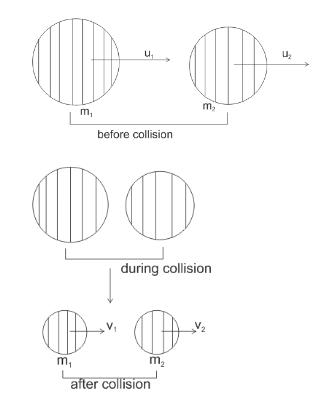
Now, using conservation of momentum
Momentum before collision $ = $ momentum after collision
$(\therefore \,\,\,momentum\,\rho = m\,v)$ and $[{u_l} > {u_2}]$
$[{m_1}{u_1} + {\text{ }}{m_2}{u_2}\; = {\text{ }}{m_1}{v_1} + {\text{ }}{m_2}{v_2}]$
Where ${v_1}$ and ${v_2}$ are the velocities of ball 1 and 2 after collision respectively
So,
$10 \times 10 + 4 \times 5 = 10{v_1} + 5{v_2}$
$\Rightarrow 100 + 20 = 10{v_1} + 5{v_2}$
$\Rightarrow 10{v_1} + 5{v_2}{\text{ = }}120$
$\Rightarrow 5(2{v_1} + {v_2}) = 5 \times 24$
$\Rightarrow 2{v_1} + {v_2} = 24$ …..(1)
We know that coefficient of restitution is
$e = \dfrac{{velocity\,of\,separation}}{{velocity\,of\,approach}}$
Given that collision is elastic and for elastic collision $e = 1$
So,
$e = \dfrac{{{v_2} - {v_1}}}{{{u_1} - {u_2}}}$ \[(\therefore {u_l} > {u_2})\]
$\Rightarrow \,e = 1$
$\Rightarrow \dfrac{{{v_2} - {v_l}}}{{{u_1} - {u_2}}} = 1$
$\Rightarrow {v_2} - {v_1} = {u_1} - {u_2}$
$\because{u_1} = 10m/s,{u_2} = 4m/s$
$\Rightarrow 10 - 4\, = {v_2} - {v_1}$
$\Rightarrow {v_2} - {v_1} = 6$
$\Rightarrow {v_2} = 6 + {v_1}$ …..(2)
From equation $\left( 1 \right) \to \left( 2 \right)$
$2{v_1} + \left( {6 + {v_1}} \right) = 24$
$\Rightarrow 2{v_1} + 6 + {v_1} = 24 $
$\Rightarrow 3{v_1} = 24 - 6 = 18$
$\Rightarrow{v_1} = \dfrac{{18}}{3} = 6$
So, $[{v_1} = 6m/s]$ …..(3)
From equation 2 & 3
$\therefore {v_2} = 6 + 6 = 12m/s$ …..(4)
Hence, the velocities of ball 1 & 2 after collision is $6m/s$ and $12m/s$ respectively.
So, option C is the correct answer.
Note: In many problems of collision, we cannot get a final answer only using law of momentum conservation. In that case, we have to use the law of energy conservation also.In case of an elastic collision, we can also use the law of kinetic energy conservation also.Basically, in the case of collision, the kinetic energy before the collision and after the collision remains the same and is not converted to any other form of energy.It can be either one-dimensional or two-dimensional. In the real world, perfectly elastic collision is not possible because there is bound to be some conversion of energy, however small.
1. Momentum conservation methods
2. Energy conservation methods
The law of momentum conservation states that when an object 1 collides with an object 2 in an isolated system, the total momentum of objects 1 and 2 before the collision equals that of the total momentum of collision between object 1 and 2 after collision.The principle of conservation of energy states that the energy of interacting bodies in a closed system remains constant.
Formula used:
In this problem, first we use the momentum conservation method and also use the expression of coefficient of restitution that is,
$e = \dfrac{{velocity\,of\,separation}}{{velocity\,of\,approach}}$
Here, $e$ is the coefficient of restitution.
Complete step by step answer:
Given that 2 balls collide with each other and also given their masses and velocities before collision.
Velocity of ball 1 $[\left( {{u_1}} \right){\text{ = }}10m/s]$
Mass of ball 1 $[\left( {{m_1}} \right) = 10kg]$
Velocity of ball 2 $[\left( {{u_2}} \right) = 4m/s]$
Mass of ball 2 $[\left( {{m_2}} \right) = 5kg]$
Now, using conservation of momentum
Momentum before collision $ = $ momentum after collision
$(\therefore \,\,\,momentum\,\rho = m\,v)$ and $[{u_l} > {u_2}]$
$[{m_1}{u_1} + {\text{ }}{m_2}{u_2}\; = {\text{ }}{m_1}{v_1} + {\text{ }}{m_2}{v_2}]$
Where ${v_1}$ and ${v_2}$ are the velocities of ball 1 and 2 after collision respectively
So,
$10 \times 10 + 4 \times 5 = 10{v_1} + 5{v_2}$
$\Rightarrow 100 + 20 = 10{v_1} + 5{v_2}$
$\Rightarrow 10{v_1} + 5{v_2}{\text{ = }}120$
$\Rightarrow 5(2{v_1} + {v_2}) = 5 \times 24$
$\Rightarrow 2{v_1} + {v_2} = 24$ …..(1)
We know that coefficient of restitution is
$e = \dfrac{{velocity\,of\,separation}}{{velocity\,of\,approach}}$
Given that collision is elastic and for elastic collision $e = 1$
So,
$e = \dfrac{{{v_2} - {v_1}}}{{{u_1} - {u_2}}}$ \[(\therefore {u_l} > {u_2})\]
$\Rightarrow \,e = 1$
$\Rightarrow \dfrac{{{v_2} - {v_l}}}{{{u_1} - {u_2}}} = 1$
$\Rightarrow {v_2} - {v_1} = {u_1} - {u_2}$
$\because{u_1} = 10m/s,{u_2} = 4m/s$
$\Rightarrow 10 - 4\, = {v_2} - {v_1}$
$\Rightarrow {v_2} - {v_1} = 6$
$\Rightarrow {v_2} = 6 + {v_1}$ …..(2)
From equation $\left( 1 \right) \to \left( 2 \right)$
$2{v_1} + \left( {6 + {v_1}} \right) = 24$
$\Rightarrow 2{v_1} + 6 + {v_1} = 24 $
$\Rightarrow 3{v_1} = 24 - 6 = 18$
$\Rightarrow{v_1} = \dfrac{{18}}{3} = 6$
So, $[{v_1} = 6m/s]$ …..(3)
From equation 2 & 3
$\therefore {v_2} = 6 + 6 = 12m/s$ …..(4)
Hence, the velocities of ball 1 & 2 after collision is $6m/s$ and $12m/s$ respectively.
So, option C is the correct answer.
Note: In many problems of collision, we cannot get a final answer only using law of momentum conservation. In that case, we have to use the law of energy conservation also.In case of an elastic collision, we can also use the law of kinetic energy conservation also.Basically, in the case of collision, the kinetic energy before the collision and after the collision remains the same and is not converted to any other form of energy.It can be either one-dimensional or two-dimensional. In the real world, perfectly elastic collision is not possible because there is bound to be some conversion of energy, however small.
Recently Updated Pages
Three beakers labelled as A B and C each containing 25 mL of water were taken A small amount of NaOH anhydrous CuSO4 and NaCl were added to the beakers A B and C respectively It was observed that there was an increase in the temperature of the solutions contained in beakers A and B whereas in case of beaker C the temperature of the solution falls Which one of the following statements isarecorrect i In beakers A and B exothermic process has occurred ii In beakers A and B endothermic process has occurred iii In beaker C exothermic process has occurred iv In beaker C endothermic process has occurred

Master Class 11 Social Science: Engaging Questions & Answers for Success
Master Class 11 Physics: Engaging Questions & Answers for Success
Master Class 11 Maths: Engaging Questions & Answers for Success
Master Class 11 Economics: Engaging Questions & Answers for Success
Master Class 11 Computer Science: Engaging Questions & Answers for Success
Three beakers labelled as A B and C each containing 25 mL of water were taken A small amount of NaOH anhydrous CuSO4 and NaCl were added to the beakers A B and C respectively It was observed that there was an increase in the temperature of the solutions contained in beakers A and B whereas in case of beaker C the temperature of the solution falls Which one of the following statements isarecorrect i In beakers A and B exothermic process has occurred ii In beakers A and B endothermic process has occurred iii In beaker C exothermic process has occurred iv In beaker C endothermic process has occurred
Master Class 11 Social Science: Engaging Questions & Answers for Success
Master Class 11 Physics: Engaging Questions & Answers for Success
Trending doubts
There are 720 permutations of the digits 1 2 3 4 5 class 11 maths CBSE
State and prove Bernoullis theorem class 11 physics CBSE
1 Quintal is equal to a 110 kg b 10 kg c 100kg d 1000 class 11 physics CBSE
Discuss the various forms of bacteria class 11 biology CBSE
Explain zero factorial class 11 maths CBSE
What is 1s 2s 2p 3s 3p class 11 chemistry CBSE