




A ball of mass 0.1kg makes an elastic head-on collision with a ball of unknown mass, initially at rest. If the 0.1kg ball rebounds at one third of its original speed. What is the mass of the other ball?
a) 0.3kg
b) 0.1kg
c) 0.2kg
d) 0.4kg
Answer
 Verified
623.1k+ views
Hint: The two balls of mass m=0.1kg and M(mass to be determined)undergo an elastic head on head collision. Therefore we can say that the linear momentum of the two balls as well as the kinetic energy is conserved. Hence we will obtain the expression for velocity of the ball with mass M in terms of its mass using the principle of conservation of momentum and substitute in the expression of conservation of kinetic energy to obtain its mass.
Formula used:
$P(\text{collision})=mv$
$K.E(\text{collision})=\dfrac{1}{2}m{{v}^{2}}$
Complete step-by-step answer:
Let us say a body with mass and a particular velocity moves in a linear direction. Then the momentum p of the particle is given by the product of its mass times the velocity.
For the same body, the kinetic energy is given as the half of the product of its mass times the square of its velocity.
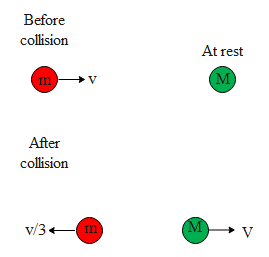
In the above figure we can see that a body of mass m moves towards a body of mass ‘M’ which is at rest with velocity v. Hence the momentum of the two before collision is given by,
$\begin{align}
& P(\text{before collision})=mv+m(0) \\
& P(\text{before collision})=mv \\
\end{align}$
Similarly the kinetic energy before collision is equal to,
$\begin{align}
& K.E(\text{before collision})=\dfrac{1}{2}m{{v}^{2}}+\dfrac{1}{2}M{{\left( 0 \right)}^{2}} \\
& K.E(\text{before collision})=\dfrac{1}{2}m{{v}^{2}} \\
\end{align}$
After two collisions the bodies move apart as shown in the figure. Hence the momentum of the two bodies after collision is,
$\begin{align}
& P(\text{after collision})=m\dfrac{v}{3}+MV \\
& P(\text{after collision})=-\dfrac{mv}{3}+MV \\
\end{align}$
Similarly the kinetic energy after collision is equal to,
$\begin{align}
& K.E(\text{after collision})=\dfrac{1}{2}m{{\left( \dfrac{-v}{3} \right)}^{2}}+\dfrac{1}{2}M{{\left( V \right)}^{2}} \\
& K.E(\text{after collision})=\dfrac{1}{18}m{{v}^{2}}+\dfrac{1}{2}M{{V}^{2}} \\
\end{align}$
Since the kinetic energy and the momentum of are conserved before and after the collision we can write,
$\begin{align}
& P(\text{before collision})=P(\text{after collision}) \\
& mv=-\dfrac{mv}{3}+MV \\
& \Rightarrow MV=\dfrac{4}{3}mv \\
& \Rightarrow V=\dfrac{4}{3M}mv \\
\end{align}$
$\begin{align}
& K.E(\text{before collision})=K.E(\text{after collision}) \\
& \dfrac{1}{2}m{{v}^{2}}=\dfrac{1}{18}m{{v}^{2}}+\dfrac{1}{2}M{{V}^{2}} \\
\end{align}$
Substituting for V in the above equation we get,
$\begin{align}
& \dfrac{1}{2}m{{v}^{2}}=\dfrac{1}{18}m{{v}^{2}}+\dfrac{1}{2}M{{V}^{2}} \\
& \Rightarrow \dfrac{1}{2}m{{v}^{2}}=\dfrac{1}{18}m{{v}^{2}}+\dfrac{1}{2}M{{\left( \dfrac{4}{3M}mv \right)}^{2}} \\
& \Rightarrow m{{v}^{2}}=\dfrac{m{{v}^{2}}}{9}+\left( \dfrac{16}{9M}{{m}^{2}}{{v}^{2}} \right) \\
& \Rightarrow 1=\dfrac{1}{9}+\left( \dfrac{16}{9M}m \right)] \\
& \Rightarrow 1-\dfrac{1}{9}=\dfrac{16m}{9M} \\
& \Rightarrow \dfrac{8}{9}=\dfrac{16m}{9M} \\
& \Rightarrow M=2m\text{, since m=0}\text{.1kg} \\
& \Rightarrow M=2\times \text{0}\text{.1kg}=0.2\text{kg} \\
\end{align}$
So, the correct answer is “Option c”.
Note: It is to be noted that the two balls are moving on a frictionless surface. And hence we can say that there is no loss of momentum to overcome the force of friction. Similarly in reality during collision some amount of energy gets lost in the form of heat or by the sound produced. If these conditions cannot be neglected then the conservation of energy does not hold true.
Formula used:
$P(\text{collision})=mv$
$K.E(\text{collision})=\dfrac{1}{2}m{{v}^{2}}$
Complete step-by-step answer:
Let us say a body with mass and a particular velocity moves in a linear direction. Then the momentum p of the particle is given by the product of its mass times the velocity.
For the same body, the kinetic energy is given as the half of the product of its mass times the square of its velocity.
In the above figure we can see that a body of mass m moves towards a body of mass ‘M’ which is at rest with velocity v. Hence the momentum of the two before collision is given by,
$\begin{align}
& P(\text{before collision})=mv+m(0) \\
& P(\text{before collision})=mv \\
\end{align}$
Similarly the kinetic energy before collision is equal to,
$\begin{align}
& K.E(\text{before collision})=\dfrac{1}{2}m{{v}^{2}}+\dfrac{1}{2}M{{\left( 0 \right)}^{2}} \\
& K.E(\text{before collision})=\dfrac{1}{2}m{{v}^{2}} \\
\end{align}$
After two collisions the bodies move apart as shown in the figure. Hence the momentum of the two bodies after collision is,
$\begin{align}
& P(\text{after collision})=m\dfrac{v}{3}+MV \\
& P(\text{after collision})=-\dfrac{mv}{3}+MV \\
\end{align}$
Similarly the kinetic energy after collision is equal to,
$\begin{align}
& K.E(\text{after collision})=\dfrac{1}{2}m{{\left( \dfrac{-v}{3} \right)}^{2}}+\dfrac{1}{2}M{{\left( V \right)}^{2}} \\
& K.E(\text{after collision})=\dfrac{1}{18}m{{v}^{2}}+\dfrac{1}{2}M{{V}^{2}} \\
\end{align}$
Since the kinetic energy and the momentum of are conserved before and after the collision we can write,
$\begin{align}
& P(\text{before collision})=P(\text{after collision}) \\
& mv=-\dfrac{mv}{3}+MV \\
& \Rightarrow MV=\dfrac{4}{3}mv \\
& \Rightarrow V=\dfrac{4}{3M}mv \\
\end{align}$
$\begin{align}
& K.E(\text{before collision})=K.E(\text{after collision}) \\
& \dfrac{1}{2}m{{v}^{2}}=\dfrac{1}{18}m{{v}^{2}}+\dfrac{1}{2}M{{V}^{2}} \\
\end{align}$
Substituting for V in the above equation we get,
$\begin{align}
& \dfrac{1}{2}m{{v}^{2}}=\dfrac{1}{18}m{{v}^{2}}+\dfrac{1}{2}M{{V}^{2}} \\
& \Rightarrow \dfrac{1}{2}m{{v}^{2}}=\dfrac{1}{18}m{{v}^{2}}+\dfrac{1}{2}M{{\left( \dfrac{4}{3M}mv \right)}^{2}} \\
& \Rightarrow m{{v}^{2}}=\dfrac{m{{v}^{2}}}{9}+\left( \dfrac{16}{9M}{{m}^{2}}{{v}^{2}} \right) \\
& \Rightarrow 1=\dfrac{1}{9}+\left( \dfrac{16}{9M}m \right)] \\
& \Rightarrow 1-\dfrac{1}{9}=\dfrac{16m}{9M} \\
& \Rightarrow \dfrac{8}{9}=\dfrac{16m}{9M} \\
& \Rightarrow M=2m\text{, since m=0}\text{.1kg} \\
& \Rightarrow M=2\times \text{0}\text{.1kg}=0.2\text{kg} \\
\end{align}$
So, the correct answer is “Option c”.
Note: It is to be noted that the two balls are moving on a frictionless surface. And hence we can say that there is no loss of momentum to overcome the force of friction. Similarly in reality during collision some amount of energy gets lost in the form of heat or by the sound produced. If these conditions cannot be neglected then the conservation of energy does not hold true.
Recently Updated Pages
Master Class 11 English: Engaging Questions & Answers for Success

Master Class 11 Social Science: Engaging Questions & Answers for Success
Master Class 11 Maths: Engaging Questions & Answers for Success
Master Class 11 Biology: Engaging Questions & Answers for Success
Master Class 11 Physics: Engaging Questions & Answers for Success
Master Class 11 Chemistry: Engaging Questions & Answers for Success
Trending doubts
One Metric ton is equal to kg A 10000 B 1000 C 100 class 11 physics CBSE
What is cell theory Who formulated it class 11 biology CBSE
Phyllotaxy is the arrangement of ALeaflets BLeaves class 11 biology CBSE
Difference Between Prokaryotic Cells and Eukaryotic Cells
The symbiotic association of fungi and algae is called class 11 biology CBSE
Cell theory was formulated by A Schleiden and Schwann class 11 biology CBSE