




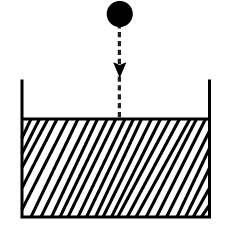
A ball of density $\rho$ is dropped from a height on the surface of a non-viscous liquid of density $2\rho$. Choose the correct options.
A.Motion of ball is periodic but not simple harmonic
B.Acceleration of ball in air and in liquid are equal
C.Magnitude of upthrust in the liquid is two times the weight of ball
D.Net force on ball in air and in liquid are equal and opposite
Answer
 Verified
600.9k+ views
Hint: Gravity is in always downward direction and upthrust force is in upward direction. The non-viscous liquid is given so we neglect viscous force. Balance all the force and then think the motion of the ball by finding out the acceleration due to liquid.
Complete step by step solution answer:
Our first work is to observe the figure properly and mention all the things in the figure as shown in figure below. As the ball is dropped from point A, so velocity at A is zero (u=0). Now, we will find velocity at point B by using the formula.
$v^{2} = u^{2} + 2as$
here, v is the final velocity i.e., at point B.
u is the initial velocity i.e., at point A.
a is the acceleration due to gravity in this case as ball is dropped $(a=g)$
s is the distance between A and B i.e., h.
v =$ \sqrt{2gh}$
So, when the ball dropped from A it goes to point B and attains some velocity now again it will cover the same distance h and then a deceleration comes into play and then ball goes to point B and then again goes back to point A (a=g). This motion can say periodic but not SHM.
upthrust force will act on the ball in upward direction and weight of ball acts in downward direction.
V is the volume occupied by the ball.
$\textit{Upthrust force} = {mass \times gravity} ={Volume \times density \times gravity}$ =V $2\rho $g (density of liquid = $2\rho$)
Weight of body = V$\rho$ g
Here, Magnitude of upthrust in the liquid is two times the weight of the ball.
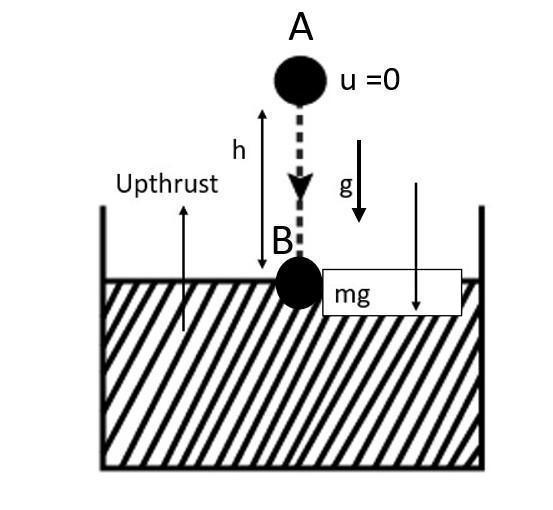
After B, an acceleration will act on the ball in upward direction.
$\textit{Acceleration in liquid} = \dfrac{upthrust - weight}{weight} =\dfrac{V 2\rho g - V \rho g}{V\rho g}= g$
Here, acceleration in air and in liquid is equal in magnitude but opposite in direction.
Net force of ball in air = mg
Net force of ball in liquid = ma
But a = -g
So, force of ball in liquid = -mg
Here, Net force on the ball in air and in liquid are equal and opposite.
So, A, C and D options are right.
Additional Information:
If viscous liquid is there, then we add some viscous force but that makes the question complicated so we deal with the non-viscous liquid mostly. Upthrust force tends to keep the ball upward and gravity pulls the ball downward. When both forces become equal then equilibrium state will achieve.
Note:
When body falls freely then its acceleration becomes equal to gravity i.e., a = g and mark the correct direction of each force otherwise the result will be wrong. Volume occupied by the body is equal to the displaced volume of the liquid when the ball falls in the liquid.
Complete step by step solution answer:
Our first work is to observe the figure properly and mention all the things in the figure as shown in figure below. As the ball is dropped from point A, so velocity at A is zero (u=0). Now, we will find velocity at point B by using the formula.
$v^{2} = u^{2} + 2as$
here, v is the final velocity i.e., at point B.
u is the initial velocity i.e., at point A.
a is the acceleration due to gravity in this case as ball is dropped $(a=g)$
s is the distance between A and B i.e., h.
v =$ \sqrt{2gh}$
So, when the ball dropped from A it goes to point B and attains some velocity now again it will cover the same distance h and then a deceleration comes into play and then ball goes to point B and then again goes back to point A (a=g). This motion can say periodic but not SHM.
upthrust force will act on the ball in upward direction and weight of ball acts in downward direction.
V is the volume occupied by the ball.
$\textit{Upthrust force} = {mass \times gravity} ={Volume \times density \times gravity}$ =V $2\rho $g (density of liquid = $2\rho$)
Weight of body = V$\rho$ g
Here, Magnitude of upthrust in the liquid is two times the weight of the ball.
After B, an acceleration will act on the ball in upward direction.
$\textit{Acceleration in liquid} = \dfrac{upthrust - weight}{weight} =\dfrac{V 2\rho g - V \rho g}{V\rho g}= g$
Here, acceleration in air and in liquid is equal in magnitude but opposite in direction.
Net force of ball in air = mg
Net force of ball in liquid = ma
But a = -g
So, force of ball in liquid = -mg
Here, Net force on the ball in air and in liquid are equal and opposite.
So, A, C and D options are right.
Additional Information:
If viscous liquid is there, then we add some viscous force but that makes the question complicated so we deal with the non-viscous liquid mostly. Upthrust force tends to keep the ball upward and gravity pulls the ball downward. When both forces become equal then equilibrium state will achieve.
Note:
When body falls freely then its acceleration becomes equal to gravity i.e., a = g and mark the correct direction of each force otherwise the result will be wrong. Volume occupied by the body is equal to the displaced volume of the liquid when the ball falls in the liquid.
Recently Updated Pages
If x a + bt + ct2 where x is in meters and t is in class 11 physics CBSE

A car covers the first half distance between two places class 11 physics CBSE
The resultant of two vectors overrightarrow P and overrightarrow class 11 physics CBSE
Find the value of cos 135 class 11 maths CBSE
A mass M is held in place by an applied force F and class 11 physics CBSE
A solution of glucose in water is labelled as 10 dfracwv class 11 chemistry CBSE
Trending doubts
Find the value of the expression given below sin 30circ class 11 maths CBSE
One Metric ton is equal to kg A 10000 B 1000 C 100 class 11 physics CBSE
Draw a diagram of nephron and explain its structur class 11 biology CBSE
10 examples of friction in our daily life
Proton was discovered by A Thomson B Rutherford C Chadwick class 11 chemistry CBSE
Bond order ofO2 O2+ O2 and O22 is in order A O2 langle class 11 chemistry CBSE