




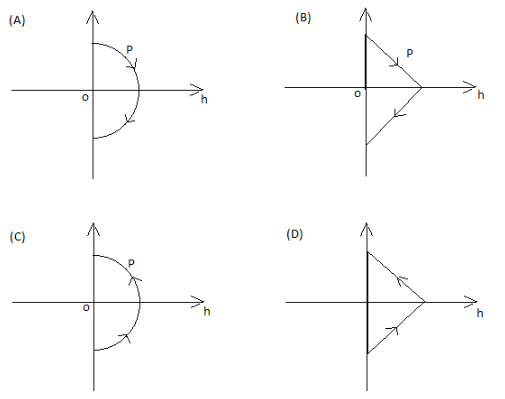
A ball is thrown vertically up (taken \[as{\text{ }} + z\] axis) from the ground. The correct momentum height (\[p - h\]) diagram is :
Answer
 Verified
603.3k+ views
Hint:Momentum, product of the mass of a particle and its velocity.
Momentum is a vector quantity as it has both magnitude and direction. It can be used to predict the resulting direction and speed of motion of objects after they collide. We can use the equation of motions under gravity,
Height \[h = \dfrac{{{u^2} - {p^2}/{m^2}}}{{2g}}\]
Complete step by step answer:
We know that equation for Momentum \[p = mv\]\[.......\left( 1 \right)\]
\[m\] is the mass of the body.
\[v\] is the velocity of the body.
For the motion under gravity
Height \[h = \dfrac{{{u^2} - {p^2}/{m^2}}}{{2g}}\]\[ \ldots ..\left( 2 \right)\]
\[u\] is the initial velocity of the mass.
\[g\] is the acceleration due to gravity.
\[g = 9.8m/{s^2}\]
\[h = \dfrac{{{u^2} - {p^2}/{m^2}}}{{2g}}\]
\[h = \dfrac{{{u^2}}}{{2g}} - \dfrac{{{p^2}}}{{2gm}}\]
This is exactly like a parabolic relation so we have two options that seem to be the same graph, but the direction of momentum shown is opposite. So for finding the direction of momentum we can further investigate the problem with the direction of velocity. We can consider the upward motion, velocity is positive, mass is a constant here. So the momentum is also positive. We can consider the downward motion, velocity is opposite direction. So it is negative. This also tells us the momentum is also negative. From our last equation, we can conclude that the velocity and height have a parabolic relationship.
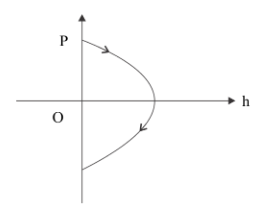
So the connect answer is option \[\left( A \right).\]
Note:There are two kinds of momentum linear and angular. A spinning object has angular momentum; an object traveling with a velocity has linear momentum. The most common symbol for momentum is \[P\]. The SI unit for momentum is \[kg{\text{ }}m/s\]. The dimensional formula for the momentum is \[ML{T^{ - 1}}\]. Momentum is conserved always in any type of collision.
Momentum is a vector quantity as it has both magnitude and direction. It can be used to predict the resulting direction and speed of motion of objects after they collide. We can use the equation of motions under gravity,
Height \[h = \dfrac{{{u^2} - {p^2}/{m^2}}}{{2g}}\]
Complete step by step answer:
We know that equation for Momentum \[p = mv\]\[.......\left( 1 \right)\]
\[m\] is the mass of the body.
\[v\] is the velocity of the body.
For the motion under gravity
Height \[h = \dfrac{{{u^2} - {p^2}/{m^2}}}{{2g}}\]\[ \ldots ..\left( 2 \right)\]
\[u\] is the initial velocity of the mass.
\[g\] is the acceleration due to gravity.
\[g = 9.8m/{s^2}\]
\[h = \dfrac{{{u^2} - {p^2}/{m^2}}}{{2g}}\]
\[h = \dfrac{{{u^2}}}{{2g}} - \dfrac{{{p^2}}}{{2gm}}\]
This is exactly like a parabolic relation so we have two options that seem to be the same graph, but the direction of momentum shown is opposite. So for finding the direction of momentum we can further investigate the problem with the direction of velocity. We can consider the upward motion, velocity is positive, mass is a constant here. So the momentum is also positive. We can consider the downward motion, velocity is opposite direction. So it is negative. This also tells us the momentum is also negative. From our last equation, we can conclude that the velocity and height have a parabolic relationship.
So the connect answer is option \[\left( A \right).\]
Note:There are two kinds of momentum linear and angular. A spinning object has angular momentum; an object traveling with a velocity has linear momentum. The most common symbol for momentum is \[P\]. The SI unit for momentum is \[kg{\text{ }}m/s\]. The dimensional formula for the momentum is \[ML{T^{ - 1}}\]. Momentum is conserved always in any type of collision.
Recently Updated Pages
Master Class 11 Social Science: Engaging Questions & Answers for Success

Master Class 11 Physics: Engaging Questions & Answers for Success
Master Class 11 Maths: Engaging Questions & Answers for Success
Master Class 11 Economics: Engaging Questions & Answers for Success
Master Class 11 Computer Science: Engaging Questions & Answers for Success
Master Class 11 Chemistry: Engaging Questions & Answers for Success
Trending doubts
One Metric ton is equal to kg A 10000 B 1000 C 100 class 11 physics CBSE
There are 720 permutations of the digits 1 2 3 4 5 class 11 maths CBSE
1 Quintal is equal to a 110 kg b 10 kg c 100kg d 1000 class 11 physics CBSE
State and prove Bernoullis theorem class 11 physics CBSE
Difference Between Prokaryotic Cells and Eukaryotic Cells
Which among the following are examples of coming together class 11 social science CBSE