




A ball is released from the top of the tower. The ratio of work done by force of gravity in first, second and third second of motion of the ball is.
A. 1:2:3
B. 1:4:9
C. 1:3:5
D. 1:5:3
Answer
 Verified
569.4k+ views
Hint: Work done is given by force multiplied by displacement, but the force acting on the ball is gravitational force, which is the same at any time. Therefore we have to find only the displacement of the ball in first, second and third second to calculate the ratio of work done in these time intervals.
Formula Used:
Work done is given by:
\[W=F.s\]
Equation of motion:
\[s=ut+\dfrac{1}{2}a{{t}^{2}}\]
Complete step by step answer:
In our question, a ball is released from the top of the tower that means the initial velocity is zero. Here the acceleration which is acting on the ball is only acceleration due to gravity which is constant. Therefore we are free to apply the equation of motion.
The distance travelled by the ball in first second of its motion is given by:
\[s=ut+\dfrac{1}{2}a{{t}^{2}}\]
Here, s is distance travelled in time t, u is the initial velocity and a is acceleration. Here acceleration is g and initial velocity is zero.
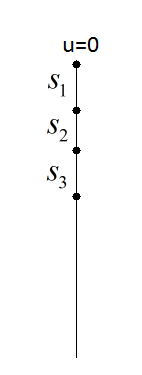
\[\begin{align}
& {{s}_{1}}=0\times 1+\dfrac{1}{2}g{{(1)}^{2}} \\
& {{s}_{1}}=\dfrac{g}{2} \\
\end{align}\]
Distance travelled in second second = distance travelled in two second minus distance travelled in first second of motion.
\[\begin{align}
& {{s}_{2}}=0\times 2+\dfrac{1}{2}g{{(2)}^{2}}-{{s}_{1}} \\
& {{s}_{2}}=\dfrac{4g}{2}-\dfrac{g}{2} \\
& {{s}_{2}}=\dfrac{3g}{2} \\
\end{align}\]
Distance travelled in third second = distance travelled in three seconds minus distance travelled in first two second.
\[\begin{align}
& {{s}_{3}}=0\times 3+\dfrac{1}{2}g{{(3)}^{2}}-0\times 2+\dfrac{1}{2}g{{(2)}^{2}} \\
& {{s}_{3}}=\dfrac{9g}{2}-\dfrac{4g}{2} \\
& {{s}_{3}}=\dfrac{5g}{2} \\
\end{align}\]
Now, taking the ratio of work done by force of gravity in first, second and third second of motion:
\[\begin{align}
& {{W}_{1}}:{{W}_{2}}:{{W}_{3}} \\
& =F{{s}_{1}}:F{{s}_{2}}:F{{s}_{3}} \\
& ={{s}_{1}}:{{s}_{2}}:{{s}_{3}} \\
& =\dfrac{g}{2}:\dfrac{3g}{2}:\dfrac{5g}{2} \\
& =1:3:5 \\
\end{align}\]
Hence, the ratio of work done by force of gravity in first, second and third second of motion is 1:3:5
Therefore, option C is correct.
Note: This question can also be done by applying the formula of distance travelled by body in \[{{n}^{th}}\] second.
\[{{s}_{n}}=u+\dfrac{a}{2}(2n-1)\]
Just put u=0 and a=g
\[{{s}_{1}}=\dfrac{g}{2}\], \[{{s}_{2}}=\dfrac{3g}{2}\], \[{{s}_{3}}=\dfrac{5g}{2}\]
If the particle starts from rest and moves with constant acceleration then the ratio of displacement in equal interval of time is.
\[{{s}_{1}}:{{s}_{2}}:{{s}_{3}}:{{s}_{4}}...=1:3:5:7...\]
Formula Used:
Work done is given by:
\[W=F.s\]
Equation of motion:
\[s=ut+\dfrac{1}{2}a{{t}^{2}}\]
Complete step by step answer:
In our question, a ball is released from the top of the tower that means the initial velocity is zero. Here the acceleration which is acting on the ball is only acceleration due to gravity which is constant. Therefore we are free to apply the equation of motion.
The distance travelled by the ball in first second of its motion is given by:
\[s=ut+\dfrac{1}{2}a{{t}^{2}}\]
Here, s is distance travelled in time t, u is the initial velocity and a is acceleration. Here acceleration is g and initial velocity is zero.
\[\begin{align}
& {{s}_{1}}=0\times 1+\dfrac{1}{2}g{{(1)}^{2}} \\
& {{s}_{1}}=\dfrac{g}{2} \\
\end{align}\]
Distance travelled in second second = distance travelled in two second minus distance travelled in first second of motion.
\[\begin{align}
& {{s}_{2}}=0\times 2+\dfrac{1}{2}g{{(2)}^{2}}-{{s}_{1}} \\
& {{s}_{2}}=\dfrac{4g}{2}-\dfrac{g}{2} \\
& {{s}_{2}}=\dfrac{3g}{2} \\
\end{align}\]
Distance travelled in third second = distance travelled in three seconds minus distance travelled in first two second.
\[\begin{align}
& {{s}_{3}}=0\times 3+\dfrac{1}{2}g{{(3)}^{2}}-0\times 2+\dfrac{1}{2}g{{(2)}^{2}} \\
& {{s}_{3}}=\dfrac{9g}{2}-\dfrac{4g}{2} \\
& {{s}_{3}}=\dfrac{5g}{2} \\
\end{align}\]
Now, taking the ratio of work done by force of gravity in first, second and third second of motion:
\[\begin{align}
& {{W}_{1}}:{{W}_{2}}:{{W}_{3}} \\
& =F{{s}_{1}}:F{{s}_{2}}:F{{s}_{3}} \\
& ={{s}_{1}}:{{s}_{2}}:{{s}_{3}} \\
& =\dfrac{g}{2}:\dfrac{3g}{2}:\dfrac{5g}{2} \\
& =1:3:5 \\
\end{align}\]
Hence, the ratio of work done by force of gravity in first, second and third second of motion is 1:3:5
Therefore, option C is correct.
Note: This question can also be done by applying the formula of distance travelled by body in \[{{n}^{th}}\] second.
\[{{s}_{n}}=u+\dfrac{a}{2}(2n-1)\]
Just put u=0 and a=g
\[{{s}_{1}}=\dfrac{g}{2}\], \[{{s}_{2}}=\dfrac{3g}{2}\], \[{{s}_{3}}=\dfrac{5g}{2}\]
If the particle starts from rest and moves with constant acceleration then the ratio of displacement in equal interval of time is.
\[{{s}_{1}}:{{s}_{2}}:{{s}_{3}}:{{s}_{4}}...=1:3:5:7...\]
Recently Updated Pages
Master Class 11 English: Engaging Questions & Answers for Success

Master Class 11 Social Science: Engaging Questions & Answers for Success
Master Class 11 Maths: Engaging Questions & Answers for Success
Master Class 11 Biology: Engaging Questions & Answers for Success
Master Class 11 Physics: Engaging Questions & Answers for Success
Master Class 11 Chemistry: Engaging Questions & Answers for Success
Trending doubts
One Metric ton is equal to kg A 10000 B 1000 C 100 class 11 physics CBSE
Difference Between Prokaryotic Cells and Eukaryotic Cells
Difference between physical and chemical change class 11 chemistry CBSE
Find the value of the expression given below sin 30circ class 11 maths CBSE
Two of the body parts which do not appear in MRI are class 11 biology CBSE
Draw a diagram of a plant cell and label at least eight class 11 biology CBSE