




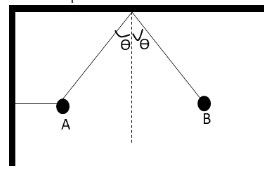
A ball is held at rest in position A in figure by two light cords. The horizontal cord is cut and the ball starts swinging as a pendulum. The ratio of the tension in the supporting cord in position B, to that in position A is
A. \[{\sin ^2}\theta \]
B. \[{\cos ^2}\theta \]
C. \[{\tan ^2}\theta \]
D. $1:1$
Answer
 Verified
635.1k+ views
Hint: Draw the free body diagram of the balls in position A and B. Use the expression for Newton’s second law of motion. Apply Newton’s second law of motion to the balls in at positions A and B and determine the values of tensions in the cords and then take the ratio of these tensions in the asked manner to calculate the final answer.
Formula used:
The expression for Newton’s second law of motion is
\[{F_{net}} = ma\]
Here, \[{F_{net}}\] is net force acting on the object, \[m\] is mass of the object and \[a\] is acceleration of the object.
Complete step by step answer:
Let \[m\] be the mass of the two balls. Let us draw the free body diagram of the two balls is as follows:
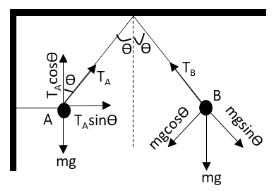
In the above free body diagram, \[mg\] is the weight of the two balls, \[{T_A}\] is the tension in the cord holding the ball at position A and \[{T_B}\] is the tension in the cord holding the ball at position B.
Let is apply Newton’s second law of motion to the ball at position A.
\[{T_A}\cos \theta = mg\]
\[ \Rightarrow {T_A} = \dfrac{{mg}}{{\cos \theta }}\]
Let is apply Newton’s second law of motion to the ball at position B.
\[{T_B} = mg\cos \theta \]
Now let us determine the ratio of the tensions in the cords.
\[ \Rightarrow \dfrac{{{T_B}}}{{{T_A}}} = \dfrac{{mg\cos \theta }}{{\dfrac{{mg}}{{\cos \theta }}}}\]
\[ \therefore \dfrac{{{T_B}}}{{{T_A}}} = {\cos ^2}\theta \]
Therefore, the ratio of the tension in the cord in position B to that in position A is \[{\cos ^2}\theta \].
Hence, the correct option is B.
Note: The students should be careful while drawing the free body diagram of eh balls at positions A and B. If this free body diagram is not drawn correctly with the correct directions and positions of all the forces then the expressions for the tensions in the cords will be incorrect and hence the final answer will also be incorrect.
Formula used:
The expression for Newton’s second law of motion is
\[{F_{net}} = ma\]
Here, \[{F_{net}}\] is net force acting on the object, \[m\] is mass of the object and \[a\] is acceleration of the object.
Complete step by step answer:
Let \[m\] be the mass of the two balls. Let us draw the free body diagram of the two balls is as follows:
In the above free body diagram, \[mg\] is the weight of the two balls, \[{T_A}\] is the tension in the cord holding the ball at position A and \[{T_B}\] is the tension in the cord holding the ball at position B.
Let is apply Newton’s second law of motion to the ball at position A.
\[{T_A}\cos \theta = mg\]
\[ \Rightarrow {T_A} = \dfrac{{mg}}{{\cos \theta }}\]
Let is apply Newton’s second law of motion to the ball at position B.
\[{T_B} = mg\cos \theta \]
Now let us determine the ratio of the tensions in the cords.
\[ \Rightarrow \dfrac{{{T_B}}}{{{T_A}}} = \dfrac{{mg\cos \theta }}{{\dfrac{{mg}}{{\cos \theta }}}}\]
\[ \therefore \dfrac{{{T_B}}}{{{T_A}}} = {\cos ^2}\theta \]
Therefore, the ratio of the tension in the cord in position B to that in position A is \[{\cos ^2}\theta \].
Hence, the correct option is B.
Note: The students should be careful while drawing the free body diagram of eh balls at positions A and B. If this free body diagram is not drawn correctly with the correct directions and positions of all the forces then the expressions for the tensions in the cords will be incorrect and hence the final answer will also be incorrect.
Recently Updated Pages
If x a + bt + ct2 where x is in meters and t is in class 11 physics CBSE

A car covers the first half distance between two places class 11 physics CBSE
The resultant of two vectors overrightarrow P and overrightarrow class 11 physics CBSE
Find the value of cos 135 class 11 maths CBSE
A mass M is held in place by an applied force F and class 11 physics CBSE
A solution of glucose in water is labelled as 10 dfracwv class 11 chemistry CBSE
Trending doubts
Find the value of the expression given below sin 30circ class 11 maths CBSE
One Metric ton is equal to kg A 10000 B 1000 C 100 class 11 physics CBSE
Draw a diagram of nephron and explain its structur class 11 biology CBSE
10 examples of friction in our daily life
Proton was discovered by A Thomson B Rutherford C Chadwick class 11 chemistry CBSE
Bond order ofO2 O2+ O2 and O22 is in order A O2 langle class 11 chemistry CBSE