




A ball impinges directly on another ball at rest. The first ball is brought to rest by the impact. If half of the kinetic energy is lost by the impact, the value of the coefficient of the restitution is:
$
(a)\dfrac{1}{2} \\
(b)\dfrac{1}{{\sqrt 3 }} \\
(c)\dfrac{1}{{\sqrt 2 }} \\
(d)\dfrac{{\sqrt 3 }}{2} \\
$
Answer
 Verified
637.5k+ views
- Hint: In this question consider two scenarios: the first one before the collision and the second one after the collision. Apply the concept of conservation of linear momentum using the fact that momentum is nothing but the product of mass and the velocity. The coefficient of restitution (e) is the magnitude of the ratio of difference of velocity after collision to before collision and the energy lost $\left( {\Delta E} \right)$ is the difference of initial kinetic energy and the final kinetic energy. This will help approaching the problem.
Complete step-by-step solution -
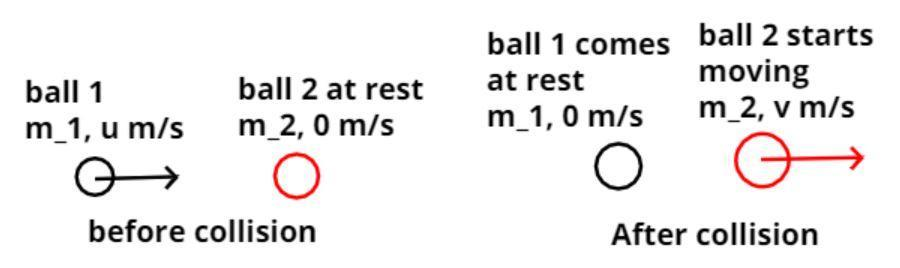
Given data:
Let the initial velocity of the first ball be u m/s.
Strikes another ball which is at rest. After collision the first ball comes at rest so the final velocity (v) of the first ball becomes zero (0) and the second ball gains some velocity.
Let the initial velocity of the second ball be v m/s.
So according to conservation of momentum we have,
As momentum is the product of mass and velocity.
Let the mass of the first ball be ${m_1}$ and the mass of the second ball be ${m_2}$
Therefore,
$ \Rightarrow {m_1}.u + {m_2}\left( 0 \right) = {m_1}\left( 0 \right) + {m_2}\left( v \right)$
$ \Rightarrow u{m_1} = v{m_2}$................... (1)
Now the coefficient of restitution (e) is the magnitude of the ratio of difference of velocity after collision to before collision therefore,
$ \Rightarrow e = \left| {\dfrac{{0 - v}}{{u - 0}}} \right|$
Now simplify this we have,
$ \Rightarrow e = \dfrac{v}{u}$..................... (2)
Now the initial kinetic energy of the ball is,
$ \Rightarrow {\left( {K.E} \right)_{ini}} = \dfrac{1}{2}{m_1}{u^2}$
And the final kinetic energy of the ball is
$ \Rightarrow {\left( {K.E} \right)_{final}} = \dfrac{1}{2}{m_2}{v^2}$
Now energy lost $\left( {\Delta E} \right)$ is the difference of initial kinetic energy and the final kinetic energy.
$ \Rightarrow \Delta E = \dfrac{1}{2}{m_1}{u^2} - \dfrac{1}{2}{m_2}{v^2}$............ (3)
Now it is given that half of the kinetic energy is lost during impact.
$ \Rightarrow \Delta E = \dfrac{1}{2}{\left( {K.E} \right)_{ini}}$
$ \Rightarrow \Delta E = \dfrac{1}{2}\left( {\dfrac{1}{2}{m_1}{u^2}} \right)$........... (4)
Now by equation (3) and (4) we have,
$ \Rightarrow \dfrac{1}{2}\left( {\dfrac{1}{2}{m_1}{u^2}} \right) = \dfrac{1}{2}{m_1}{u^2} - \dfrac{1}{2}{m_2}{v^2}$
Now simplify this we have,
$ \Rightarrow \dfrac{1}{4}{m_1}{u^2} = \dfrac{1}{2}{m_1}{u^2} - \dfrac{1}{2}{m_2}{v^2}$
$ \Rightarrow \dfrac{1}{2}{m_1}{u^2} - \dfrac{1}{4}{m_1}{u^2} = \dfrac{1}{2}{m_2}{v^2}$
$ \Rightarrow \dfrac{1}{4}{m_1}{u^2} = \dfrac{1}{2}{m_2}{v^2}$.................. (5)
Now from equation (1) we have,
$ \Rightarrow {m_1} = \dfrac{v}{u}{m_2}$
Substitute this value in equation (5) we have,
$ \Rightarrow \dfrac{1}{4}\left( {\dfrac{v}{u}{m_2}} \right){u^2} = \dfrac{1}{2}{m_2}{v^2}$
$ \Rightarrow \dfrac{1}{2}u = v$
$ \Rightarrow \dfrac{v}{u} = \dfrac{1}{2}$............. (6)
Now from equation (2) and (6) we have,
$ \Rightarrow e = \dfrac{1}{2}$
So this is the required coefficient of restitution.
Hence option (A) is the correct answer.
Note – The above shown scenario is not that one of perfectly inelastic collision as in that case the body tends to stick together and move with a combined velocity, whenever we see a problem stating the bodies stick together after the collision, directly think of perfectly inelastic collision and the coefficient of restitution can directly be marked as 0 in that case, but however not in this case.
Complete step-by-step solution -
Given data:
Let the initial velocity of the first ball be u m/s.
Strikes another ball which is at rest. After collision the first ball comes at rest so the final velocity (v) of the first ball becomes zero (0) and the second ball gains some velocity.
Let the initial velocity of the second ball be v m/s.
So according to conservation of momentum we have,
As momentum is the product of mass and velocity.
Let the mass of the first ball be ${m_1}$ and the mass of the second ball be ${m_2}$
Therefore,
$ \Rightarrow {m_1}.u + {m_2}\left( 0 \right) = {m_1}\left( 0 \right) + {m_2}\left( v \right)$
$ \Rightarrow u{m_1} = v{m_2}$................... (1)
Now the coefficient of restitution (e) is the magnitude of the ratio of difference of velocity after collision to before collision therefore,
$ \Rightarrow e = \left| {\dfrac{{0 - v}}{{u - 0}}} \right|$
Now simplify this we have,
$ \Rightarrow e = \dfrac{v}{u}$..................... (2)
Now the initial kinetic energy of the ball is,
$ \Rightarrow {\left( {K.E} \right)_{ini}} = \dfrac{1}{2}{m_1}{u^2}$
And the final kinetic energy of the ball is
$ \Rightarrow {\left( {K.E} \right)_{final}} = \dfrac{1}{2}{m_2}{v^2}$
Now energy lost $\left( {\Delta E} \right)$ is the difference of initial kinetic energy and the final kinetic energy.
$ \Rightarrow \Delta E = \dfrac{1}{2}{m_1}{u^2} - \dfrac{1}{2}{m_2}{v^2}$............ (3)
Now it is given that half of the kinetic energy is lost during impact.
$ \Rightarrow \Delta E = \dfrac{1}{2}{\left( {K.E} \right)_{ini}}$
$ \Rightarrow \Delta E = \dfrac{1}{2}\left( {\dfrac{1}{2}{m_1}{u^2}} \right)$........... (4)
Now by equation (3) and (4) we have,
$ \Rightarrow \dfrac{1}{2}\left( {\dfrac{1}{2}{m_1}{u^2}} \right) = \dfrac{1}{2}{m_1}{u^2} - \dfrac{1}{2}{m_2}{v^2}$
Now simplify this we have,
$ \Rightarrow \dfrac{1}{4}{m_1}{u^2} = \dfrac{1}{2}{m_1}{u^2} - \dfrac{1}{2}{m_2}{v^2}$
$ \Rightarrow \dfrac{1}{2}{m_1}{u^2} - \dfrac{1}{4}{m_1}{u^2} = \dfrac{1}{2}{m_2}{v^2}$
$ \Rightarrow \dfrac{1}{4}{m_1}{u^2} = \dfrac{1}{2}{m_2}{v^2}$.................. (5)
Now from equation (1) we have,
$ \Rightarrow {m_1} = \dfrac{v}{u}{m_2}$
Substitute this value in equation (5) we have,
$ \Rightarrow \dfrac{1}{4}\left( {\dfrac{v}{u}{m_2}} \right){u^2} = \dfrac{1}{2}{m_2}{v^2}$
$ \Rightarrow \dfrac{1}{2}u = v$
$ \Rightarrow \dfrac{v}{u} = \dfrac{1}{2}$............. (6)
Now from equation (2) and (6) we have,
$ \Rightarrow e = \dfrac{1}{2}$
So this is the required coefficient of restitution.
Hence option (A) is the correct answer.
Note – The above shown scenario is not that one of perfectly inelastic collision as in that case the body tends to stick together and move with a combined velocity, whenever we see a problem stating the bodies stick together after the collision, directly think of perfectly inelastic collision and the coefficient of restitution can directly be marked as 0 in that case, but however not in this case.
Recently Updated Pages
Master Class 12 Economics: Engaging Questions & Answers for Success

Master Class 12 English: Engaging Questions & Answers for Success
Master Class 12 Social Science: Engaging Questions & Answers for Success
Master Class 12 Maths: Engaging Questions & Answers for Success
Master Class 12 Physics: Engaging Questions & Answers for Success
Master Class 9 General Knowledge: Engaging Questions & Answers for Success
Trending doubts
One Metric ton is equal to kg A 10000 B 1000 C 100 class 11 physics CBSE
Difference Between Prokaryotic Cells and Eukaryotic Cells
Find the value of the expression given below sin 30circ class 11 maths CBSE
Two of the body parts which do not appear in MRI are class 11 biology CBSE
Draw a diagram of nephron and explain its structur class 11 biology CBSE
10 examples of friction in our daily life