




A bacterial cell undergoes binary fission every twenty minutes. Starting with a single bacterium how many bacteria will form after 3 hours?
a. 128
b. 256
c. 512
d. 1024
Answer
 Verified
660.6k+ views
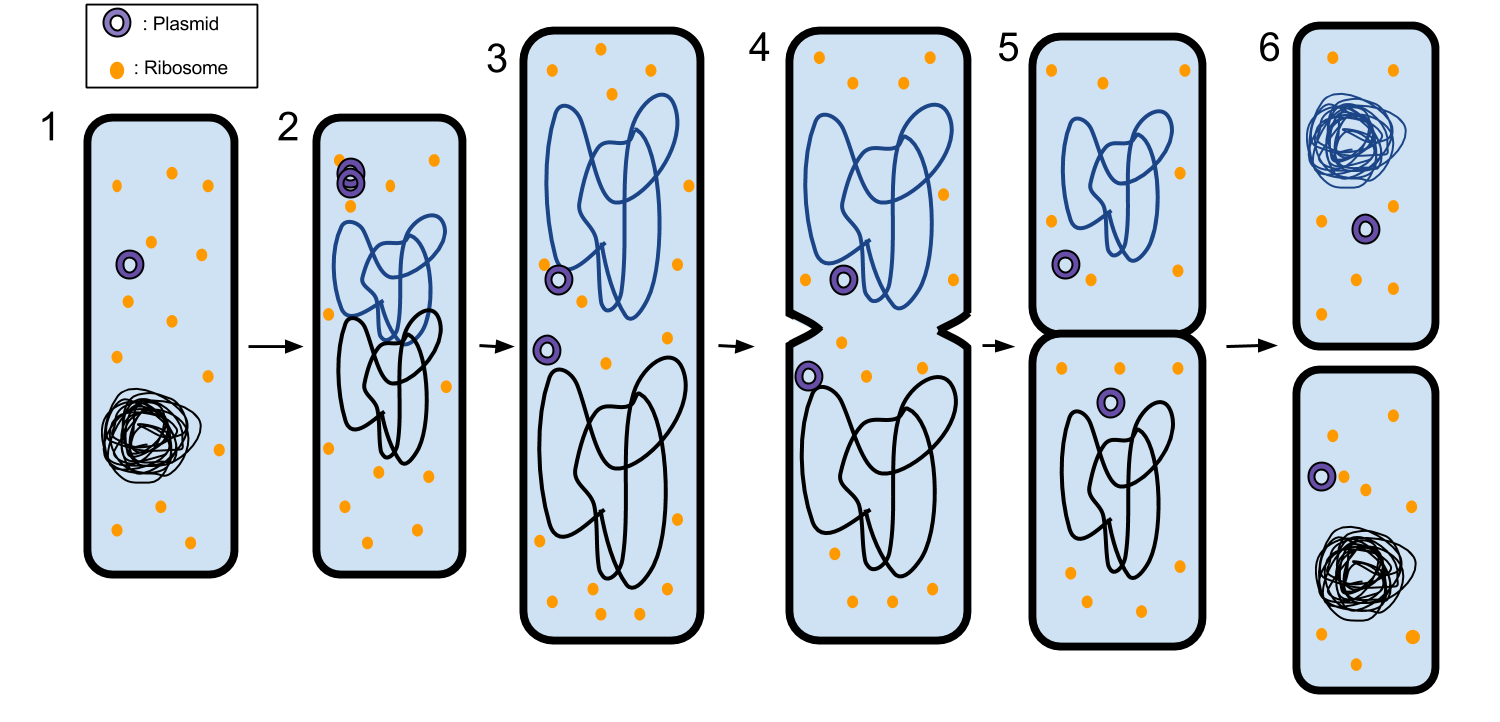
Hint: When cells separate by mitosis in the body of a multicellular organism, they eventually cause the organism to nurture larger or replace old, worn-out cells with new ones. Bacterial binary fission is the route that bacteria use to do cell division. Binary fission is analogous in concept to the mitosis that occurs in multicellular organisms (such as plants and animals), but its intention is different.
Complete answer:
In the case of a bacterium, though, cell division is not just a way of creating more cells for the body. Instead, it’s truly how bacteria reproduce or add more bacteria to the population.
The parent cell splits to form two daughter cells with the help of binary fission. There is a distinct bacterial cell that divides after every 20 minutes via binary fission.
Given that the bacterial cell divides for three hours, in which there are 180 minutes. The bacterial cell replicates (180/20= 9) i.e., 9 times in 3 hours. So, the full amount of numbers of bacteria produced after 3 hours are 512 cells.
Hence, the correct answer is option (C).
Note: In Bacteria, replication persists until the entire chromosome is copied and the replication enzymes assemble at the far side. Once the new chromosomes have moved to opposite cell ends and left the center of the cell, the division of the cytoplasm can happen. In this development, the membrane pinches inmost and a septum, or fresh dividing wall, creates down the middle of the cell. (Bacteria have a cell wall, so they have to redevelop this wall when they go through cell division).
Complete answer:
In the case of a bacterium, though, cell division is not just a way of creating more cells for the body. Instead, it’s truly how bacteria reproduce or add more bacteria to the population.
The parent cell splits to form two daughter cells with the help of binary fission. There is a distinct bacterial cell that divides after every 20 minutes via binary fission.
Given that the bacterial cell divides for three hours, in which there are 180 minutes. The bacterial cell replicates (180/20= 9) i.e., 9 times in 3 hours. So, the full amount of numbers of bacteria produced after 3 hours are 512 cells.
Hence, the correct answer is option (C).
Note: In Bacteria, replication persists until the entire chromosome is copied and the replication enzymes assemble at the far side. Once the new chromosomes have moved to opposite cell ends and left the center of the cell, the division of the cytoplasm can happen. In this development, the membrane pinches inmost and a septum, or fresh dividing wall, creates down the middle of the cell. (Bacteria have a cell wall, so they have to redevelop this wall when they go through cell division).
Recently Updated Pages
Which will be the least stable resonating structure class 11 chemistry CBSE

How many 5 digit telephone numbers can be construc-class-11-maths-CBSE
How do you find the angle of the resultant vector class 11 physics CBSE
Draw labelled diagram of the following i Gram seed class 11 biology CBSE
1 Quintal is equal to a 110 kg b 10 kg c 100kg d 1000 class 11 physics CBSE
What is the need and importance of classification class 11 biology CBSE
Trending doubts
Find the value of the expression given below sin 30circ class 11 maths CBSE
One Metric ton is equal to kg A 10000 B 1000 C 100 class 11 physics CBSE
10 examples of friction in our daily life
Draw a diagram of a plant cell and label at least eight class 11 biology CBSE
Difference between physical and chemical change class 11 chemistry CBSE
Proton was discovered by A Thomson B Rutherford C Chadwick class 11 chemistry CBSE