




a, b are the intercepts made by a line on the axes such that $\dfrac{1}{a} + \dfrac{1}{b} = \dfrac{1}{c}$. Then the line passes through the points
A.(1,1)
B.(a,a)
C.(c,c)
D.$\left( {\dfrac{1}{c},\dfrac{1}{c}} \right)$
Answer
 Verified
584.4k+ views
Hint: In this question, we need to determine the coordinates of the point through which the line passes, making an intercept of a and b on the axes. For this, we will establish the equation of the line first and then compare the same with the given condition in the question $\dfrac{1}{a} + \dfrac{1}{b} = \dfrac{1}{c}$.
Complete step-by-step answer:
Let the line make an intercept of ‘a’ on the x-axis and ‘b’ on the y-axis such. The following figure depicts the same.
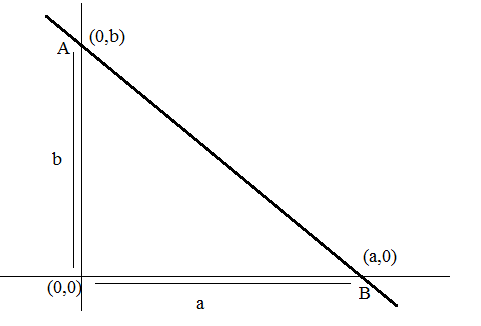
From the figure, we can see that the coordinates of points A and B are given as A(0,b) and B(a,0), respectively.
Following the property of the equation of the line segment joining two points is given as:
$\Rightarrow y - {y_1} = \dfrac{{{y_2} - {y_1}}}{{{x_2} - {x_1}}}\left( {x - {x_1}} \right)$ where $\left( {{x_1},{y_1}} \right)$ and $\left( {{x_2},{y_2}} \right)$ are the endpoints of the line segments.
Here, $ \left( {{x_1},{y_1}} \right) \equiv \left( {0,b} \right)$ and $\left( {{x_2},{y_2}} \right) \equiv \left( {a,0} \right)$. So, substitute these values in the equation $\Rightarrow y - {y_1} = \dfrac{{{y_2} - {y_1}}}{{{x_2} - {x_1}}}\left( {x - {x_1}} \right)$ to establish the equation of the line segment AB.
$
\Rightarrow y - {y_1} = \dfrac{{{y_2} - {y_1}}}{{{x_2} - {x_1}}}\left( {x - {x_1}} \right) \\
\Rightarrow y - b = \dfrac{{0 - b}}{{a - 0}}\left( {x - 0} \right) \\
\Rightarrow y - b = \dfrac{{ - bx}}{a} \\
$
Rearranging the terms in the above equation, we get
$
\Rightarrow y - b = \dfrac{{ - bx}}{a} \\
\Rightarrow ya - ab = - bx \\
\Rightarrow bx + ay = ab - - - - (i) \\
$
It is given in the question that the line also follows the equation $\dfrac{1}{a} + \dfrac{1}{b} = \Rightarrow \dfrac{1}{c}$ , so, rearranging the given equation, we get
$
\Rightarrow \dfrac{1}{a} + \dfrac{1}{b} = \dfrac{1}{c} \\
\Rightarrow \dfrac{{a + b}}{{ab}} = \dfrac{1}{c} \\
\Rightarrow ac + bc = ab - - - - (ii) \\
$
Now, comparing the equations (i) and (ii), we get
$
\Rightarrow bx + ay = ab{\text{ and }}ab = ac + bc \\
\Rightarrow bx + ay = ac + bc \\
\Rightarrow x = c{\text{ and }}y = c \\
$
Hence, $(x,y) \equiv (c,c)$
As, x and y are the coordinates on the line segment AB so, the line will pass through (x,y), which is equivalent to (c,c).
Hence, we can say that the line will pass through the point (c,c).
So, the correct answer is “Option C”.
Note: Here, we have taken a and b as the intercept on the x and y- axes, respectively, but the students can also take a as the y-intercept and b as the x-intercept. It will not change the answer. Moreover, the selection of the points $({x_1},{y_1})$ can also be taken as either of the endpoints of the line AB.
Complete step-by-step answer:
Let the line make an intercept of ‘a’ on the x-axis and ‘b’ on the y-axis such. The following figure depicts the same.
From the figure, we can see that the coordinates of points A and B are given as A(0,b) and B(a,0), respectively.
Following the property of the equation of the line segment joining two points is given as:
$\Rightarrow y - {y_1} = \dfrac{{{y_2} - {y_1}}}{{{x_2} - {x_1}}}\left( {x - {x_1}} \right)$ where $\left( {{x_1},{y_1}} \right)$ and $\left( {{x_2},{y_2}} \right)$ are the endpoints of the line segments.
Here, $ \left( {{x_1},{y_1}} \right) \equiv \left( {0,b} \right)$ and $\left( {{x_2},{y_2}} \right) \equiv \left( {a,0} \right)$. So, substitute these values in the equation $\Rightarrow y - {y_1} = \dfrac{{{y_2} - {y_1}}}{{{x_2} - {x_1}}}\left( {x - {x_1}} \right)$ to establish the equation of the line segment AB.
$
\Rightarrow y - {y_1} = \dfrac{{{y_2} - {y_1}}}{{{x_2} - {x_1}}}\left( {x - {x_1}} \right) \\
\Rightarrow y - b = \dfrac{{0 - b}}{{a - 0}}\left( {x - 0} \right) \\
\Rightarrow y - b = \dfrac{{ - bx}}{a} \\
$
Rearranging the terms in the above equation, we get
$
\Rightarrow y - b = \dfrac{{ - bx}}{a} \\
\Rightarrow ya - ab = - bx \\
\Rightarrow bx + ay = ab - - - - (i) \\
$
It is given in the question that the line also follows the equation $\dfrac{1}{a} + \dfrac{1}{b} = \Rightarrow \dfrac{1}{c}$ , so, rearranging the given equation, we get
$
\Rightarrow \dfrac{1}{a} + \dfrac{1}{b} = \dfrac{1}{c} \\
\Rightarrow \dfrac{{a + b}}{{ab}} = \dfrac{1}{c} \\
\Rightarrow ac + bc = ab - - - - (ii) \\
$
Now, comparing the equations (i) and (ii), we get
$
\Rightarrow bx + ay = ab{\text{ and }}ab = ac + bc \\
\Rightarrow bx + ay = ac + bc \\
\Rightarrow x = c{\text{ and }}y = c \\
$
Hence, $(x,y) \equiv (c,c)$
As, x and y are the coordinates on the line segment AB so, the line will pass through (x,y), which is equivalent to (c,c).
Hence, we can say that the line will pass through the point (c,c).
So, the correct answer is “Option C”.
Note: Here, we have taken a and b as the intercept on the x and y- axes, respectively, but the students can also take a as the y-intercept and b as the x-intercept. It will not change the answer. Moreover, the selection of the points $({x_1},{y_1})$ can also be taken as either of the endpoints of the line AB.
Recently Updated Pages
Master Class 11 Business Studies: Engaging Questions & Answers for Success

Master Class 11 Economics: Engaging Questions & Answers for Success
Master Class 11 Computer Science: Engaging Questions & Answers for Success
Master Class 11 English: Engaging Questions & Answers for Success
Master Class 11 Maths: Engaging Questions & Answers for Success
Master Class 11 Biology: Engaging Questions & Answers for Success
Trending doubts
One Metric ton is equal to kg A 10000 B 1000 C 100 class 11 physics CBSE
Discuss the various forms of bacteria class 11 biology CBSE
Draw a diagram of a plant cell and label at least eight class 11 biology CBSE
State the laws of reflection of light
Explain zero factorial class 11 maths CBSE
10 examples of friction in our daily life