




A, B and C are three collinear points. The coordinates of A and B are $ \left( 3,4 \right) $ and $ \left( 7,7 \right) $ respectively and $ AC=10 $ units. Find the sum of the coordinates of C.
Answer
 Verified
633.9k+ views
Hint: If three points A, B and C are collinear in that order, then $ AB+BC=AC $.
The section formula gives the coordinates of a point $ P\left( x,y \right) $ which divides the line joining two points $ A\left( {{x}_{1}},{{y}_{1}} \right) $ and $ B\left( {{x}_{2}},{{y}_{2}} \right) $ in the ratio $ AP:PB=m:n $, internally or externally.
For internal division: $ P(x,y)=\left( \dfrac{m{{x}_{2}}+n{{x}_{1}}}{m+n},\dfrac{m{{y}_{2}}+n{{y}_{1}}}{m+n} \right) $.
For external division: $ P(x,y)=\left( \dfrac{m{{x}_{2}}-n{{x}_{1}}}{m-n},\dfrac{m{{y}_{2}}-n{{y}_{1}}}{m-n} \right) $.
The distance between two points $ A\left( {{x}_{1}},{{y}_{1}} \right) $ and $ B\left( {{x}_{2}},{{y}_{2}} \right) $ can be calculated by using the Pythagoras' theorem. It is given by $ A{{B}^{2}}={{({{x}_{1}}-{{x}_{2}})}^{2}}+{{({{y}_{1}}-{{y}_{2}})}^{2}} $.
Assume the coordinates of C to be $ \left( x,y \right) $. Use the section formula to find the values of $ x $ and $ y $.
Complete step by step answer:
The two given points are $ A\left( 3,4 \right) $ and $ B\left( 7,7 \right) $. Let's say that the coordinates of the third point are $ C\left( x,y \right) $.
We can find the distance AB using the formula for the distance:
$ A{{B}^{2}}={{(3-7)}^{2}}+{{(4-7)}^{2}} $
⇒ $ A{{B}^{2}}={{4}^{2}}+{{3}^{2}} $
⇒ $ A{{B}^{2}}=16+9 $
⇒ $ A{{B}^{2}}=25 $
⇒ $ AB=5 $
We are also given that $ AC=10 $.
Since the points are given to be collinear and $ AC>AB $, either A is between B and C or B is between A and C. The two positions of the point C are shown in the diagram below:
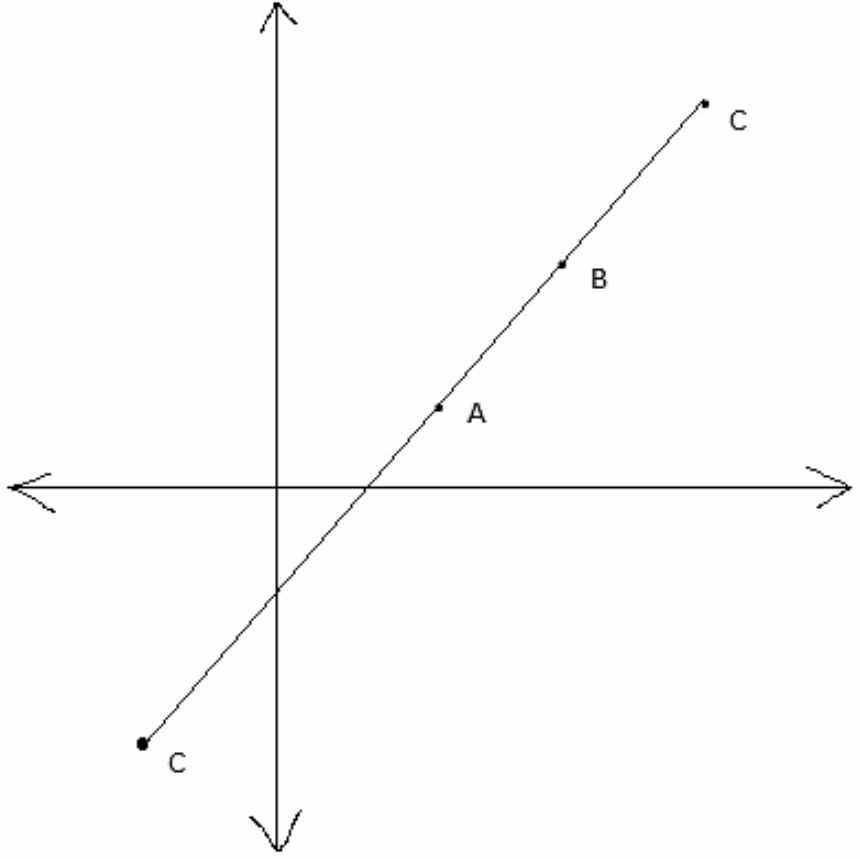
We have the following two cases:
CASE 1: A divides BC in the ratio $ BA:AC=5:10=1:2 $ internally.
Using the section formula, $ A(3,4)=\left( \dfrac{2(7)+1(x)}{2+1},\dfrac{2(7)+1(y)}{2+1} \right) $.
⇒ $ 3=\dfrac{14+x}{3} $ and $ 4=\dfrac{14+y}{3} $
⇒ $ 9=14+x $ and $ 12=14+y $
⇒ $ x=-5 $ and $ y=-2 $
CASE 2: B divides AC in the ratio $ AB:BC=5:5=1:1 $ internally.
Using the section formula, $ B(7,7)=\left( \dfrac{1(3)+1(x)}{1+1},\dfrac{1(4)+1(y)}{1+1} \right) $.
⇒ $ 7=\dfrac{3+x}{2} $ and $ 7=\dfrac{4+y}{2} $
⇒ $ 14=3+x $ and $ 14=4+y $
⇒ $ x=11 $ and $ y=10 $
Therefore, the coordinates of C are either $ C\left( -5,-2 \right) $ or $ C\left( 11,10 \right) $.
The sum of the coordinates of C will be either $ -5+(-2)=-7 $ or $ 11+10=21 $.
Note: The question can also be solved using the distance formula.
For three points $ A\left( {{x}_{1}},{{y}_{1}} \right) $, $ B\left( {{x}_{2}},{{y}_{2}} \right) $ and $ C\left( {{x}_{3}},{{y}_{3}} \right) $ to be collinear, the slope of each line segment should be same. i.e. $ \dfrac{{{x}_{1}}-{{x}_{2}}}{{{y}_{1}}-{{y}_{2}}}=\dfrac{{{x}_{2}}-{{x}_{3}}}{{{y}_{2}}-{{y}_{3}}}=\dfrac{{{x}_{3}}-{{x}_{1}}}{{{y}_{3}}-{{y}_{1}}} $.
There are many ways to show that three points A, B and C are collinear (in a straight line):
Section formula (Ratio / Slope method).
Distance method: $ AB+BC=AC $.
Area method: $ \text{Area of }\Delta ABC=0 $.
The section formula gives the coordinates of a point $ P\left( x,y \right) $ which divides the line joining two points $ A\left( {{x}_{1}},{{y}_{1}} \right) $ and $ B\left( {{x}_{2}},{{y}_{2}} \right) $ in the ratio $ AP:PB=m:n $, internally or externally.
For internal division: $ P(x,y)=\left( \dfrac{m{{x}_{2}}+n{{x}_{1}}}{m+n},\dfrac{m{{y}_{2}}+n{{y}_{1}}}{m+n} \right) $.
For external division: $ P(x,y)=\left( \dfrac{m{{x}_{2}}-n{{x}_{1}}}{m-n},\dfrac{m{{y}_{2}}-n{{y}_{1}}}{m-n} \right) $.
The distance between two points $ A\left( {{x}_{1}},{{y}_{1}} \right) $ and $ B\left( {{x}_{2}},{{y}_{2}} \right) $ can be calculated by using the Pythagoras' theorem. It is given by $ A{{B}^{2}}={{({{x}_{1}}-{{x}_{2}})}^{2}}+{{({{y}_{1}}-{{y}_{2}})}^{2}} $.
Assume the coordinates of C to be $ \left( x,y \right) $. Use the section formula to find the values of $ x $ and $ y $.
Complete step by step answer:
The two given points are $ A\left( 3,4 \right) $ and $ B\left( 7,7 \right) $. Let's say that the coordinates of the third point are $ C\left( x,y \right) $.
We can find the distance AB using the formula for the distance:
$ A{{B}^{2}}={{(3-7)}^{2}}+{{(4-7)}^{2}} $
⇒ $ A{{B}^{2}}={{4}^{2}}+{{3}^{2}} $
⇒ $ A{{B}^{2}}=16+9 $
⇒ $ A{{B}^{2}}=25 $
⇒ $ AB=5 $
We are also given that $ AC=10 $.
Since the points are given to be collinear and $ AC>AB $, either A is between B and C or B is between A and C. The two positions of the point C are shown in the diagram below:
We have the following two cases:
CASE 1: A divides BC in the ratio $ BA:AC=5:10=1:2 $ internally.
Using the section formula, $ A(3,4)=\left( \dfrac{2(7)+1(x)}{2+1},\dfrac{2(7)+1(y)}{2+1} \right) $.
⇒ $ 3=\dfrac{14+x}{3} $ and $ 4=\dfrac{14+y}{3} $
⇒ $ 9=14+x $ and $ 12=14+y $
⇒ $ x=-5 $ and $ y=-2 $
CASE 2: B divides AC in the ratio $ AB:BC=5:5=1:1 $ internally.
Using the section formula, $ B(7,7)=\left( \dfrac{1(3)+1(x)}{1+1},\dfrac{1(4)+1(y)}{1+1} \right) $.
⇒ $ 7=\dfrac{3+x}{2} $ and $ 7=\dfrac{4+y}{2} $
⇒ $ 14=3+x $ and $ 14=4+y $
⇒ $ x=11 $ and $ y=10 $
Therefore, the coordinates of C are either $ C\left( -5,-2 \right) $ or $ C\left( 11,10 \right) $.
The sum of the coordinates of C will be either $ -5+(-2)=-7 $ or $ 11+10=21 $.
Note: The question can also be solved using the distance formula.
For three points $ A\left( {{x}_{1}},{{y}_{1}} \right) $, $ B\left( {{x}_{2}},{{y}_{2}} \right) $ and $ C\left( {{x}_{3}},{{y}_{3}} \right) $ to be collinear, the slope of each line segment should be same. i.e. $ \dfrac{{{x}_{1}}-{{x}_{2}}}{{{y}_{1}}-{{y}_{2}}}=\dfrac{{{x}_{2}}-{{x}_{3}}}{{{y}_{2}}-{{y}_{3}}}=\dfrac{{{x}_{3}}-{{x}_{1}}}{{{y}_{3}}-{{y}_{1}}} $.
There are many ways to show that three points A, B and C are collinear (in a straight line):
Section formula (Ratio / Slope method).
Distance method: $ AB+BC=AC $.
Area method: $ \text{Area of }\Delta ABC=0 $.
Recently Updated Pages
Write any three differences between metals and nonmetals class 10 social science CBSE

Amit standing on a horizontal plane finds a bird flying class 10 maths CBSE
Two circles of radii 5 cm and 3 cm intersect at two class 10 maths CBSE
Solve the following i John and Jivanti together have class 10 maths CBSE
What is the relation between orthocenter circumcentre class 10 maths CBSE
Two plane mirrors are inclined at 70circ A ray incident class 10 physics CBSE
Trending doubts
Explain the Treaty of Vienna of 1815 class 10 social science CBSE
Which country is known as "The land of Fire and Ice"?
1 GB equals how many MB?
10 examples of evaporation in daily life with explanations
What is the full form of POSCO class 10 social science CBSE
Make a sketch of the human nerve cell What function class 10 biology CBSE