




What do $a$ and $b$ represent in the standard form of the equation for an ellipse?
Answer
 Verified
521.7k+ views
Hint: We explain the general equation of an ellipse and show with the help of an example what the terms $a$ and $b$ represent in the equation of an ellipse. The general form of the equation of an ellipse is given by $\dfrac{{{x}^{2}}}{{{a}^{2}}}+\dfrac{{{y}^{2}}}{{{b}^{2}}}=1.$
Complete step by step solution:
In order to answer this question, let us first explain the general equation of an ellipse and what an ellipse is. An ellipse is a curve such that it is formed by the locus of all the points such that the sum of their distances from two fixed points called foci is constant. The general equation for an ellipse is given by $\dfrac{{{x}^{2}}}{{{a}^{2}}}+\dfrac{{{y}^{2}}}{{{b}^{2}}}=1.$ Here, a and be stand for the major axis and minor axis respectively. It represents the length along the x-axis and y-axis respectively. Let us explain this with the help of an example.
Consider the equation of the ellipse as,
$\Rightarrow \dfrac{{{x}^{2}}}{{{3}^{2}}}+\dfrac{{{y}^{2}}}{{{1.5}^{2}}}=1$
Let us plot this as shown in the figure below.
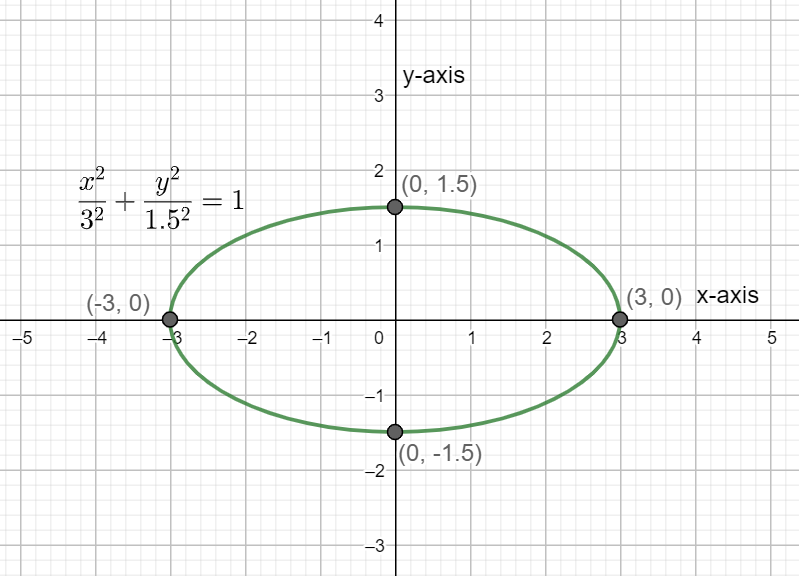
The major axis or a is given by the value 3. This measures its value along the length of the x-axis from the centre or origin to one end of the ellipse. Similarly, the minor axis or b is given by the value 1.5. This measures its value along the length of the y-axis from the centre or origin to one end of the ellipse.
We have plotted the corresponding points on the edges of the ellipse as $\left( a,0 \right)$ and $\left( -a,0 \right),$ which are the ends of the ellipse on the x-axis. These points are $\left( 3,0 \right)$ and $\left( -3,0 \right)$ respectively. Similarly, we have plotted the corresponding points on the edges of the ellipse along the y-axis as $\left( 0,b \right)$ and $\left( 0,-b \right).$ These points are $\left( 0,1.5 \right)$ and $\left( 0,-1.5 \right)$ respectively.
Hence, $a$ and $b$ represent the major and minor axis in the standard form of the equation for an ellipse.
Note: We need to know the basic equation for an ellipse in order to answer this question. We need to note that the major and minor axis need not necessarily be the x-axis and y-axis respectively. It can be the other way around too. The longest part of the ellipse having the axis forms the major axis and the narrow part of the ellipse having the axis forms the minor axis. If the length of both the axes are same, it becomes a circle.
Complete step by step solution:
In order to answer this question, let us first explain the general equation of an ellipse and what an ellipse is. An ellipse is a curve such that it is formed by the locus of all the points such that the sum of their distances from two fixed points called foci is constant. The general equation for an ellipse is given by $\dfrac{{{x}^{2}}}{{{a}^{2}}}+\dfrac{{{y}^{2}}}{{{b}^{2}}}=1.$ Here, a and be stand for the major axis and minor axis respectively. It represents the length along the x-axis and y-axis respectively. Let us explain this with the help of an example.
Consider the equation of the ellipse as,
$\Rightarrow \dfrac{{{x}^{2}}}{{{3}^{2}}}+\dfrac{{{y}^{2}}}{{{1.5}^{2}}}=1$
Let us plot this as shown in the figure below.
The major axis or a is given by the value 3. This measures its value along the length of the x-axis from the centre or origin to one end of the ellipse. Similarly, the minor axis or b is given by the value 1.5. This measures its value along the length of the y-axis from the centre or origin to one end of the ellipse.
We have plotted the corresponding points on the edges of the ellipse as $\left( a,0 \right)$ and $\left( -a,0 \right),$ which are the ends of the ellipse on the x-axis. These points are $\left( 3,0 \right)$ and $\left( -3,0 \right)$ respectively. Similarly, we have plotted the corresponding points on the edges of the ellipse along the y-axis as $\left( 0,b \right)$ and $\left( 0,-b \right).$ These points are $\left( 0,1.5 \right)$ and $\left( 0,-1.5 \right)$ respectively.
Hence, $a$ and $b$ represent the major and minor axis in the standard form of the equation for an ellipse.
Note: We need to know the basic equation for an ellipse in order to answer this question. We need to note that the major and minor axis need not necessarily be the x-axis and y-axis respectively. It can be the other way around too. The longest part of the ellipse having the axis forms the major axis and the narrow part of the ellipse having the axis forms the minor axis. If the length of both the axes are same, it becomes a circle.
Recently Updated Pages
Master Class 11 Computer Science: Engaging Questions & Answers for Success

Master Class 11 Business Studies: Engaging Questions & Answers for Success
Master Class 11 Economics: Engaging Questions & Answers for Success
Master Class 11 English: Engaging Questions & Answers for Success
Master Class 11 Maths: Engaging Questions & Answers for Success
Master Class 11 Biology: Engaging Questions & Answers for Success
Trending doubts
One Metric ton is equal to kg A 10000 B 1000 C 100 class 11 physics CBSE
There are 720 permutations of the digits 1 2 3 4 5 class 11 maths CBSE
Discuss the various forms of bacteria class 11 biology CBSE
Draw a diagram of a plant cell and label at least eight class 11 biology CBSE
State the laws of reflection of light
Explain zero factorial class 11 maths CBSE