




A and B are two persons sitting in a circular arrangement with \[8\] other persons. Find the probability that both \[A\] and \[B\;\] sit together.
Answer
 Verified
510k+ views
Hint: First, we have to define what the terms we need to solve the problem are. The number of people given in this question is \[8\]plus the two others are sitting in a circular arrangement Thus, the total number of people is $10$. We will take the possibility of the two persons sitting on either side of the \[8\] other persons to interchange their seats.
Complete answer:
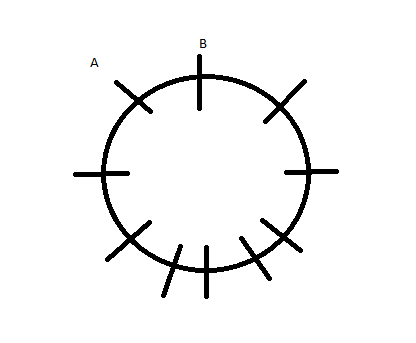
Now the number of persons in the given question is $10$( two persons sitting in a circular arrangement with \[8\] other persons).
So total number of including $A,B$ is $8 + 2 = 10$
Permutation is a way of changing or arranging the elements or objects in a linear order. The formula for permutation for n objects taken r at a time is given by \[P\left( {n,r} \right){\text{ }} = {\text{ }}\dfrac{{n!}}{{\left( {n - r} \right)!}}\]
As this a case of circular permutations, ten people randomly be arranged around a circular table in$(n - 1)!$hence applying the know values in the formula we get $(n - 1)! = (10 - 1)! = 9!$ ways
Since two particular people are always together, so consider them as one person and let it be saying $P$
Now $P$ with others \[8\], so $9$ can arrange around the table in $8!$ways (as arranged around a circular table is$(n - 1)!$) also the two between themselves can arrange in $2!$ways.
Hence the required probability is $\dfrac{{8! \times 2!}}{{9!}}$$\dfrac{{8! \times 2!}}{{9 \times 8!}} = \dfrac{2}{9}$(since $9!$ can be written as $9 \times 8!$ and canceling each other)
Therefore, the probability for both \[A\] and \[B\;\] sit together is $\dfrac{2}{9}$
Note: For probability first, determine a single event with a single outcome and identify the total number of outcomes that can occur then finally divide the number of events by the number of possible outcomes.
Which is \[Probability = \dfrac{{{\text{ }}number{\text{ }}of{\text{ }}favourable{\text{ }}outcomes}}{{total{\text{ }}number{\text{ }}of{\text{ }}outcome}}\].
Complete answer:
Now the number of persons in the given question is $10$( two persons sitting in a circular arrangement with \[8\] other persons).
So total number of including $A,B$ is $8 + 2 = 10$
Permutation is a way of changing or arranging the elements or objects in a linear order. The formula for permutation for n objects taken r at a time is given by \[P\left( {n,r} \right){\text{ }} = {\text{ }}\dfrac{{n!}}{{\left( {n - r} \right)!}}\]
As this a case of circular permutations, ten people randomly be arranged around a circular table in$(n - 1)!$hence applying the know values in the formula we get $(n - 1)! = (10 - 1)! = 9!$ ways
Since two particular people are always together, so consider them as one person and let it be saying $P$
Now $P$ with others \[8\], so $9$ can arrange around the table in $8!$ways (as arranged around a circular table is$(n - 1)!$) also the two between themselves can arrange in $2!$ways.
Hence the required probability is $\dfrac{{8! \times 2!}}{{9!}}$$\dfrac{{8! \times 2!}}{{9 \times 8!}} = \dfrac{2}{9}$(since $9!$ can be written as $9 \times 8!$ and canceling each other)
Therefore, the probability for both \[A\] and \[B\;\] sit together is $\dfrac{2}{9}$
Note: For probability first, determine a single event with a single outcome and identify the total number of outcomes that can occur then finally divide the number of events by the number of possible outcomes.
Which is \[Probability = \dfrac{{{\text{ }}number{\text{ }}of{\text{ }}favourable{\text{ }}outcomes}}{{total{\text{ }}number{\text{ }}of{\text{ }}outcome}}\].
Recently Updated Pages
Master Class 12 Economics: Engaging Questions & Answers for Success

Master Class 12 English: Engaging Questions & Answers for Success
Master Class 12 Social Science: Engaging Questions & Answers for Success
Master Class 12 Maths: Engaging Questions & Answers for Success
Master Class 12 Physics: Engaging Questions & Answers for Success
Master Class 12 Business Studies: Engaging Questions & Answers for Success
Trending doubts
Which are the Top 10 Largest Countries of the World?
Draw a labelled sketch of the human eye class 12 physics CBSE
Differentiate between homogeneous and heterogeneous class 12 chemistry CBSE
Sulphuric acid is known as the king of acids State class 12 chemistry CBSE
Why is the cell called the structural and functional class 12 biology CBSE
Draw ray diagrams each showing i myopic eye and ii class 12 physics CBSE