




A \[60\,{\text{kg}}\] body is pushed with just enough to start it moving across a floor and the same force continues to act afterwards. The coefficient of the static friction and sliding friction are \[0.5\] and \[0.4\] respectively. The acceleration of the body is:
(A) \[9.8\,{\text{m}}{{\text{s}}^{ - 2}}\]
(B) \[3.2\,{\text{m}}{{\text{s}}^{ - 2}}\]
(C) \[1\,{\text{m}}{{\text{s}}^{ - 2}}\]
(D) \[5\,{\text{m}}{{\text{s}}^{ - 2}}\]
Answer
 Verified
643.5k+ views
Hint: First of all, we will find the limiting friction and the kinetic friction separately. Then we will find out the net accelerating force by subtracting these two quantities. We will find the acceleration by using Newton’s second law of motion.
Complete step by step answer:
In the given question, we are provided with the following data:
The mass of the body is \[60\,{\text{kg}}\] .
The coefficient of the static friction and sliding friction are \[0.5\] and \[0.4\] respectively.
We are asked to find the acceleration of the body.
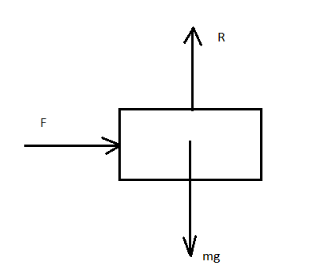
For better understanding, we draw a diagram which shows all the forces acting on the body. The weight of the body acts in the downward direction. The normal reaction acts upwards. The force applied acts towards right.
First, we will find the limiting friction, which is given by the formula:
\[{F_{\text{l}}} = {\mu _{\text{s}}}R\] …… (1)
Where,
\[{F_{\text{l}}}\] indicates limiting friction.
\[{\mu _{\text{s}}}\] indicates coefficient of the static friction.
\[R\] indicates normal reaction.
Substituting the required values in the equation (1), we get:
\[
{F_{\text{l}}} = {\mu _{\text{s}}}R \\
{F_{\text{l}}} = {\mu _{\text{s}}}mg \\
{F_{\text{l}}} = 0.5 \times 60 \times 10\,{\text{N}} \\
{F_{\text{l}}} = 300\,{\text{N}} \\
\]
The value of limiting friction is found to be \[300\,{\text{N}}\] .
For the second case, we find the kinetic friction:
\[{F_{\text{k}}} = {\mu _{\text{k}}}mg\] …… (1)
Where,
\[{F_{\text{k}}}\] indicates kinetic friction.
\[{\mu _{\text{k}}}\] indicates coefficient of the kinetic friction.
\[mg\] indicates weight force.
Substituting the required values in the equation (1), we get:
\[
{F_{\text{k}}} = {\mu _{\text{k}}}mg \\
{F_{\text{k}}} = 0.4 \times 60 \times 10\,{\text{N}} \\
{F_{\text{k}}} = 240\,{\text{N}} \\
\]
The value of kinetic friction is found to be \[240\,{\text{N}}\] .
The force applied force is \[300\,{\text{N}}\] .
So, we need to find the net accelerating force which is the difference of limiting friction and the kinetic friction.
So, we can write:
\[F = {F_{\text{l}}} - {F_{\text{k}}}\] …… (2)
Where,
\[F\] indicates the net accelerating force.
\[{F_{\text{l}}}\] indicates the limiting force.
\[{F_{\text{k}}}\] indicates the kinetic friction.
Substituting the required values in the equation (2), we get:
\[
F = {F_{\text{l}}} - {F_{\text{k}}} \\
ma = 300 - 240 \\
a = \dfrac{{60}}{{60}} \\
a = 1\,{\text{m}}{{\text{s}}^{ - 2}} \\
\]
Hence, the acceleration of the body is found to be \[1\,{\text{m}}{{\text{s}}^{ - 2}}\] .
The correct option is C..
Note: While solving this problem, we need to understand that limiting friction is different from kinetic friction. Limiting friction is the maximum friction that is generated between two static surfaces which are in contact. Kinetic friction is that force which acts between two surfaces when they are moving.
Complete step by step answer:
In the given question, we are provided with the following data:
The mass of the body is \[60\,{\text{kg}}\] .
The coefficient of the static friction and sliding friction are \[0.5\] and \[0.4\] respectively.
We are asked to find the acceleration of the body.
For better understanding, we draw a diagram which shows all the forces acting on the body. The weight of the body acts in the downward direction. The normal reaction acts upwards. The force applied acts towards right.
First, we will find the limiting friction, which is given by the formula:
\[{F_{\text{l}}} = {\mu _{\text{s}}}R\] …… (1)
Where,
\[{F_{\text{l}}}\] indicates limiting friction.
\[{\mu _{\text{s}}}\] indicates coefficient of the static friction.
\[R\] indicates normal reaction.
Substituting the required values in the equation (1), we get:
\[
{F_{\text{l}}} = {\mu _{\text{s}}}R \\
{F_{\text{l}}} = {\mu _{\text{s}}}mg \\
{F_{\text{l}}} = 0.5 \times 60 \times 10\,{\text{N}} \\
{F_{\text{l}}} = 300\,{\text{N}} \\
\]
The value of limiting friction is found to be \[300\,{\text{N}}\] .
For the second case, we find the kinetic friction:
\[{F_{\text{k}}} = {\mu _{\text{k}}}mg\] …… (1)
Where,
\[{F_{\text{k}}}\] indicates kinetic friction.
\[{\mu _{\text{k}}}\] indicates coefficient of the kinetic friction.
\[mg\] indicates weight force.
Substituting the required values in the equation (1), we get:
\[
{F_{\text{k}}} = {\mu _{\text{k}}}mg \\
{F_{\text{k}}} = 0.4 \times 60 \times 10\,{\text{N}} \\
{F_{\text{k}}} = 240\,{\text{N}} \\
\]
The value of kinetic friction is found to be \[240\,{\text{N}}\] .
The force applied force is \[300\,{\text{N}}\] .
So, we need to find the net accelerating force which is the difference of limiting friction and the kinetic friction.
So, we can write:
\[F = {F_{\text{l}}} - {F_{\text{k}}}\] …… (2)
Where,
\[F\] indicates the net accelerating force.
\[{F_{\text{l}}}\] indicates the limiting force.
\[{F_{\text{k}}}\] indicates the kinetic friction.
Substituting the required values in the equation (2), we get:
\[
F = {F_{\text{l}}} - {F_{\text{k}}} \\
ma = 300 - 240 \\
a = \dfrac{{60}}{{60}} \\
a = 1\,{\text{m}}{{\text{s}}^{ - 2}} \\
\]
Hence, the acceleration of the body is found to be \[1\,{\text{m}}{{\text{s}}^{ - 2}}\] .
The correct option is C..
Note: While solving this problem, we need to understand that limiting friction is different from kinetic friction. Limiting friction is the maximum friction that is generated between two static surfaces which are in contact. Kinetic friction is that force which acts between two surfaces when they are moving.
Recently Updated Pages
Master Class 11 Social Science: Engaging Questions & Answers for Success

Master Class 11 English: Engaging Questions & Answers for Success
Master Class 11 Accountancy: Engaging Questions & Answers for Success
Master Class 11 Physics: Engaging Questions & Answers for Success
Master Class 11 Computer Science: Engaging Questions & Answers for Success
Master Class 11 Business Studies: Engaging Questions & Answers for Success
Trending doubts
Find the value of the expression given below sin 30circ class 11 maths CBSE
The teeth used for biting and cutting food are called class 11 biology CBSE
Bond order ofO2 O2+ O2 and O22 is in order A O2 langle class 11 chemistry CBSE
Frogs heart when taken out of the body continues to class 11 biology CBSE
10 examples of diffusion in everyday life
Can anyone list 10 advantages and disadvantages of friction