




A 60Hp electric motor lifts an elevator having a maximum load capacity of $2000kg$. If the frictional force on the elevator is 4000N, the speed of the elevator at full load is close to: $(1Hp=746watt, g=10m{{s}^{-2}})$
$\begin{align}
& \text{A}\text{. }1.5m{{s}^{-1}} \\
& \text{B}\text{. }1.9m{{s}^{-1}} \\
& \text{C}\text{. }1.7m{{s}^{-1}} \\
& \text{D}\text{. 2}\text{.0}m{{s}^{-1}} \\
\end{align}$
Answer
 Verified
558k+ views
Hint: Power is the rate of doing work. Commercial unit of power is horsepower. First convert horsepower to watt.Now calculate total force on the elevator which will be the sum of the weight and the frictional force. As power is also defined as the product of force and velocity. So equate the maximum Power to product of the force on the elevator and the velocity. Form that finds the velocity of the elevator at full load.
Formulas used: Total force on the body is
$F=\text{ Weight at maximum load + Frictional Force}$
Power ,$P=\overrightarrow{F}.\overrightarrow{v}=Fv\cos \theta $
Where,$v=\text{Velocity}$,$\theta =\text{ angle between the force and velocity}$
Weight of an object of mass $m$is $W=\text{mass }\times \text{ acceleration due to gravity=}mg$
Complete step-by-step solution:
Given that, $1Hp=746watt,g=10m{{s}^{-2}}$ and frictional force on the elevator is $f=4000N$, maximum load $m=2000kg$
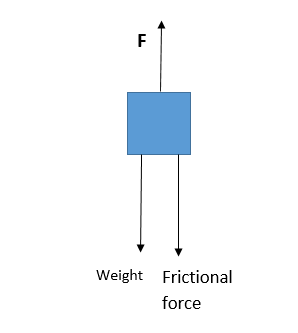
The power of the electric motor which lifts the elevator is $60Hp$and its maximum load is $2000kg$.
From the free body diagram the total force on the elevator at maximum load is
$\begin{align}
& F=\text{ Weight at maximum load + Frictional Force} \\
& \Rightarrow F=\text{ Maximum mass }\times \text{ acceleration due to gravity + Frictional force=}mgf \\
& \Rightarrow F=2000\times 10+4000=24000N \\
\end{align}$
But we know power generated is the dot product of Force and velocity.so
$P=\overrightarrow{F}.\overrightarrow{v}=Fv\cos \theta $
From free body diagram the angle between the force and the velocity is zero so
$P=Fv\text{ , or, }v=\dfrac{P}{F}$
Maximum power generated by the engine is $P=60Hp=60\times 746watt=44760watt$
And maximum force is, $F=24000N$
So the velocity of the elevator at full load is
$v=\dfrac{P}{F}=\dfrac{44760}{24000}=1.866\simeq 1.9m{{s}^{-1}}$
So the correct option is $\text{B}\text{. }1.9m{{s}^{-1}}$.
Note: For problems like this first draw the free body diagram. Then for equilibrium condition calculate the forces. From the force you can calculate work done by the force and also power delivered. Also note that the S.I unit of power is not $Hp$. $Hp$ stands for “Horse-power” which is a relative term invented by James Watt to compare the output of engines with the output of a horse. Also the S.I unit of power i.e. watt is very small so commercially we use a bigger unit of power which is Horse-power.
Formulas used: Total force on the body is
$F=\text{ Weight at maximum load + Frictional Force}$
Power ,$P=\overrightarrow{F}.\overrightarrow{v}=Fv\cos \theta $
Where,$v=\text{Velocity}$,$\theta =\text{ angle between the force and velocity}$
Weight of an object of mass $m$is $W=\text{mass }\times \text{ acceleration due to gravity=}mg$
Complete step-by-step solution:
Given that, $1Hp=746watt,g=10m{{s}^{-2}}$ and frictional force on the elevator is $f=4000N$, maximum load $m=2000kg$
The power of the electric motor which lifts the elevator is $60Hp$and its maximum load is $2000kg$.
From the free body diagram the total force on the elevator at maximum load is
$\begin{align}
& F=\text{ Weight at maximum load + Frictional Force} \\
& \Rightarrow F=\text{ Maximum mass }\times \text{ acceleration due to gravity + Frictional force=}mgf \\
& \Rightarrow F=2000\times 10+4000=24000N \\
\end{align}$
But we know power generated is the dot product of Force and velocity.so
$P=\overrightarrow{F}.\overrightarrow{v}=Fv\cos \theta $
From free body diagram the angle between the force and the velocity is zero so
$P=Fv\text{ , or, }v=\dfrac{P}{F}$
Maximum power generated by the engine is $P=60Hp=60\times 746watt=44760watt$
And maximum force is, $F=24000N$
So the velocity of the elevator at full load is
$v=\dfrac{P}{F}=\dfrac{44760}{24000}=1.866\simeq 1.9m{{s}^{-1}}$
So the correct option is $\text{B}\text{. }1.9m{{s}^{-1}}$.
Note: For problems like this first draw the free body diagram. Then for equilibrium condition calculate the forces. From the force you can calculate work done by the force and also power delivered. Also note that the S.I unit of power is not $Hp$. $Hp$ stands for “Horse-power” which is a relative term invented by James Watt to compare the output of engines with the output of a horse. Also the S.I unit of power i.e. watt is very small so commercially we use a bigger unit of power which is Horse-power.
Recently Updated Pages
Master Class 11 Computer Science: Engaging Questions & Answers for Success

Master Class 11 Business Studies: Engaging Questions & Answers for Success
Master Class 11 Economics: Engaging Questions & Answers for Success
Master Class 11 English: Engaging Questions & Answers for Success
Master Class 11 Maths: Engaging Questions & Answers for Success
Master Class 11 Biology: Engaging Questions & Answers for Success
Trending doubts
One Metric ton is equal to kg A 10000 B 1000 C 100 class 11 physics CBSE
There are 720 permutations of the digits 1 2 3 4 5 class 11 maths CBSE
Discuss the various forms of bacteria class 11 biology CBSE
Draw a diagram of a plant cell and label at least eight class 11 biology CBSE
State the laws of reflection of light
Explain zero factorial class 11 maths CBSE