




A 60 kg man goes around the earth in a satellite. In the satellite, his weight will be
A. 60 N
B. 60 kg
C. 600 N
D. Zero
Answer
 Verified
611.4k+ views
Hint: Weight of any body is determined by the product of mass of that body and the acceleration due to gravity acting at that place. A satellite revolving around the Earth is constantly falling in the gravitational force field of the Earth.
Complete step-by-step answer:
We know that for an object of mass m at a separation of r from the center of the earth, the acceleration due to gravity is; $g' = \dfrac{GM}{r^2}$.
which means that in the satellite, the person should have some weight mg'. But we also know that the satellite is moving around with a speed of v in a circular path. Therefore the centripetal force acting towards the center of the earth is $mv^2/r$. Now, there are total three forces;
1. Centripetal force acting downwards (towards the centre of the Earth).
2. Normal force of the surface of the satellite on the person.
3. Weight of the person mg'.
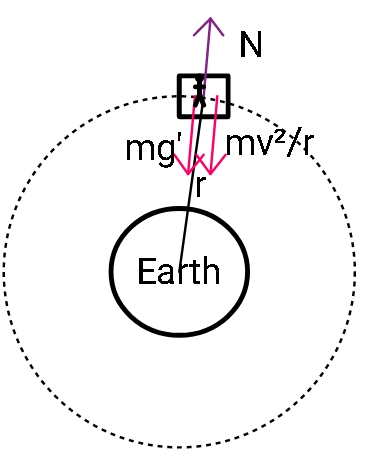 Balancing these produces:
$N = mg'- \dfrac{mv^2}{r} $.
It happens so that the velocity v of the satellite is given by:
$v = \sqrt{\dfrac{GM}{r}}$.
Therefore, upon substituting the values of v and g' we get the normal force as: N = 0.
Therefore, the person experiences weightlessness. The correct answer is therefore option (D). Zero.
So, the correct answer is “Option D”.
Additional Information: This example is somehow similar to the case of free fall of an elevator. Any object in a freely falling elevator has no weight. For downwards acceleration,
Weight = mg - ma
If a = g, the body has no weight.
A satellite revolving around the earth can be thought to be falling freely in earth's gravity.
Note: One can come up with the right answer here but with wrong explanation. One might think that as the satellite is in space and in space there is no gravity so option (D) must be correct. But if the satellite were stationary then, weightlessness would not have been observed. Certain amount of gravitational force acts on the satellite and weightlessness is not due to absence of gravity.
Complete step-by-step answer:
We know that for an object of mass m at a separation of r from the center of the earth, the acceleration due to gravity is; $g' = \dfrac{GM}{r^2}$.
which means that in the satellite, the person should have some weight mg'. But we also know that the satellite is moving around with a speed of v in a circular path. Therefore the centripetal force acting towards the center of the earth is $mv^2/r$. Now, there are total three forces;
1. Centripetal force acting downwards (towards the centre of the Earth).
2. Normal force of the surface of the satellite on the person.
3. Weight of the person mg'.
$N = mg'- \dfrac{mv^2}{r} $.
It happens so that the velocity v of the satellite is given by:
$v = \sqrt{\dfrac{GM}{r}}$.
Therefore, upon substituting the values of v and g' we get the normal force as: N = 0.
Therefore, the person experiences weightlessness. The correct answer is therefore option (D). Zero.
So, the correct answer is “Option D”.
Additional Information: This example is somehow similar to the case of free fall of an elevator. Any object in a freely falling elevator has no weight. For downwards acceleration,
Weight = mg - ma
If a = g, the body has no weight.
A satellite revolving around the earth can be thought to be falling freely in earth's gravity.
Note: One can come up with the right answer here but with wrong explanation. One might think that as the satellite is in space and in space there is no gravity so option (D) must be correct. But if the satellite were stationary then, weightlessness would not have been observed. Certain amount of gravitational force acts on the satellite and weightlessness is not due to absence of gravity.
Recently Updated Pages
Master Class 11 English: Engaging Questions & Answers for Success

Master Class 11 Maths: Engaging Questions & Answers for Success
Class 11 Question and Answer - Your Ultimate Solutions Guide
Master Class 11 Biology: Engaging Questions & Answers for Success
Master Class 11 Physics: Engaging Questions & Answers for Success
Master Class 11 Accountancy: Engaging Questions & Answers for Success
Trending doubts
Differentiate between an exothermic and an endothermic class 11 chemistry CBSE
One Metric ton is equal to kg A 10000 B 1000 C 100 class 11 physics CBSE
Difference Between Prokaryotic Cells and Eukaryotic Cells
There are 720 permutations of the digits 1 2 3 4 5 class 11 maths CBSE
Draw a diagram of a plant cell and label at least eight class 11 biology CBSE
1 Quintal is equal to a 110 kg b 10 kg c 100kg d 1000 class 11 physics CBSE