




A 5gm lump of clay, moving with a velocity of 10 cm/s towards east, collides head-on with another 2gm lump of clay moving with 15 cm/s towards west. After the collision, the two lumps stick together. What will be the velocity of the compound lump?
A. 5 cm/s towards east
B. 5 cm/s towards west
C. 2.88 cm/s towards east
D. 2.5 cm/s towards west
Answer
 Verified
638.1k+ views
Hint: For this question we need to have the knowledge of Conservation of momentum which states that for two or more bodies in an isolated system acting upon each other, their total momentum remains constant unless an external force is applied. Hence, momentum can neither be created nor be destroyed.
Step by step solution:
1. In the diagram drawn below $m_1$ be the mass of 5gm which is moving with a velocity of 10 cm/s towards east and $m_2$ be the mass of 2gm moving with velocity 15 cm/s towards west.
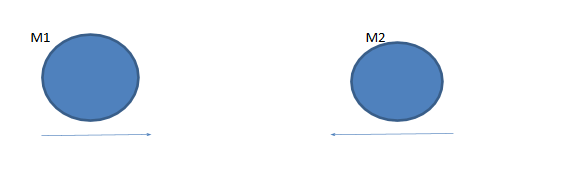
2. Now after collision the two masses stick together, that is they combine to form a new lump of clay weighing (5+2) = 7gm. So now we will apply the law of conservation of momentum.
Initial momentum=final momentum
${p_i} = {p_f}$
${m_1}{v_1} + {m_2}{v_2} = MV$ …………….equation 1
Where $M = {m_1} + {m_2}$ and V=velocity of the compound lump.
3. Substituting the values in equation 1, we get
$ \Rightarrow $ $5 \times 10 + 2 \times ( - 15) = (5 + 2) \times V$ (- sign is because both the lumps are moving in the opposite directions)
$ \Rightarrow $ $50 - 30 = 7 \times V$
$ \Rightarrow $ $20 = 7 \times V$
$ \Rightarrow $ $V = \dfrac{{20}}{7} = 2.8$m/s
4. Now it's direction will be east because by taking the east direction as reference direction we got positive velocity. If we had taken otherwise then velocity would have come negative and hence we have taken other directions than the reference direction.
That means option C is correct.
Note: Here we could also take the velocity of the 1st mass as negative and another one as negative then also we would get the same answer. It totally depends on us which direction we are taking as a reference direction.
Step by step solution:
1. In the diagram drawn below $m_1$ be the mass of 5gm which is moving with a velocity of 10 cm/s towards east and $m_2$ be the mass of 2gm moving with velocity 15 cm/s towards west.
2. Now after collision the two masses stick together, that is they combine to form a new lump of clay weighing (5+2) = 7gm. So now we will apply the law of conservation of momentum.
Initial momentum=final momentum
${p_i} = {p_f}$
${m_1}{v_1} + {m_2}{v_2} = MV$ …………….equation 1
Where $M = {m_1} + {m_2}$ and V=velocity of the compound lump.
3. Substituting the values in equation 1, we get
$ \Rightarrow $ $5 \times 10 + 2 \times ( - 15) = (5 + 2) \times V$ (- sign is because both the lumps are moving in the opposite directions)
$ \Rightarrow $ $50 - 30 = 7 \times V$
$ \Rightarrow $ $20 = 7 \times V$
$ \Rightarrow $ $V = \dfrac{{20}}{7} = 2.8$m/s
4. Now it's direction will be east because by taking the east direction as reference direction we got positive velocity. If we had taken otherwise then velocity would have come negative and hence we have taken other directions than the reference direction.
That means option C is correct.
Note: Here we could also take the velocity of the 1st mass as negative and another one as negative then also we would get the same answer. It totally depends on us which direction we are taking as a reference direction.
Recently Updated Pages
Master Class 11 English: Engaging Questions & Answers for Success

Master Class 11 Social Science: Engaging Questions & Answers for Success
Master Class 11 Maths: Engaging Questions & Answers for Success
Master Class 11 Biology: Engaging Questions & Answers for Success
Master Class 11 Physics: Engaging Questions & Answers for Success
Master Class 11 Chemistry: Engaging Questions & Answers for Success
Trending doubts
One Metric ton is equal to kg A 10000 B 1000 C 100 class 11 physics CBSE
Difference Between Prokaryotic Cells and Eukaryotic Cells
Find the value of the expression given below sin 30circ class 11 maths CBSE
Difference between physical and chemical change class 11 chemistry CBSE
Two of the body parts which do not appear in MRI are class 11 biology CBSE
Draw a diagram of a plant cell and label at least eight class 11 biology CBSE