



A \[5 \times 5 \times 5\;\] cube is formed by using \[1 \times 1 \times 1\;\]cubes. If we add another layer of such \[1 \times 1 \times 1\;\]cube around the \[5 \times 5 \times 5\;\] cube. What will be the number of \[1 \times 1 \times 1\;\]cubes in the newly formed cube?
Answer
 Verified
660k+ views
Hint: Here we should find the dimension of the new cube which is formed by adding the new layer of cubes then with the help of it we will find the number of cubes which is present in the newly formed cube.
Complete step by step answer:
A \[5 \times 5 \times 5\;\]cube has 5 cubes of \[1 \times 1 \times 1\;\] cubes along its length, breadth and width each.
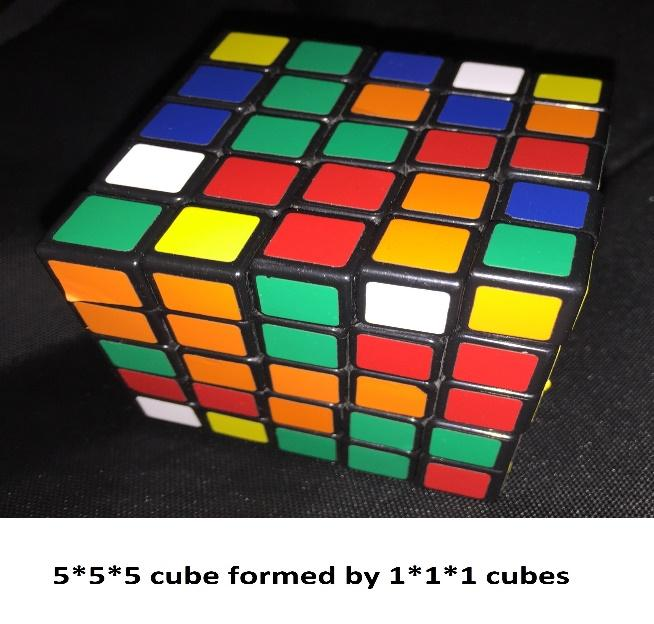
That is it contains 5 cubes of \[1 \times 1 \times 1\;\] cubes along its length and contains 5 cubes of \[1 \times 1 \times 1\;\] cubes along its breadth and also it contains 5 cubes of \[1 \times 1 \times 1\;\] cubes along its width.
If we add a layer of \[1 \times 1 \times 1\;\] cubes that are the smaller cubes then the new cube will have the following dimensions:
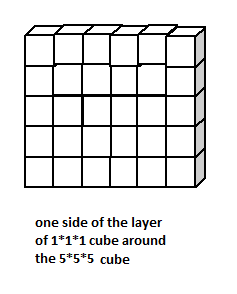
Adding like this layer in image in \[5 \times 5 \times 5\;\] cube I will makes the dimensions of newly formed cube is the addition of the old dimension and the added layer
That is length \[ = 5 + 1 + 1 = 7\]
Breadth \[ = 5 + 1 + 1 = 7\]
Width\[ = 5 + 1 + 1 = 7\].
Here we add 2 to every dimension because if one cube is added it extends in 2 ways. That is if one cube is added it will increase the length by one and also the breadth by one.
Therefore the newly formed cube is of the dimension\[7 \times 7 \times 7\].
Now to find the number of \[1 \times 1 \times 1\;\] cubes in the newly formed \[7 \times 7 \times 7\] cube
We multiply the length breadth and width of the newly formed cube.
The number of \[1 \times 1 \times 1\;\] cubes in the newly formed \[7 \times 7 \times 7\] cube\[ = 7 \times 7 \times 7\; = 343\].
Hence we have found the number of \[1 \times 1 \times 1\;\]cubes in the newly formed \[7 \times 7 \times 7\] cube is \[343\].
Note:
Like this problem first, we have to imagine the problem practically. Because thinking like this we will get how the cube will be in the structure. It will help to understand the solution of the problem and more we have to concentrate on calculating the sides of the cube. We may go wrong on that step.
Complete step by step answer:
A \[5 \times 5 \times 5\;\]cube has 5 cubes of \[1 \times 1 \times 1\;\] cubes along its length, breadth and width each.
That is it contains 5 cubes of \[1 \times 1 \times 1\;\] cubes along its length and contains 5 cubes of \[1 \times 1 \times 1\;\] cubes along its breadth and also it contains 5 cubes of \[1 \times 1 \times 1\;\] cubes along its width.
If we add a layer of \[1 \times 1 \times 1\;\] cubes that are the smaller cubes then the new cube will have the following dimensions:
Adding like this layer in image in \[5 \times 5 \times 5\;\] cube I will makes the dimensions of newly formed cube is the addition of the old dimension and the added layer
That is length \[ = 5 + 1 + 1 = 7\]
Breadth \[ = 5 + 1 + 1 = 7\]
Width\[ = 5 + 1 + 1 = 7\].
Here we add 2 to every dimension because if one cube is added it extends in 2 ways. That is if one cube is added it will increase the length by one and also the breadth by one.
Therefore the newly formed cube is of the dimension\[7 \times 7 \times 7\].
Now to find the number of \[1 \times 1 \times 1\;\] cubes in the newly formed \[7 \times 7 \times 7\] cube
We multiply the length breadth and width of the newly formed cube.
The number of \[1 \times 1 \times 1\;\] cubes in the newly formed \[7 \times 7 \times 7\] cube\[ = 7 \times 7 \times 7\; = 343\].
Hence we have found the number of \[1 \times 1 \times 1\;\]cubes in the newly formed \[7 \times 7 \times 7\] cube is \[343\].
Note:
Like this problem first, we have to imagine the problem practically. Because thinking like this we will get how the cube will be in the structure. It will help to understand the solution of the problem and more we have to concentrate on calculating the sides of the cube. We may go wrong on that step.
Recently Updated Pages
What are the two major island groups in India class 9 social science CBSE

What is Jhum cultivation class 9 biology CBSE
Write an Article on Save Earth Save Life
Silk is obtained from of the silk moth APupa BLarva class 9 chemistry CBSE
Write chemical formulas of the following compounds class 9 chemistry CBSE
The Indo Gangetic Plains of India are fertile due to class 9 social science CBSE
Trending doubts
Fill the blanks with the suitable prepositions 1 The class 9 english CBSE
Difference Between Plant Cell and Animal Cell
What is the full form of pH?
What is pollution? How many types of pollution? Define it
On an outline map of India show its neighbouring c class 9 social science CBSE
What is momentum with examples class 9 physics CBSE