




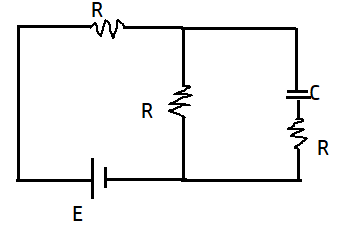
A- 3RC
B- \[\dfrac{3RC}{2}\]
C- \[\dfrac{RC}{3}\]
D- RC
Answer
 Verified
584.1k+ views
Hint: The time constant of the RC circuit is a useful quantity and determines the time taken by the capacitor to charge and discharge fully.
Complete step by step answer:
To find out the time constant which is equal to the product of capacitance and resistance present in the circuit we need to first find out the net resistance of the circuit as there are more than one resistance present in the circuit.
So in finding the net resistance we redraw our circuit by removing all the things except resistances and the battery.
The figure looks like this:
Here all the resistances are equal, so \[{{R}_{1}}={{R}_{2}}={{R}_{3}}=R\]
Now to find out the net resistance, in the figure below \[{{R}_{2}}\And {{R}_{3}}\] are in parallel,
So
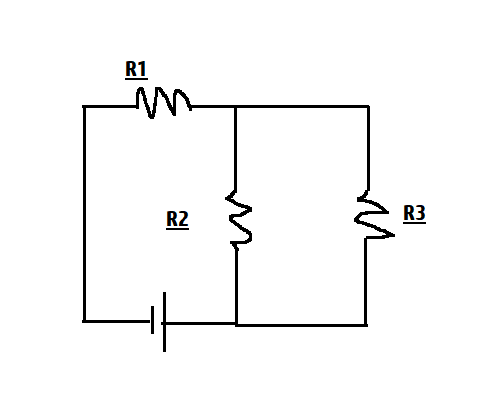
R’= \[\dfrac{{{R}_{2}}{{R}_{3}}}{{{R}_{2}}+{{R}_{3}}}=\dfrac{R}{2}\]
Now R’ and \[{{R}_{1}}\] are in series, so net resistance= \[{{R}_{1}}\]+R’= \[\dfrac{3R}{2}\]
So total resistance of the circuit is \[\dfrac{3R}{2}\].
Now we have net resistance and since there is only one capacitor so we have capacitance.
Time constant of a RC circuit is represented by \[\tau \]
\[\tau =RC\]
\[\tau =\dfrac{3RC}{2}\]
So, the correct answer is “Option C”.
Note:
Time constant is also called transient response. In a given RC circuit, R is the value of the resistor in ohms and C is the value of the capacitor in Farads. So, the unit of Time constant is ohms-Farad represented by \[\Omega F\], and another unit is seconds. It helps us figure out how long it will take a capacitor to charge or to discharge up to a certain voltage level.
Complete step by step answer:
To find out the time constant which is equal to the product of capacitance and resistance present in the circuit we need to first find out the net resistance of the circuit as there are more than one resistance present in the circuit.
So in finding the net resistance we redraw our circuit by removing all the things except resistances and the battery.
The figure looks like this:
Here all the resistances are equal, so \[{{R}_{1}}={{R}_{2}}={{R}_{3}}=R\]
Now to find out the net resistance, in the figure below \[{{R}_{2}}\And {{R}_{3}}\] are in parallel,
So
R’= \[\dfrac{{{R}_{2}}{{R}_{3}}}{{{R}_{2}}+{{R}_{3}}}=\dfrac{R}{2}\]
Now R’ and \[{{R}_{1}}\] are in series, so net resistance= \[{{R}_{1}}\]+R’= \[\dfrac{3R}{2}\]
So total resistance of the circuit is \[\dfrac{3R}{2}\].
Now we have net resistance and since there is only one capacitor so we have capacitance.
Time constant of a RC circuit is represented by \[\tau \]
\[\tau =RC\]
\[\tau =\dfrac{3RC}{2}\]
So, the correct answer is “Option C”.
Note:
Time constant is also called transient response. In a given RC circuit, R is the value of the resistor in ohms and C is the value of the capacitor in Farads. So, the unit of Time constant is ohms-Farad represented by \[\Omega F\], and another unit is seconds. It helps us figure out how long it will take a capacitor to charge or to discharge up to a certain voltage level.
Recently Updated Pages
Master Class 12 Economics: Engaging Questions & Answers for Success

Master Class 12 Physics: Engaging Questions & Answers for Success
Master Class 12 English: Engaging Questions & Answers for Success
Master Class 12 Social Science: Engaging Questions & Answers for Success
Master Class 12 Maths: Engaging Questions & Answers for Success
Master Class 12 Business Studies: Engaging Questions & Answers for Success
Trending doubts
Which are the Top 10 Largest Countries of the World?
What are the major means of transport Explain each class 12 social science CBSE
Draw a labelled sketch of the human eye class 12 physics CBSE
Differentiate between insitu conservation and exsitu class 12 biology CBSE
Draw a neat and well labeled diagram of TS of ovary class 12 biology CBSE
Give 10 examples of unisexual and bisexual flowers