




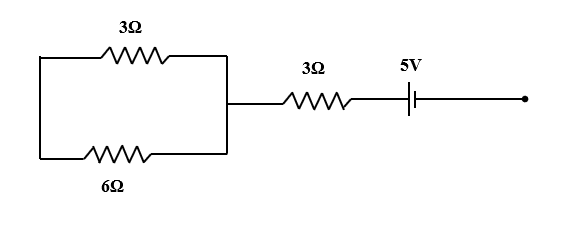
A $3\Omega$ resistor and a $6\Omega$ resistor are connected in parallel and the combination is connected in series to a battery of 5V and a $3\Omega$ resistor. The potential difference across the $6\Omega$ resistor
A. 2V
B. 4V
C. 3V
D. 1V
Answer
 Verified
652.5k+ views
Hint: To solve this problem, first find the equivalent resistance across $3\Omega$ and $6\Omega$ resistors. Then, find the total resistance in the circuit. Substitute the total resistance and the voltage of the batter in the formula for Ohm’s law. This will give the current flowing through the circuit. Then, find the current passing through $6\Omega$ resistor. Now, using this obtained current across $6\Omega $ resistor, find the potential difference across $6\Omega$ resistor.
Complete answer:
Given: ${ R }_{ 1 }=3\Omega$
${ R }_{ 2 }=6\Omega$
${ R }_{ 1 }=3\Omega$
Voltage (V)= 5V
Resistors ${ R }_{ 1 }$ and ${ R }_{ 2 }$ are connected in parallel.
So, the equivalent resistance in the combination is given by,
$\dfrac { 1 }{ { R }_{ eq } } =\dfrac { 1 }{ { R }_{ 1 } } +\dfrac { 1 }{ { R }_{ 2 } }$
Substituting the values we get,
$\dfrac { 1 }{ { R }_{ eq } } =\dfrac { 1 }{ 3 } +\dfrac { 1 }{ 6 }$
$\Rightarrow \dfrac { 1 }{ { R }_{ eq } } =\dfrac { 9 }{ 18 }$
$\Rightarrow { R }_{ eq }=\dfrac { 18 }{ 9 }$
$\therefore {R}_{eq} = 2\Omega$
Therefore, the total resistance in the circuit is,
$R= {R}_{eq}+ {R}_{3}$
Substituting the values we get,
$R= 2 + 3$
$\Rightarrow R= 5\Omega$
Using Ohm’s Law,
$V=IR$
Substituting the values we get,
$5= I \times 5$
$\Rightarrow I =1A$
Current flowing through $6\Omega$ resistor is given by,
${ I }^{ ' }=\dfrac { { R }_{ 3 } }{ { R }_{ 3 }+{ R }_{ 2 } } I$
Substituting the values in above expression we get,
${ I }^{ ' }=\dfrac { 3 }{ 3+6 } \times 1$
$\Rightarrow { I }^{ ' }=\dfrac { 3 }{ 9 }$
$\Rightarrow { I }^{ ' }=\dfrac { 1 }{ 3 }$
Voltage across $6\Omega $ resistor is given by,
${ V }^{ ' }={ I }^{ ' }\times { R }_{ 2 }$
Substituting the values in above equation we get,
${ V }^{ ' }=\dfrac { 1 }{ 3 } \times 6$
$\therefore { V }^{ ' }= 2V$
Hence, the potential difference across the $6\Omega$ resistor is 2V.
So, the correct answer is “Option A”.
Note:
Students generally get confused between the formula for equivalent resistance in parallel combination and series combination & the equivalent capacitance in series and parallel combination. So, they should clearly know these formulas to solve these types of problems. Students should also remember that the equivalent resistance of a combination is always less than the smallest resistance in the parallel network.
Complete answer:
Given: ${ R }_{ 1 }=3\Omega$
${ R }_{ 2 }=6\Omega$
${ R }_{ 1 }=3\Omega$
Voltage (V)= 5V
Resistors ${ R }_{ 1 }$ and ${ R }_{ 2 }$ are connected in parallel.
So, the equivalent resistance in the combination is given by,
$\dfrac { 1 }{ { R }_{ eq } } =\dfrac { 1 }{ { R }_{ 1 } } +\dfrac { 1 }{ { R }_{ 2 } }$
Substituting the values we get,
$\dfrac { 1 }{ { R }_{ eq } } =\dfrac { 1 }{ 3 } +\dfrac { 1 }{ 6 }$
$\Rightarrow \dfrac { 1 }{ { R }_{ eq } } =\dfrac { 9 }{ 18 }$
$\Rightarrow { R }_{ eq }=\dfrac { 18 }{ 9 }$
$\therefore {R}_{eq} = 2\Omega$
Therefore, the total resistance in the circuit is,
$R= {R}_{eq}+ {R}_{3}$
Substituting the values we get,
$R= 2 + 3$
$\Rightarrow R= 5\Omega$
Using Ohm’s Law,
$V=IR$
Substituting the values we get,
$5= I \times 5$
$\Rightarrow I =1A$
Current flowing through $6\Omega$ resistor is given by,
${ I }^{ ' }=\dfrac { { R }_{ 3 } }{ { R }_{ 3 }+{ R }_{ 2 } } I$
Substituting the values in above expression we get,
${ I }^{ ' }=\dfrac { 3 }{ 3+6 } \times 1$
$\Rightarrow { I }^{ ' }=\dfrac { 3 }{ 9 }$
$\Rightarrow { I }^{ ' }=\dfrac { 1 }{ 3 }$
Voltage across $6\Omega $ resistor is given by,
${ V }^{ ' }={ I }^{ ' }\times { R }_{ 2 }$
Substituting the values in above equation we get,
${ V }^{ ' }=\dfrac { 1 }{ 3 } \times 6$
$\therefore { V }^{ ' }= 2V$
Hence, the potential difference across the $6\Omega$ resistor is 2V.
So, the correct answer is “Option A”.
Note:
Students generally get confused between the formula for equivalent resistance in parallel combination and series combination & the equivalent capacitance in series and parallel combination. So, they should clearly know these formulas to solve these types of problems. Students should also remember that the equivalent resistance of a combination is always less than the smallest resistance in the parallel network.
Recently Updated Pages
What is BLO What is the full form of BLO class 8 social science CBSE

Explain the Treaty of Vienna of 1815 class 10 social science CBSE
10 examples of friction in our daily life
Draw a diagram of nephron and explain its structur class 11 biology CBSE
Write structures of the following compounds i 2 Chloro3methylpentane class 11 chemistry CBSE
A Paragraph on Pollution in about 100-150 Words
Trending doubts
Draw a labelled sketch of the human eye class 12 physics CBSE
Which are the Top 10 Largest Countries of the World?
Differentiate between homogeneous and heterogeneous class 12 chemistry CBSE
Draw ray diagrams each showing i myopic eye and ii class 12 physics CBSE
Materials which do not allow an electric current to class 12 physics CBSE
Which is the correct genotypic ratio of mendel dihybrid class 12 biology CBSE