




A $3\mu F$ capacitor is charged to a potential of 300 volts and a $2\mu F$ capacitor is charged to a potential of 200 volts. The capacitors connected in parallel, plates of opposite polarities being connected together. The final potential difference between the plates of the capacitor after they are connected is now equal to:
$\left( A \right)700V$
$\left( B \right)240V$
$\left( C \right)250V$
$\left( D \right)260V$
Answer
 Verified
609.3k+ views
Hint: In this question use the concept that on parallel combination voltage should be equal and the connection is in phase opposition so the charge lost by one capacitor is gained by another capacitor so use these concepts to reach the solution of the question.
Complete Step-by-Step solution:
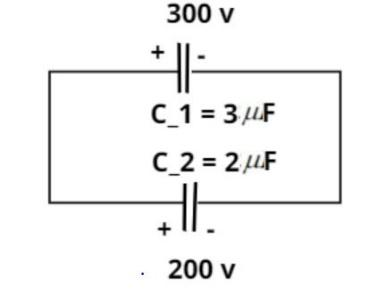
Formula used – $Q = CV$
Given data:
${C_1} = 3\mu F,{V_1} = 300V,{C_2} = 2\mu F,{V_2} = 200V$
So charged store on first capacitor is
${Q_1} = {C_1}{V_1} = \left( {3 \times 300} \right) = 900\mu C$(micro Coulomb).
And the charged store on second capacitor is
${Q_2} = {C_2}{V_2} = \left( {2 \times 200} \right) = 400\mu C$(micro Coulomb).
Let the net charge on the combination is ${Q_{net}}$.
Now it is given that they both connected in parallel with phase opposition (i.e. plates of opposite polarities being connected together).
So the charge lost by the first capacitor is gained by another capacitor.
So in parallel we know voltage is same so we have to equate the voltages of the system so we have,
$ \Rightarrow V = \dfrac{{Q_1^ + }}{{{C_1}}} = \dfrac{{Q_2^ + }}{{{C_2}}}$, where $Q_1^ + $ and $Q_2^ + $ are the charges on the capacitors after the combination.
$ \Rightarrow \dfrac{{{Q_1} - {Q_{net}}}}{{{C_1}}} = \dfrac{{{Q_{net}} + {Q_2}}}{{{C_2}}}$
Now substitute the values we have,
$ \Rightarrow \dfrac{{900 - {Q_{net}}}}{3} = \dfrac{{{Q_{net}} + 400}}{2}$
$ \Rightarrow 2\left( {900 - {Q_{net}}} \right) = 3\left( {{Q_{net}} + 400} \right)$
$ \Rightarrow \left( {1800 - 2{Q_{net}}} \right) = \left( {3{Q_{net}} + 1200} \right)$
$ \Rightarrow 5{Q_{net}} = 600$
$ \Rightarrow {Q_{net}} = \dfrac{{600}}{5} = 120\mu C$
So the final potential difference is
$ \Rightarrow V = \dfrac{{Q_1^ + }}{{{C_1}}} = \dfrac{{Q_2^ + }}{{{C_2}}}$
$ \Rightarrow V = \dfrac{{{Q_1} - {Q_{net}}}}{{{C_1}}} = \dfrac{{{Q_{net}} + {Q_2}}}{{{C_2}}}$
$ \Rightarrow V = \dfrac{{900 - 120}}{3} = \dfrac{{780}}{3} = 260$ volts.
So this is the required answer.
Hence option (D) is the correct answer.
Note – Whenever we face such types of question the key concept is parallel connection as in parallel connection voltages are equal so equate them which is the required final voltage on the combination, so first calculate the charges on both the capacitor as above then they combined in parallel as shown in the figure in phase opposition so the charge lost by one capacitor is gained by the other capacitor as written above in the equation so just substitute the values in this equation and simplify, we will get the required answer.
Complete Step-by-Step solution:
Formula used – $Q = CV$
Given data:
${C_1} = 3\mu F,{V_1} = 300V,{C_2} = 2\mu F,{V_2} = 200V$
So charged store on first capacitor is
${Q_1} = {C_1}{V_1} = \left( {3 \times 300} \right) = 900\mu C$(micro Coulomb).
And the charged store on second capacitor is
${Q_2} = {C_2}{V_2} = \left( {2 \times 200} \right) = 400\mu C$(micro Coulomb).
Let the net charge on the combination is ${Q_{net}}$.
Now it is given that they both connected in parallel with phase opposition (i.e. plates of opposite polarities being connected together).
So the charge lost by the first capacitor is gained by another capacitor.
So in parallel we know voltage is same so we have to equate the voltages of the system so we have,
$ \Rightarrow V = \dfrac{{Q_1^ + }}{{{C_1}}} = \dfrac{{Q_2^ + }}{{{C_2}}}$, where $Q_1^ + $ and $Q_2^ + $ are the charges on the capacitors after the combination.
$ \Rightarrow \dfrac{{{Q_1} - {Q_{net}}}}{{{C_1}}} = \dfrac{{{Q_{net}} + {Q_2}}}{{{C_2}}}$
Now substitute the values we have,
$ \Rightarrow \dfrac{{900 - {Q_{net}}}}{3} = \dfrac{{{Q_{net}} + 400}}{2}$
$ \Rightarrow 2\left( {900 - {Q_{net}}} \right) = 3\left( {{Q_{net}} + 400} \right)$
$ \Rightarrow \left( {1800 - 2{Q_{net}}} \right) = \left( {3{Q_{net}} + 1200} \right)$
$ \Rightarrow 5{Q_{net}} = 600$
$ \Rightarrow {Q_{net}} = \dfrac{{600}}{5} = 120\mu C$
So the final potential difference is
$ \Rightarrow V = \dfrac{{Q_1^ + }}{{{C_1}}} = \dfrac{{Q_2^ + }}{{{C_2}}}$
$ \Rightarrow V = \dfrac{{{Q_1} - {Q_{net}}}}{{{C_1}}} = \dfrac{{{Q_{net}} + {Q_2}}}{{{C_2}}}$
$ \Rightarrow V = \dfrac{{900 - 120}}{3} = \dfrac{{780}}{3} = 260$ volts.
So this is the required answer.
Hence option (D) is the correct answer.
Note – Whenever we face such types of question the key concept is parallel connection as in parallel connection voltages are equal so equate them which is the required final voltage on the combination, so first calculate the charges on both the capacitor as above then they combined in parallel as shown in the figure in phase opposition so the charge lost by one capacitor is gained by the other capacitor as written above in the equation so just substitute the values in this equation and simplify, we will get the required answer.
Recently Updated Pages
Master Class 10 Computer Science: Engaging Questions & Answers for Success

Master Class 10 General Knowledge: Engaging Questions & Answers for Success
Master Class 10 English: Engaging Questions & Answers for Success
Master Class 10 Social Science: Engaging Questions & Answers for Success
Master Class 10 Maths: Engaging Questions & Answers for Success
Master Class 10 Science: Engaging Questions & Answers for Success
Trending doubts
What is the median of the first 10 natural numbers class 10 maths CBSE
Which women's tennis player has 24 Grand Slam singles titles?
Who is the Brand Ambassador of Incredible India?
Why is there a time difference of about 5 hours between class 10 social science CBSE
Write a letter to the principal requesting him to grant class 10 english CBSE
A moving boat is observed from the top of a 150 m high class 10 maths CBSE