




A 32 kg disc moving with the velocity $v=25m/s$ toward the two stationary discs of mass 8 kg on a frictionless surface. The discs collide elastically. After the collision, the heavy disc is at rest and the two smaller discs scatter outward at the same speed. What is the x-component of the velocity of each of the 8 kg discs in the final state?
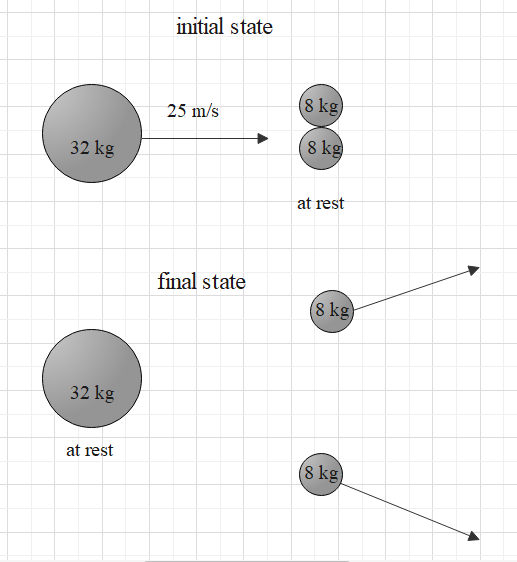
a) 12.5 m/s
b) 16 m/s
c) 25 m/s
d) 50 m/s
e) 100 m/s
Answer
 Verified
585.3k+ views
Hint: By applying conservation of momentum formula for the initial and final conditions given: ${{\left( {{m}_{1}}{{v}_{1}}+{{m}_{2}}{{v}_{2}} \right)}_{initial}}={{\left( {{m}_{1}}{{v}_{1}}+{{m}_{2}}{{v}_{2}} \right)}_{final}}$ and find final velocity.
Complete step by step answer:
We have the following data:
$\begin{align}
& {{m}_{1}}=32kg \\
& {{m}_{2}}=8kg \\
& {{m}_{3}}=8kg \\
\end{align}$
Initial condition:
$\begin{align}
& {{v}_{1}}=25m/s \\
& {{v}_{2}}={{v}_{3}}=0 \\
\end{align}$
Fina condition:
$\begin{align}
& {{v}_{1}}=0 \\
& {{v}_{2}}={{v}_{3}}=v \\
\end{align}$
So, by applying the conservation of momentum formula:
${{\left( {{m}_{1}}{{v}_{1}}+{{m}_{2}}{{v}_{2}} \right)}_{initial}}={{\left( {{m}_{1}}{{v}_{1}}+{{m}_{2}}{{v}_{2}} \right)}_{final}}$
We get:
$ \left( 32\times 25 \right)+\left( 8\times 0 \right)+\left( 8\times 0 \right)=\left( 32\times 0 \right)+\left( 8\times v \right)+\left( 8\times v \right) \\ $
$ \implies 800+0+0=0+8v+8v \\ $
$ \implies 800=16v \\
v=50m/s
$
Therefore, the x-component of the velocity of each of the 8 kg discs in the final state is 50 m/s.
So, the correct answer is “Option D”.
Note:
The conservation of momentum states that, within some problem domain, the amount of momentum remains constant; momentum is neither created nor destroyed, but only changed through the action of forces as described by Newton's laws of motion.
An elastic collision is a collision in which there is no net loss in kinetic energy in the system as a result of the collision. Both momentum and kinetic energy are conserved quantities in elastic collisions.
Therefore, we can solve the given question by conservation of energy also.
Complete step by step answer:
We have the following data:
$\begin{align}
& {{m}_{1}}=32kg \\
& {{m}_{2}}=8kg \\
& {{m}_{3}}=8kg \\
\end{align}$
Initial condition:
$\begin{align}
& {{v}_{1}}=25m/s \\
& {{v}_{2}}={{v}_{3}}=0 \\
\end{align}$
Fina condition:
$\begin{align}
& {{v}_{1}}=0 \\
& {{v}_{2}}={{v}_{3}}=v \\
\end{align}$
So, by applying the conservation of momentum formula:
${{\left( {{m}_{1}}{{v}_{1}}+{{m}_{2}}{{v}_{2}} \right)}_{initial}}={{\left( {{m}_{1}}{{v}_{1}}+{{m}_{2}}{{v}_{2}} \right)}_{final}}$
We get:
$ \left( 32\times 25 \right)+\left( 8\times 0 \right)+\left( 8\times 0 \right)=\left( 32\times 0 \right)+\left( 8\times v \right)+\left( 8\times v \right) \\ $
$ \implies 800+0+0=0+8v+8v \\ $
$ \implies 800=16v \\
v=50m/s
$
Therefore, the x-component of the velocity of each of the 8 kg discs in the final state is 50 m/s.
So, the correct answer is “Option D”.
Note:
The conservation of momentum states that, within some problem domain, the amount of momentum remains constant; momentum is neither created nor destroyed, but only changed through the action of forces as described by Newton's laws of motion.
An elastic collision is a collision in which there is no net loss in kinetic energy in the system as a result of the collision. Both momentum and kinetic energy are conserved quantities in elastic collisions.
Therefore, we can solve the given question by conservation of energy also.
Recently Updated Pages
Master Class 11 English: Engaging Questions & Answers for Success

Master Class 11 Maths: Engaging Questions & Answers for Success
Master Class 11 Biology: Engaging Questions & Answers for Success
Master Class 11 Social Science: Engaging Questions & Answers for Success
Master Class 11 Physics: Engaging Questions & Answers for Success
Master Class 11 Accountancy: Engaging Questions & Answers for Success
Trending doubts
One Metric ton is equal to kg A 10000 B 1000 C 100 class 11 physics CBSE
Discuss the various forms of bacteria class 11 biology CBSE
Draw a diagram of a plant cell and label at least eight class 11 biology CBSE
State the laws of reflection of light
Explain zero factorial class 11 maths CBSE
10 examples of friction in our daily life