




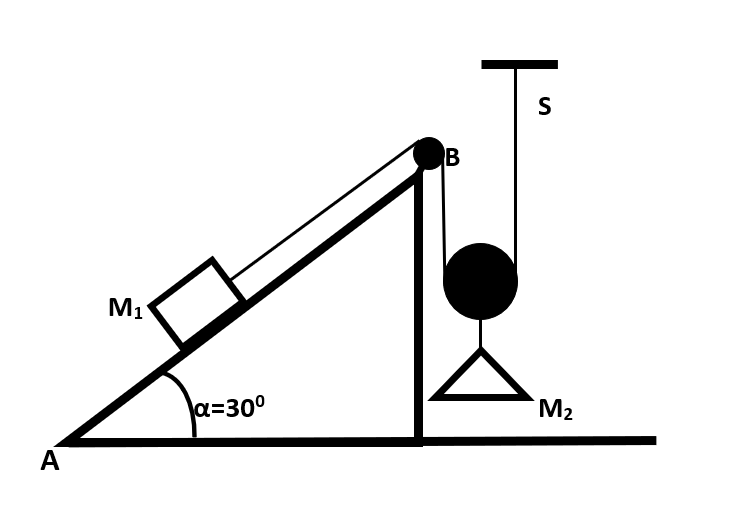
A 30kg block of mass ${{M}_{1}}$ rests on a smooth inclined plane AB. It is attached by a flexible in-extensible string over frictionless light pulley to a 45kg mass ${{M}_{2}}$and a support S. If the angle of inclination of the plane is ${{30}^{0}}$, find at what distance will the block ${{M}_{1}}$ attain the speed of $3m{{s}^{-1}}$ .
Answer
 Verified
601.2k+ views
Hint: We will first of all relate the accelerations of the two masses and then write the force equation on these two blocks to get the required acceleration of block 1. Once, we get the acceleration, we can calculate the time taken to reach the desired speed. And then, the distance travelled by the block to reach its desired speed.
Complete answer:
Let the acceleration of block 1 be ‘a’ and the acceleration of block 2 be ‘b’. Then, we can relate these two accelerations as:
$\Rightarrow a=b$
Now, we can write the force equation on these blocks as follows:
On the block weighing 45kg, the force equation will be written as follows:
$\Rightarrow {{M}_{2}}g-2T={{M}_{2}}a$ [Since, accelerations are equal]
And on the block weighing 30kg, we have:
$\Rightarrow T-{{M}_{1}}g\sin \alpha ={{M}_{1}}a$
On multiplying the second equation by 2 and adding it to the first equation, we get:
$\begin{align}
& \Rightarrow {{M}_{2}}g-2{{M}_{1}}g\sin \alpha =(2{{M}_{1}}+{{M}_{2}})a \\
& \therefore a=\dfrac{({{M}_{2}}-2{{M}_{1}}\sin \alpha )g}{(2{{M}_{1}}+{{M}_{2}})} \\
\end{align}$
Putting the values of all the known terms, we get:
$\begin{align}
& \Rightarrow a=\dfrac{\left( 45-2\times 30\times \dfrac{1}{2} \right)10}{\left( 45+2\times 30 \right)} \\
& \therefore a=\dfrac{10}{7}m{{s}^{-2}} \\
\end{align}$
Thus, if the block starts from rest, time taken to reach a speed of $3m{{s}^{-1}}$ is:
$\begin{align}
& \Rightarrow 3=0+\dfrac{10}{7}t \\
& \therefore t=2.1s \\
\end{align}$
Hence, the distance travelled to reach this speed is equal to:
$\begin{align}
& \Rightarrow s=0\times 2.1+\dfrac{1}{2}\times \dfrac{10}{7}\times {{(2.1)}^{2}} \\
& \therefore s=3.15m \\
\end{align}$
Hence, the distance at which the block ${{M}_{1}}$ will attain a speed of $3m{{s}^{-1}}$ is 3.15 meters.
Note:
In problems like these, the tricky part is to establish the relation between the objects that are under tension. But once, this is done the problem can then be easily solved by just writing the force equations on the blocks. The total number of equations will always be greater than the total number of variables present in the problem.
Complete answer:
Let the acceleration of block 1 be ‘a’ and the acceleration of block 2 be ‘b’. Then, we can relate these two accelerations as:
$\Rightarrow a=b$
Now, we can write the force equation on these blocks as follows:
On the block weighing 45kg, the force equation will be written as follows:
$\Rightarrow {{M}_{2}}g-2T={{M}_{2}}a$ [Since, accelerations are equal]
And on the block weighing 30kg, we have:
$\Rightarrow T-{{M}_{1}}g\sin \alpha ={{M}_{1}}a$
On multiplying the second equation by 2 and adding it to the first equation, we get:
$\begin{align}
& \Rightarrow {{M}_{2}}g-2{{M}_{1}}g\sin \alpha =(2{{M}_{1}}+{{M}_{2}})a \\
& \therefore a=\dfrac{({{M}_{2}}-2{{M}_{1}}\sin \alpha )g}{(2{{M}_{1}}+{{M}_{2}})} \\
\end{align}$
Putting the values of all the known terms, we get:
$\begin{align}
& \Rightarrow a=\dfrac{\left( 45-2\times 30\times \dfrac{1}{2} \right)10}{\left( 45+2\times 30 \right)} \\
& \therefore a=\dfrac{10}{7}m{{s}^{-2}} \\
\end{align}$
Thus, if the block starts from rest, time taken to reach a speed of $3m{{s}^{-1}}$ is:
$\begin{align}
& \Rightarrow 3=0+\dfrac{10}{7}t \\
& \therefore t=2.1s \\
\end{align}$
Hence, the distance travelled to reach this speed is equal to:
$\begin{align}
& \Rightarrow s=0\times 2.1+\dfrac{1}{2}\times \dfrac{10}{7}\times {{(2.1)}^{2}} \\
& \therefore s=3.15m \\
\end{align}$
Hence, the distance at which the block ${{M}_{1}}$ will attain a speed of $3m{{s}^{-1}}$ is 3.15 meters.
Note:
In problems like these, the tricky part is to establish the relation between the objects that are under tension. But once, this is done the problem can then be easily solved by just writing the force equations on the blocks. The total number of equations will always be greater than the total number of variables present in the problem.
Recently Updated Pages
If x a + bt + ct2 where x is in meters and t is in class 11 physics CBSE

A car covers the first half distance between two places class 11 physics CBSE
The resultant of two vectors overrightarrow P and overrightarrow class 11 physics CBSE
Find the value of cos 135 class 11 maths CBSE
A mass M is held in place by an applied force F and class 11 physics CBSE
A solution of glucose in water is labelled as 10 dfracwv class 11 chemistry CBSE
Trending doubts
One Metric ton is equal to kg A 10000 B 1000 C 100 class 11 physics CBSE
Find the value of the expression given below sin 30circ class 11 maths CBSE
Draw a diagram of nephron and explain its structur class 11 biology CBSE
10 examples of friction in our daily life
Proton was discovered by A Thomson B Rutherford C Chadwick class 11 chemistry CBSE
Bond order ofO2 O2+ O2 and O22 is in order A O2 langle class 11 chemistry CBSE