




A $2m$ long wire of resistance 4 ohms ($4\Omega $ ) and diameter $0.64mm$ is coated with plastic insulation of thickness$0.66mm$. When a current $5A$ flows through the wire, find the temperature difference across the insulation in steady-state.
If $K=0.16\times {{10}^{-2}}cal/cm{}^\circ C\sec $ .
Answer
 Verified
642.6k+ views
Hint: When current is flowing through a conductor continuously some amount of the heat will get wasted in the form of the heat. The change in the heat results in an increase in the temperature around the conductor. In terms of electronics, the heat loss can be termed as the power loss of the system.
As per the given data,
The length $\left( l \right)$ of the wire is $2m$
The resistance of the wire $4\Omega $
The diameter of the wire is $0.64mm$. (Radius is $0.32mm$)
The thickness of the plastic insulation is $0.66mm$ (so the radius from the center of the conductor will be $0.33mm$)
The value of $K=0.16\times {{10}^{-2}}cal/cm{}^\circ C\sec $ .
Complete answer:
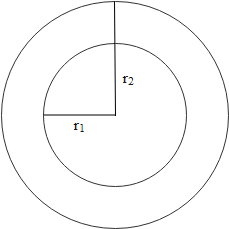
Consider a cross-section of a conductor having the following labeled dimensions.
So the power loss is given as,
$P={{I}^{2}}R$
By putting the values from the given information from the question,
$\begin{align}
& P=({{5}^{2}})4 \\
& \Rightarrow P=100W \\
\end{align}$
The power loss is in the terms of heat energy only so it can be said that $100W$ power will be converted into heat.
The relation between the heat and the change in the temperature (temperature difference) is given as,
$H=\dfrac{\Delta T}{R}\quad .....(1)$
The value of R for the case of a cylindrical conductor is given as,
$R=\dfrac{\ln (\dfrac{{{r}_{2}}}{{{r}_{1}}})}{2\pi kl}$
So, after putting the value of $R$ the equation (1) can be written as,
$100=\dfrac{2\pi kl\Delta T}{\ln \left( \dfrac{{{r}_{1}}}{{{r}_{2}}} \right)}$
By putting the values from the given information in the above equation the temperature difference is given as,
$\Delta T=2.23{}^\circ C$
Thus, the required answer to the question is $2.23{}^\circ C$.
Note:
According to the law of conservation of energy, energy can never be created or destroyed; it can be just transformed from one form to another. In practical studies during any energy transfer, the energy cannot be transferred completely so the energy gets released as heat energy. Also creates a temperature difference in the material. The heat-generating property of the material is used to produce many instruments such as water heater, induction cooking plate, immersion rod, etc.
As per the given data,
The length $\left( l \right)$ of the wire is $2m$
The resistance of the wire $4\Omega $
The diameter of the wire is $0.64mm$. (Radius is $0.32mm$)
The thickness of the plastic insulation is $0.66mm$ (so the radius from the center of the conductor will be $0.33mm$)
The value of $K=0.16\times {{10}^{-2}}cal/cm{}^\circ C\sec $ .
Complete answer:
Consider a cross-section of a conductor having the following labeled dimensions.
So the power loss is given as,
$P={{I}^{2}}R$
By putting the values from the given information from the question,
$\begin{align}
& P=({{5}^{2}})4 \\
& \Rightarrow P=100W \\
\end{align}$
The power loss is in the terms of heat energy only so it can be said that $100W$ power will be converted into heat.
The relation between the heat and the change in the temperature (temperature difference) is given as,
$H=\dfrac{\Delta T}{R}\quad .....(1)$
The value of R for the case of a cylindrical conductor is given as,
$R=\dfrac{\ln (\dfrac{{{r}_{2}}}{{{r}_{1}}})}{2\pi kl}$
So, after putting the value of $R$ the equation (1) can be written as,
$100=\dfrac{2\pi kl\Delta T}{\ln \left( \dfrac{{{r}_{1}}}{{{r}_{2}}} \right)}$
By putting the values from the given information in the above equation the temperature difference is given as,
$\Delta T=2.23{}^\circ C$
Thus, the required answer to the question is $2.23{}^\circ C$.
Note:
According to the law of conservation of energy, energy can never be created or destroyed; it can be just transformed from one form to another. In practical studies during any energy transfer, the energy cannot be transferred completely so the energy gets released as heat energy. Also creates a temperature difference in the material. The heat-generating property of the material is used to produce many instruments such as water heater, induction cooking plate, immersion rod, etc.
Recently Updated Pages
If x a + bt + ct2 where x is in meters and t is in class 11 physics CBSE

A car covers the first half distance between two places class 11 physics CBSE
The resultant of two vectors overrightarrow P and overrightarrow class 11 physics CBSE
Find the value of cos 135 class 11 maths CBSE
A mass M is held in place by an applied force F and class 11 physics CBSE
A solution of glucose in water is labelled as 10 dfracwv class 11 chemistry CBSE
Trending doubts
One Metric ton is equal to kg A 10000 B 1000 C 100 class 11 physics CBSE
Find the value of the expression given below sin 30circ class 11 maths CBSE
What do you mean by retardation What is its SI uni class 11 physics CBSE
Draw a diagram of nephron and explain its structur class 11 biology CBSE
10 examples of friction in our daily life
Difference between physical and chemical change class 11 chemistry CBSE