




A 2g ball of glass is released from the edge of a hemispherical cup of radius 20cm.how much work is done by gravitational force during the balls’ motion to the bottom of the cup?
Answer
 Verified
570.9k+ views
Hint: Work is defined as the capacity of a body to some action. Work defined in physics is different from work we do in our life.
Work done in physics is actually a dot product of force acting and the displacement the force causes.
$ work\,\,done=\overrightarrow{F\,}.\overrightarrow{d}=Fd\cos \theta $ where $ \theta $ is the angle between force and displacement.
Force due to gravity is defined as $ mg $ .it always acts downwards on a body.
Complete step-by-step answer:
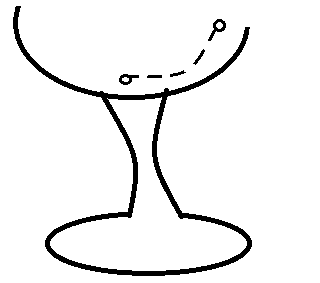
From analyzing the work done formula and the figure we can see that the force acting on the body and displacement of the body which is actually the radius of the cup are both in same direction that is downwards and hence the angle between force due to gravity and displacement is $ 0 $
Work done by the gravitational force will be
$ mg\times r\times \cos \,0 $
Given values,
Mass $ \left( m \right)=2grams $
Radius $ \left( r \right)=20cm $
$ g=10m{{s}^{-2}} $
Putting the values in equation then work done will be,
Work done by gravity= $ \dfrac{2}{1000}\times 10\times \dfrac{20}{100} $
$ \Rightarrow 4\times {{10}^{-3}}Joules $
This is the work done by the gravitational force on the ball.
Note: The work done against the gravitational force goes into an important form of stored energy which is known as gravitational potential energy.
Gravitational potential energy may be converted to other forms of energy, such as kinetic energy. If we release the mass, gravitational force will do an amount of work equal to $ mgh $ on it, thereby increasing its kinetic energy by that same amount.
This arises from the conservation of total energy and inter conversion of energy from one form to another.
Work done in physics is actually a dot product of force acting and the displacement the force causes.
$ work\,\,done=\overrightarrow{F\,}.\overrightarrow{d}=Fd\cos \theta $ where $ \theta $ is the angle between force and displacement.
Force due to gravity is defined as $ mg $ .it always acts downwards on a body.
Complete step-by-step answer:
From analyzing the work done formula and the figure we can see that the force acting on the body and displacement of the body which is actually the radius of the cup are both in same direction that is downwards and hence the angle between force due to gravity and displacement is $ 0 $
Work done by the gravitational force will be
$ mg\times r\times \cos \,0 $
Given values,
Mass $ \left( m \right)=2grams $
Radius $ \left( r \right)=20cm $
$ g=10m{{s}^{-2}} $
Putting the values in equation then work done will be,
Work done by gravity= $ \dfrac{2}{1000}\times 10\times \dfrac{20}{100} $
$ \Rightarrow 4\times {{10}^{-3}}Joules $
This is the work done by the gravitational force on the ball.
Note: The work done against the gravitational force goes into an important form of stored energy which is known as gravitational potential energy.
Gravitational potential energy may be converted to other forms of energy, such as kinetic energy. If we release the mass, gravitational force will do an amount of work equal to $ mgh $ on it, thereby increasing its kinetic energy by that same amount.
This arises from the conservation of total energy and inter conversion of energy from one form to another.
Recently Updated Pages
Master Class 11 Computer Science: Engaging Questions & Answers for Success

Master Class 11 Business Studies: Engaging Questions & Answers for Success
Master Class 11 Economics: Engaging Questions & Answers for Success
Master Class 11 English: Engaging Questions & Answers for Success
Master Class 11 Maths: Engaging Questions & Answers for Success
Master Class 11 Biology: Engaging Questions & Answers for Success
Trending doubts
One Metric ton is equal to kg A 10000 B 1000 C 100 class 11 physics CBSE
There are 720 permutations of the digits 1 2 3 4 5 class 11 maths CBSE
Discuss the various forms of bacteria class 11 biology CBSE
Draw a diagram of a plant cell and label at least eight class 11 biology CBSE
State the laws of reflection of light
Explain zero factorial class 11 maths CBSE