




A $ 1kg $ stone at the end of $ 1m $ long string is whirled in a vertical circle at a constant speed of $ 4m{s^{ - 1}} $ . The tension in the string is $ 6N $ , when the stone is
(A) At the top of the circle
(B) At the bottom of the circle
(C) Half way down
(D) None of above
Answer
 Verified
545.4k+ views
Hint :In the given question we need to be aware of the term circular motion and the terms related to it which are the movement of an object along the circumference of a circle or rotation along a circular path. Now by using the formula of the $ T < \dfrac{{m{v^2}}}{R} $ we get the $ \theta = - {180^o} $ . which is the ultimate answer to the question.
Complete Step By Step Answer:
Firstly we should be aware of the term and the terminology of circular motion.
In the field of physics, the circular motion is considered as the movement of an object along the circumference of a circle or rotation along a circular path. It can be either uniform, with the constant angular rate of rotation and constant speed. Or as the non-uniform with a changing rate of rotation. The rotation which is around the fixed axis of a three-dimensional body involves circular motion of its parts and therefore the equations of motion describe the movement of the center of mass of a body.
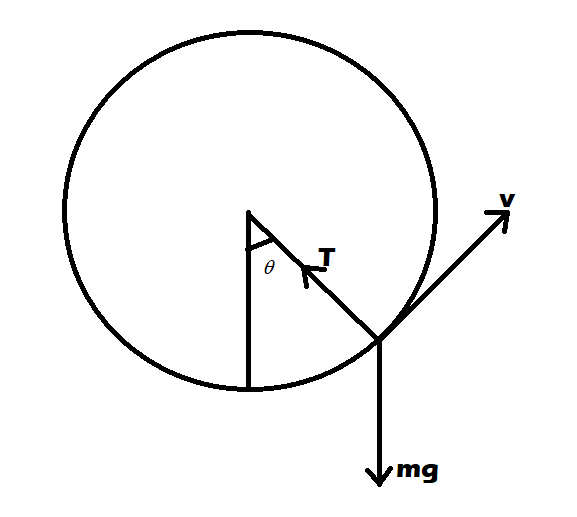
Now, first thing is to write the equation balancing the forces:
$ \dfrac{{m{v^2}}}{R} = \dfrac{{1*{4^2}}}{1} = 16N $
By the observation we get that:
$ T < \dfrac{{m{v^2}}}{R} $
Now at the highest point we will get:
$
T = mg\cos \theta + \dfrac{{m{v^2}}}{R} \\
6 = 10\cos \theta + 16 \\
\theta = - {180^o} \\
$
Note :
In the case of rotation around a fixed axis of a rigid body that is not negligibly small compared to the radius of the path, each particle of the body describes a uniform circular motion with the same angular velocity, but with velocity and acceleration varying with the position with respect to the axis.
Complete Step By Step Answer:
Firstly we should be aware of the term and the terminology of circular motion.
In the field of physics, the circular motion is considered as the movement of an object along the circumference of a circle or rotation along a circular path. It can be either uniform, with the constant angular rate of rotation and constant speed. Or as the non-uniform with a changing rate of rotation. The rotation which is around the fixed axis of a three-dimensional body involves circular motion of its parts and therefore the equations of motion describe the movement of the center of mass of a body.
Now, first thing is to write the equation balancing the forces:
$ \dfrac{{m{v^2}}}{R} = \dfrac{{1*{4^2}}}{1} = 16N $
By the observation we get that:
$ T < \dfrac{{m{v^2}}}{R} $
Now at the highest point we will get:
$
T = mg\cos \theta + \dfrac{{m{v^2}}}{R} \\
6 = 10\cos \theta + 16 \\
\theta = - {180^o} \\
$
Note :
In the case of rotation around a fixed axis of a rigid body that is not negligibly small compared to the radius of the path, each particle of the body describes a uniform circular motion with the same angular velocity, but with velocity and acceleration varying with the position with respect to the axis.
Recently Updated Pages
Master Class 11 Computer Science: Engaging Questions & Answers for Success

Master Class 11 Business Studies: Engaging Questions & Answers for Success
Master Class 11 Economics: Engaging Questions & Answers for Success
Master Class 11 English: Engaging Questions & Answers for Success
Master Class 11 Maths: Engaging Questions & Answers for Success
Master Class 11 Biology: Engaging Questions & Answers for Success
Trending doubts
One Metric ton is equal to kg A 10000 B 1000 C 100 class 11 physics CBSE
There are 720 permutations of the digits 1 2 3 4 5 class 11 maths CBSE
Discuss the various forms of bacteria class 11 biology CBSE
Draw a diagram of a plant cell and label at least eight class 11 biology CBSE
State the laws of reflection of light
Explain zero factorial class 11 maths CBSE