




A $1kg$ mass is rotated along a horizontal circle by a tightened string which has a tension$T = 16{\pi ^2}N$. Find the frequency of rotation.
Answer
 Verified
588k+ views
Hint: For rotational motion, there is always a centripetal force acting along the radius inwards. Here, the mass is rotated horizontally; hence you can safely discard the effect of gravity on it. The centripetal force for this motion is actually the tension of the tightened string.
Formulae Used:
You can calculate the centripetal force from the expression:
${F_C} = mr{\omega ^2}$................................(1)
where ${F_C}$ is the centripetal force of the rotational motion, $m$ is the mass of the body under rotation $r$ is the radius of the circular path, and is the angular frequency of the rotation.
You can define the angular frequency of as
$\omega = 2\pi \nu $
where, $\nu $ is the frequency of the rotation.
Step by step answer:
Given:
The mass of the body under rotation is $m = 1kg$
The tension of the tightened string $T = 16{\pi ^2}N$
To calculate: Frequency of rotation $\nu $.
Step 1:
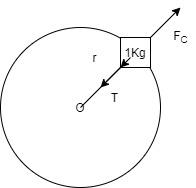
Let the length of the tightened string is $rcm$. Now you can see from the figure, this $r$ is basically the radius of the circular path traversed by the body.
Then calculate the centripetal force of the motion from eq (1).
$
{F_C} = mr{\omega ^2} \\
= 1 \times r \times {\omega ^2}N \\
= r{\omega ^2}N \\
$
where, the body experiences an angular frequency of $\omega {s^{ - 1}}$.
Step 2:
Now the tension of the string is the required centripetal force to keep the rotational motion uniform.
Hence, you can write the expression
${F_C} = T$
Now putting the values, you can write
$
\Rightarrow r{\omega ^2} = 16{\pi ^2} \\
\Rightarrow {\omega ^2} = \dfrac{{16{\pi ^2}}}{r} \\
\Rightarrow \omega = \sqrt {\dfrac{{16{\pi ^2}}}{r}} \\
\therefore \omega = \dfrac{{4\pi }}{{\sqrt r }} \\
$
Step 3:
You can rewrite the expression in eq (2) to get the value of the frequency of the rotation.
$\nu = \dfrac{\omega }{{2\pi }}$ (4)
Step 4:
Now put the value of $\omega $ in eq (4)
$
\nu = \dfrac{{4\pi }}{{\sqrt r 2\pi }}{s^{ - 1}} \\
\therefore \nu = \dfrac{2}{{\sqrt r }}{s^{ - 1}} \\
$
Final answer: A $1kg$ mass is rotated along a horizontal circle by the tightened string, which has a tension $T = 16{\pi ^2}N$, where the string length is $rcm$ then the frequency of the rotation is $\dfrac{2}{{\sqrt r }}{s^{ - 1}}$.
Note: Generally, some of you may miss the point of horizontal rotation, then the case will be much more complicated and the gravity will be in play to accelerate the motion. There is another subtle concept that many of you may miss, that is the centripetal force acts inwards along the radial direction and here, the tension acts inwards to pull the string, which plays the role of the centripetal force to carry on the rotational motion. Many of you may think that there should be an outward force to balance the tension of the string and that is the centripetal force, but then you are wrong. The force outwards is not a centripetal force but a centrifugal reaction.
Formulae Used:
You can calculate the centripetal force from the expression:
${F_C} = mr{\omega ^2}$................................(1)
where ${F_C}$ is the centripetal force of the rotational motion, $m$ is the mass of the body under rotation $r$ is the radius of the circular path, and is the angular frequency of the rotation.
You can define the angular frequency of as
$\omega = 2\pi \nu $
where, $\nu $ is the frequency of the rotation.
Step by step answer:
Given:
The mass of the body under rotation is $m = 1kg$
The tension of the tightened string $T = 16{\pi ^2}N$
To calculate: Frequency of rotation $\nu $.
Step 1:
Let the length of the tightened string is $rcm$. Now you can see from the figure, this $r$ is basically the radius of the circular path traversed by the body.
Then calculate the centripetal force of the motion from eq (1).
$
{F_C} = mr{\omega ^2} \\
= 1 \times r \times {\omega ^2}N \\
= r{\omega ^2}N \\
$
where, the body experiences an angular frequency of $\omega {s^{ - 1}}$.
Step 2:
Now the tension of the string is the required centripetal force to keep the rotational motion uniform.
Hence, you can write the expression
${F_C} = T$
Now putting the values, you can write
$
\Rightarrow r{\omega ^2} = 16{\pi ^2} \\
\Rightarrow {\omega ^2} = \dfrac{{16{\pi ^2}}}{r} \\
\Rightarrow \omega = \sqrt {\dfrac{{16{\pi ^2}}}{r}} \\
\therefore \omega = \dfrac{{4\pi }}{{\sqrt r }} \\
$
Step 3:
You can rewrite the expression in eq (2) to get the value of the frequency of the rotation.
$\nu = \dfrac{\omega }{{2\pi }}$ (4)
Step 4:
Now put the value of $\omega $ in eq (4)
$
\nu = \dfrac{{4\pi }}{{\sqrt r 2\pi }}{s^{ - 1}} \\
\therefore \nu = \dfrac{2}{{\sqrt r }}{s^{ - 1}} \\
$
Final answer: A $1kg$ mass is rotated along a horizontal circle by the tightened string, which has a tension $T = 16{\pi ^2}N$, where the string length is $rcm$ then the frequency of the rotation is $\dfrac{2}{{\sqrt r }}{s^{ - 1}}$.
Note: Generally, some of you may miss the point of horizontal rotation, then the case will be much more complicated and the gravity will be in play to accelerate the motion. There is another subtle concept that many of you may miss, that is the centripetal force acts inwards along the radial direction and here, the tension acts inwards to pull the string, which plays the role of the centripetal force to carry on the rotational motion. Many of you may think that there should be an outward force to balance the tension of the string and that is the centripetal force, but then you are wrong. The force outwards is not a centripetal force but a centrifugal reaction.
Recently Updated Pages
Master Class 11 Computer Science: Engaging Questions & Answers for Success

Master Class 11 Business Studies: Engaging Questions & Answers for Success
Master Class 11 Economics: Engaging Questions & Answers for Success
Master Class 11 English: Engaging Questions & Answers for Success
Master Class 11 Maths: Engaging Questions & Answers for Success
Master Class 11 Biology: Engaging Questions & Answers for Success
Trending doubts
One Metric ton is equal to kg A 10000 B 1000 C 100 class 11 physics CBSE
There are 720 permutations of the digits 1 2 3 4 5 class 11 maths CBSE
Discuss the various forms of bacteria class 11 biology CBSE
Draw a diagram of a plant cell and label at least eight class 11 biology CBSE
State the laws of reflection of light
Explain zero factorial class 11 maths CBSE